






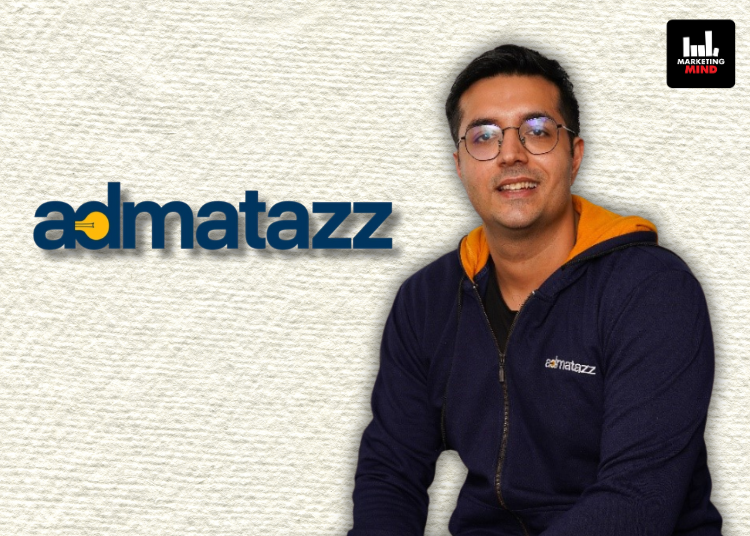
There’s something refreshingly unfiltered about Yash Chandiramani, Founder and Chief Strategist at Admatazz, the kind of clarity that cuts through the clutter much like his ideas on marketing itself. “It was never one eureka moment,” he said with a smile, recalling the early years of building Admatazz. “With every campaign report, every client, I used to ask myself, are we actually solving something for them?”
Having worked across both brand awareness and performance campaigns, Chandiramani has realised that the industry’s problem has never been creativity or data, but “how loosely we think about both.” He said, “We have gone viral, trended, and gotten covered, but when you sit down to see if it’s making sense for the business, that’s where the real questions begin.”
His turning point came two years ago, when he stumbled upon Byron Sharp’s ‘How Brands Grow.’ “That book has changed the way I think about advertising, marketing, and brand growth overall,” he said. “Before that, I used to teach digital marketing and brand management at Jai Hind College, but I noticed that what we called marketing was often superficial and gut-feeling oriented. That book, and following real marketing scientists, has helped me develop a scientific temper toward marketing.”
Chandiramani once compared marketers to doctors (only as a simple metaphor, not a literal equivalence). “I don’t actually compare the two professions,” he laughed. “I have only used the example once to explain that just like doctors rely on evidence instead of quick fixes, marketers too must stop chasing easy cures like random metrics or trends. Turmeric milk does not replace antibiotics, and vanity metrics do not replace real strategy.”
Among the “marketing misdiagnoses” he has seen most often, Chandiramani said that loyalty and retention metrics top the list. “Retention, repurchase, repeat rates, these are vanity metrics,” he asserted. “Loyalty is not a strategy, it is a side effect. There’s no marketing that can engineer loyalty, it’s simply a natural outcome of reach and market share.”
He also said that this obsession with loyalty is only worsening. “Every day I read new dashboards and metrics that have made things worse,” he said. “People keep drawing random correlations, like users from Instagram ads being more loyal. It’s pseudoscience. They’re misleading founders, brand managers, and young marketers alike.”
On working with clients, Chandiramani famously wrote, “If you’re not our client, we’re not obliged to care if your brand dies.” When asked about this brutally honest line, he explained, “If you’re not my client, and you’re not listening to my advice, I can’t help you. Agencies are not obligated to rescue brands from their own decisions. But for our clients, we go all in, we debate, we train, we fight for what we believe is right. Still, if they choose not to implement something, that’s their call.”
He applied the same logic-driven clarity to funnel marketing. “I just hope CMOs understand ninth-grade probability,” he joked. “The chance that someone opens three emails in the exact order you planned is minuscule. You’re better off writing each email as a standalone message that can build memory independently. Those nurture funnels are sold by people who don’t understand basic math.”
Chandiramani also made a clear distinction between marketing and advertising, something he has said founders often blur. “Big brands are sorted, but startups tend to confuse the two,” he explained. “Advertising is a part of promotion, just like PR and communication. Marketing is much broader, it includes product, price, place, and promotion. Yet founders keep expecting performance agencies to give pricing advice, which isn’t their expertise.”
When it comes to what drives brand success, he has refused to assign hard numbers. “There are four Ps, product, price, place, promotion, and each matters equally,” he said. “Of course, your product has to work. Nobody will buy a bad product, however great the promotion is. But even the best product must be available where and when people want it, that’s distribution. And promotion ensures they remember it.”
Talking numbers, Chandiramani has been clear-eyed about digital spending inefficiencies. “I’ve seen brands waste up to 20-25% of their digital budgets on tools that add no incremental value,” he revealed. “Expensive CRMs, loyalty systems, constant push notifications, these don’t work. You don’t need to remind someone three times they’ve left something in their cart. Once is enough.”
He added, “CRM tools are great for managing data, not for constantly badgering customers. The cost of some loyalty programs equals a brand’s entire social media budget for the year. That’s just a waste.”
When asked about brand purpose, Chandiramani has been equally blunt. “Most brand-purpose decks are expensive fiction,” he said. “I once sat through a presentation that beautifully defined the ideal audience, and then realised the actual buyers were the exact opposite. There was no evidence behind those claims. My floor cleaner’s only purpose should be to clean floors. My milk brand’s purpose should be to be more milky. Not to save the world.”
For Chandiramani, marketing begins with realism. “You advertise the product and its benefits,” he said. “No one will pay more just because your brand claims to solve the world’s problems. Consumers go for the better quality or the brand they remember first.”
On the state of evidence-led marketing in India, he has offered an optimistic yet measured view. “There are a few brands that follow evidence-based marketing,” he said. “They’ve built that discipline. But most new-age brands still rely on gut. They lead with vibes, not evidence.”
At Admatazz, Chandiramani has built what he proudly calls a creative agency with a scientific core. “We’re part college, part organisation,” he said. “Every strategist and account manager here knows how to read an academic research paper. Juniors are given books, case studies, and asked to present insights to the team. We debate ideas. It’s not just about viral content, it’s about reasoning.”
He added that this discipline shows in their relationships too. “The best client-agency partnerships treat each other as partners, not vendors,” he said. “We’ve worked with JBCN International School and BGauss Electric Scooters for years because they respect that partnership. They debate ideas but trust our expertise. That’s what keeps it strong.”
Looking ahead, Chandiramani said he hopes Indian brands grow out of what he calls “childish metrics.” “We need to outgrow last-click attribution, vanity dashboards, and obsession with cost of acquisition,” he said. “It’s time to focus on sensible, evidence-based brand growth. The future of marketing must be led by science, not superstition.”
And to the next generation of marketers, his advice has been disarmingly simple: take the craft seriously. “Marketing has been made to look unserious, just about viral moments and trends,” he said. “But if you study it deeply, train in it like a lawyer or doctor would in their field, you can do something very few in this country can, build real brands. The life and death of a brand is in your hands.”
He added with conviction, “Don’t treat marketing like a playground for trending ideas. Treat it like the science it is, because when done right, marketing is not just creative, it’s consequential.”