






Nobody proudly admits they’re greedy. We call it a craving, a weakness, a cheat day or simply “I couldn’t resist.” That’s precisely what made Alpenliebe’s “Lalach… Aaha Laplap!” so clever. Instead of pretending temptation didn’t exist, the brand leaned into it with a wink, wrapped it in caramel, sprinkled it with absurd humour, and served up one of Indian advertising’s most unforgettable commercials. Released in 2009, the campaign has remained far more than a confectionery ad, it has become part of the country’s everyday vocabulary, proving that sometimes the smallest toffee can leave the biggest cultural imprint.
Created by McCann Erickson India, the campaign has been conceptualised by acclaimed creative leader Prasoon Joshi, who has long been known for blending everyday human behaviour with humour that refuses to age. The commercial has starred Kajol in a campaign that has celebrated one universal truth: temptation rarely asks for permission.
But before the famous tagline arrives, the film has taken viewers into a delightfully upside-down universe where logic has been happily suspended.
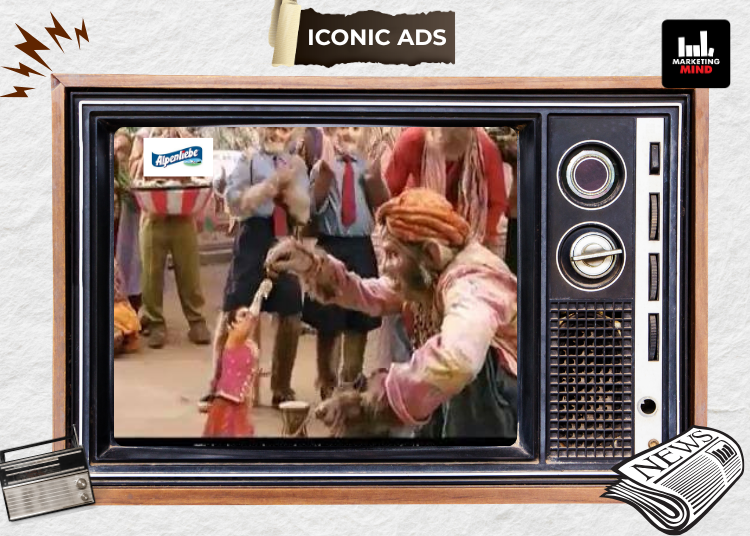
The commercial has opened in a world where evolution seems to have taken a very unexpected turn. A monkey has become the madari, while a tiny human, played by Kajol, has become the performer. Perched high atop a tree, she refuses to come down as the monkey, surrounded by an audience of equally curious monkeys, struggles to convince her otherwise. The visual itself has felt like stepping into a fever dream where every rule of nature has politely excused itself for a few minutes.
Just when the monkey begins running out of ideas, a school-going monkey, dressed neatly in a uniform, offers a suggestion that changes everything: tempt her with an Alpenliebe toffee.
It has been the kind of solution that needs no explanation.
Kajol’s tiny human immediately takes the bait. She obediently climbs down, dances enthusiastically for her monkey master, and after tiring herself out, casually announces,
“I’ll go to the movies and become a heroine. I know a lot of people there.”
Even inside this wonderfully absurd universe, the line has landed perfectly because Kajol has essentially been winking at her own stardom. The humour hasn’t relied on loud punchlines alone; it has come from layers of self-awareness hidden beneath the chaos.
The monkey pauses to think. His eyes wander towards film posters reading “Aadmi Log” and “Mann Aur Human,” little visual jokes that have completed this topsy-turvy world with remarkable attention to detail. Realising he has finally found the perfect bargaining chip, he offers Kajol the Alpenliebe toffee.
She cannot resist. And neither, the commercial cheekily suggests, can anyone else. That moment has flowed into one of Indian advertising’s most unforgettable voiceovers:
“Aadmi ho ya bandar, laalach ek shashwat satya hai.” (Whether human or monkey, greed is an eternal truth.)
The film then has melted into its sweetest image. The monkey and Kajol ride away together on a bicycle, temptation having settled every disagreement. Floating over the closing frames comes the line that has travelled far beyond television screens:
“Lalach… Aaha Laplap.”
Few advertising sign-offs have managed to become everyday vocabulary. This one has.
Everything about the campaign has worked because it has embraced absurdity without ever losing sight of a simple consumer truth: temptation doesn’t need logic. It only needs the right trigger. Rather than preaching about taste, Alpenliebe has dramatised desire itself, turning a caramel candy into something almost impossible to refuse. The fantasy, the playful role reversal, Kajol’s effortless comic timing, and the razor-sharp writing have blended into a film that has felt less like an advertisement and more like a tiny comedy sketch audiences happily revisited.
The music and sound design have further amplified the madness, allowing every pause, reaction and punchline to breathe before culminating in the instantly recognisable “Lalach… Aaha Laplap” mnemonic. Together, the writing, performance, production and memorable audio branding have ensured the campaign stayed lodged in popular culture long after it stopped airing regularly.
Great advertising often disappears after the product has been sold. This one has refused to leave. It has lingered in schoolyard jokes, family conversations, internet memes and nostalgic rewatches, proving that the most enduring campaigns aren’t always the loudest—they’re the ones that sneak into memory like the aroma of perfume lingering in an elevator long after the wearer has walked away. You may forget the wrapper, the price, even the exact flavour. But the moment someone says, “Lalach…”, millions of Indians instinctively know exactly how the sentence ends.
“…Aaha Laplap.”