




For years, the internet rewarded scale. But as feeds grow denser and attention spans fragment further, digital platforms are being forced to solve a different problem altogether: reducing noise without reducing engagement. News and information apps now sit at the centre of that shift, balancing immediacy with credibility while attempting to understand not just what users click on, but what they return for consistently.
The mechanics behind these platforms have consequently evolved beyond publishing and distribution into something far more layered, with behavioural mapping, personalised curation, and trust-led ecosystems taking the lead.
That evolution becomes particularly visible in India’s information landscape, where the expectations of an English-speaking metro user differ sharply from those of audiences consuming hyperlocal updates in smaller towns and districts. While some apps are optimising for brevity and seamless discovery, others are building deeply local community networks powered by verified creators and informational utility rather than entertainment-led virality.
For platforms like Inshorts and Public, the larger play extends beyond audience growth. It lies in building digital habits strong enough to survive an era where AI can summarise almost everything, but cannot easily replicate relevance, familiarity and human judgement at scale.
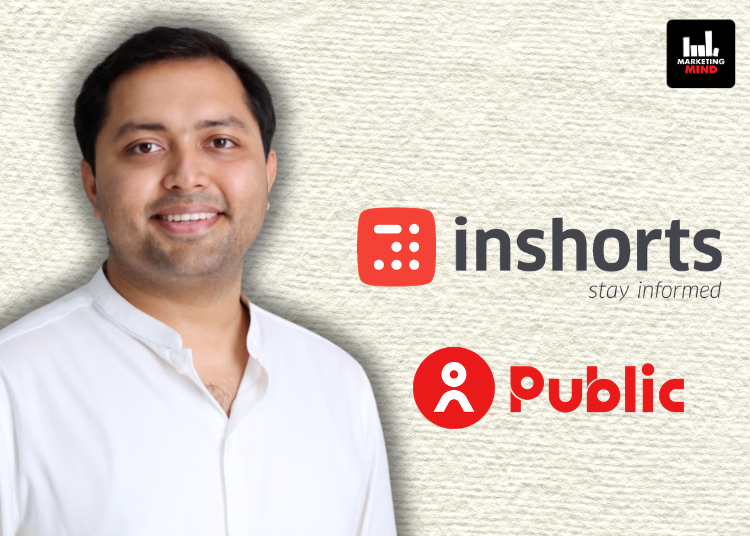
On the sidelines of MMA Impact India 2026, Deepit Purkayastha, Co-Founder and CEO of Inshorts and Public, spoke to Marketing Mind about the evolving information economy, the art of building trust at scale, and why in a world saturated with content, curation remains the most defensible moat.
Excerpt from the interview:
When users have access to AI that can summarise information just as efficiently, how does Inshorts differentiate itself?
There are two differences that are really critical, and our audience already understands them. The first is the distinction between on-demand consumption of information versus the desire to simply stay informed without having to make too many decisions.
These are fundamentally different contexts. If you’re thinking, “I want to know what’s happening in advertising and marketing in India today,” that is a clearly articulated, on-demand query, and an AI platform handles it very well.
But when you’re in the frame of mind where you simply don’t know what’s happening in the world and want to open an app and find out, that’s when you want curation, and you want simplicity. We draw extensively from users’ own consumption patterns to personalise their feeds. All of that compounds. So curation and personalisation are really what we’re offering. Inshorts is the hook that gets us into people’s lives, but the reason users can consume 5,000 stories a day is because we ensure they’re the right ones. That is the core value we deliver.
Going hyperlocal into Tier 2 and Tier 3 cities requires on-the-ground understanding of local realities. How do you achieve that without it becoming cost-prohibitive?
With Public, we’ve built a community-led model. We have over 22,000 verified creators across 700 districts in India, all creating content about their own localities.
It operates on a framework similar to Instagram or YouTube, where people come to the platform, build their channels, post content, and grow a following. However, what we do differently is ensure that every creator on the platform is 100% verified. There is no anonymous creator sitting in another country and trolling Indian celebrities. It’s a clean ecosystem because every content category and every creator is verified.
We are the only social media platform where the creators themselves are curated. Instead of curating content, we curate the people who create it.
Many apps now offer premium, ad-free tiers. Do you see the future of Inshorts’ monetisation being led by such models, or will advertising remain central – albeit made more value-driven?
Inshorts currently carries a relatively low ad load, and our users, for the most part, don’t complain about advertising on the platform. We have experimented with ad-free models, but so far, users haven’t demonstrated a strong willingness to pay for them.
One reason for this is that advertising on Inshorts is designed to feel seamless and non-intrusive – much of it is integrated through native formats that align naturally with the overall content experience. Our focus remains on keeping the platform engaging, smooth, and genuinely valuable for users.
In that context, what does ‘good advertising’ look like to you?
Good advertising, to my mind, is indistinguishable from good content. Advertising is ultimately a subset of content.
You need to capture attention early, offer genuine substance, and leave the user feeling that the two minutes they spent on that ad actually taught them something useful. That’s where brand solutioning comes in. We invest significantly in building interactive, rich solutions that the user genuinely appreciates and that deliver real value to the brand as well. That balance is what we take pride in.
Inshorts scaled on the back of quick news consumption for urban users, while Public grew by tapping into the very different mindset of Tier 2 and Tier 3 India. Which journey was more challenging to scale, and where do you see the next 10 million users coming from?
I think growth will be proportional across both. Inshorts currently reaches around 12 million users, and Public reaches around 80 million, which, in many ways, reflects how India itself is structured. What’s interesting about Public is that we deliberately chose not to go the route of reels-style content.
On that platform, 99.99% of all content is informational. That is our key differentiator: it’s a platform hyper-loaded with information-rich content, which is also why we see strong engagement and retention.
The content spans education, community updates, local news, or anything relevant to a local audience. A prominent figure in a small town sharing something with their neighbourhood. Businessmen, lawyers, doctors communicating with their communities. We also partner with government bodies to disseminate scheme information and train local entrepreneurs. We work across state governments, departments, and political parties to help them reach their audiences more effectively.
In the hyperlocal segment, competition can be intense. How have you navigated that?
When Public launched in 2019, there was significant competition in this space. But today, we hold approximately 90% market share, so the competitive landscape has effectively been resolved over the past six years.
What drives that outcome is a ‘winner-takes-all’ dynamic that is inherent to this kind of play. Once a platform achieves a critical mass of users in a particular location, new creators naturally gravitate towards it because it offers them greater visibility. That flywheel, once in motion, is very difficult to disrupt.