






In a world where leadership is often measured by titles, targets, and timelines, the real test of impact lies in how women leaders navigate both visibility and voice within evolving industries. As media continues to transform – structurally by placing women across every function and level, and perceptually by reshaping how their roles are viewed – the idea of leadership itself is being redefined in quieter, more meaningful ways.
From building teams and making high-stakes decisions to holding space for personal grounding and self-awareness, today’s women leaders are constantly balancing ambition with authenticity, while also shaping what the next generation of leadership can look like.
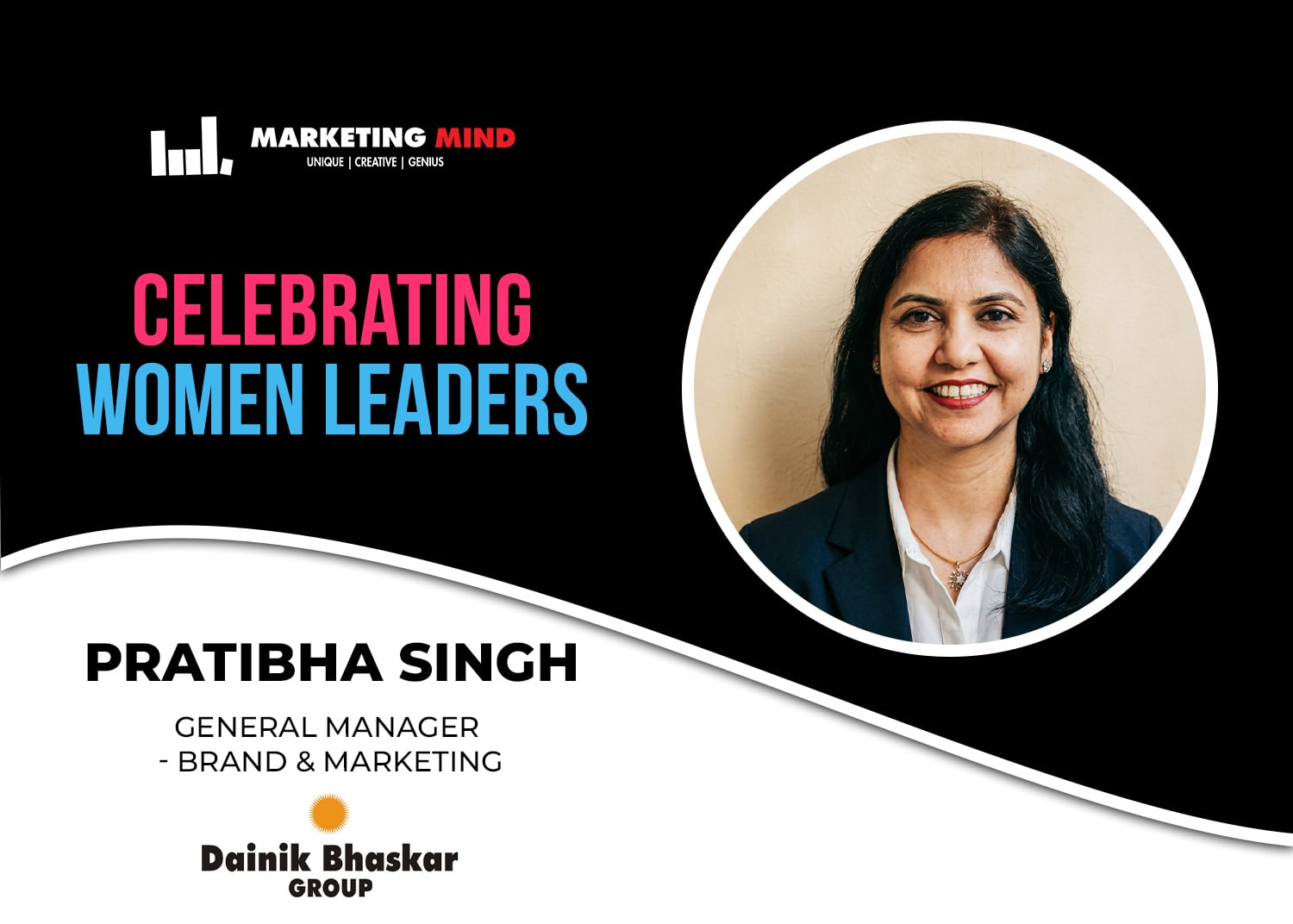
In this edition of Marketing Mind’s ‘Celebrating Women Leaders’ IP, we feature Pratibha Singh, General Manager – Brand and Marketing, Dainik Bhaskar Group, who reflects on her journey in media, the evolving role of women in the industry, and the values that have shaped her leadership philosophy over the years.
On being asked how the portrayal of women has evolved over the years through the lens of someone who has spent decades in media, Singh highlighted that over two decades, she has seen two distinct changes in media – one structural, one perception-led.
“The structural one is visible and real. Women are now in every section, every beat, every level – including roles that were once considered exclusively male territory. The perception shift is equally significant. There was a time when “oh, you’re in media?” came with a hint of scepticism. Today that same line is said with genuine respect,” she said.
She went on to say, “And what gives me the genuine optimism is the current generation – the ambition I see in young women who are actively choosing media as a career. That eagerness, that intentionality, tells me the best is still ahead.”
Singh also reflected on a defining moment in her career that transformed the way she viewed her own leadership potential. She said, “When you are young, we often can’t see our own potential – it’s the people around us who do first. And when you are surrounded with good people, which I was in abundant, they push you to do better.”
Singh gave a very clear example of this, highlighting her early radio career where she was given a product head role with zero background in radio programming.
“I had no idea what I was getting into. But my boss trusted me with it, and my colleagues stepped up to teach me – generously, patiently. I learnt everything on the job. And within no time, I was heading full regions – Madhya Pradesh, Chandigarh, Punjab, and Haryana. That moment told me something I hadn’t known about myself before. That I could walk into unfamiliar territory, learn fast, lead well, and deliver,” Singh said.
She added, “That’s the thing about leadership potential – sometimes you discover it only by being thrown into the deep end by someone who already saw it in you. The key is to swim, not to wait until you feel ready. Because that feeling of readiness? It rarely comes before the opportunity.”
Furthermore, Singh also spoke about how, in an industry shaped by voice and visibility, she consciously ensures that her own voice does not get lost while leading large teams. She pointed out that in a team setting, she always listens first and shares her point of view after.
“This is intentional – I don’t want my team to simply mirror what I think. My voice comes in to add, challenge, or redirect – not to set the direction before they’ve had a chance to think. In leadership discussions, I hold my point of view fully and don’t hesitate to say what I believe is right for the organisation. At the same time, I listen equally openly to other perspectives and if there is a better idea on the table, I’ll back that. The goal is always the best outcome, not defending my own position,” Singh said.
Furthermore, she went on to say, “That consistency – of always having a clear perspective, voicing it honestly, and staying open to what is best – is what keeps your voice your own.”
Reflecting on the one leadership trait she had to consciously develop over time rather than inherently possess, Singh emphasised that one thing she has consciously built over time is being solution oriented.
Singh explained, “Early in my career, when things went wrong, the natural instinct was to dwell – why did this happen, what went wrong. Over time I trained myself out of that. For many years now, my first instinct is always – okay, this happened, so what can I do right now to make it better? It sounds simple but it fundamentally changes how you lead. Your team stops being afraid to bring you problems – in fact they come prepared with solutions. That changes the entire energy of a room. Decisions get faster, and nothing gets wasted on things you can’t change anyway.”
“And the mantra I’ve come to live by: if you can’t improve a situation, why worry about it – and if you can, why worry at all?” she added.
Singh also highlighted that if there is one mindset that will set you apart early in your career, it is this – raise your hand for things you don’t yet know how to do.
“When something lands on your plate that feels unfamiliar or beyond your current role, don’t step back. Step up. Take the responsibility, own it completely, and deliver – regardless of the constraints,” Singh said.
She added, “Everyone, at every level, is looking for people they can depend on. And dependability is rare enough that when you demonstrate it early, you grow faster than you ever would by staying within the boundaries of your job description. Every such opportunity becomes a chance to learn something you simply wouldn’t have otherwise. The world opens up for people who can be trusted to figure it out.”
Singh also spoke about what “balance” realistically looks like in a demanding leadership role today, underscoring how her definition of it has evolved over the years. She pointed out that the biggest myth about balance is that it looks like 50-50 every day. It doesn’t and at different stages of life and career, it looks completely different. The sooner you learn that, the easier everything becomes.
“Earlier in my career, balance was simpler – when the day ended, work shifted to the next day. But when there was work, you did it. I’ve worked into the wee hours on big campaign launches and didn’t think twice. At a leadership level, the line between work and home is genuinely fluid. The key is being able to shift between the two without guilt and that itself takes time to learn,” Singh said.
She added, “A strong support system, at home and around you – is not a luxury, it is a necessity. Invest in it early. And through all of it, quality time with family and friends is something I am intentional about. That I protect.”
Speaking about what she would tell her younger self at the start of her career to worry less about, she said that the only thing truly worth focusing on was being clear about what she wanted. Once that clarity was in place, she added, everything else eventually fell into place on its own.
Furthermore, she explained, “As my younger self, I always knew I wanted to be in marketing. When most people around me were taking conventional routes, I made unconventional choices, started with Rs 4,000 sales job, and stayed committed to the path I had chosen. So, I’d tell her – you’re doing just fine. Once you know your path, keep walking. Relentlessly. Hold on to that belief that you are building something meaningful and don’t let it go. Whatever you imagined for yourself, what’s coming is greater than that. It always pans out better than expected when you stay true to what you want.”
Moving ahead, Singh also shifted gears to speak about one habit or boundary she has built over the years to protect her personal space and sanity, emphasising that the one boundary she has built and protected fiercely is knowing when to say no and keeping her focus entirely on the work.
“Saying a clear, unapologetic ‘no’ to anything that doesn’t align with my values, or my priorities has been liberating. Once people understand that you won’t be nudged into things that don’t suit you, they stop pushing,” Singh said.
“And beyond that, I have always focused on the work, and not on the noise around it. When you are that focused, everything else simply falls away. These two things together have protected my sanity, my integrity, and my peace – more than anything else,” she added.
She also reflected on what truly grounds her and helps her reconnect with herself beyond work and professional titles, emphasising, “I answered this question to myself a long time ago. Strip away the work and the title, and what remains is the quality of the human being you are – because that’s what shows up in your behaviour, your thoughts, and how you live. I just focus on being a good human – whether it’s a one-time interaction or a lifelong relationship. Because once the designation is gone, two things define you – how the world treats you, and how you see yourself when no one is watching.”
In conclusion, Singh highlighted, “The one thing I wish women would stop doubting is their own capability. You are ready before you think you are. Even at 70% conviction, go ahead – ask for it, do it. It will turn out far better than you imagined. The second trap is overthinking – weighing every angle, waiting for the perfect moment. That moment rarely comes. Keep your ambitions high and follow through.”
“And when success comes, wear it lightly. Let it fuel you, not define you. On leadership – there is no fixed mold. Understand your own style, your own strengths, and build your own mold. The world needs women who lead as themselves. And yes, keep growing, keep evolving but as you do, never lose yourself in the process. That’s where true leadership lives,” she added.