

A brand puts out an ad.
An audience engages with it.
The brand owns the message.
That’s how advertising has worked for decades but not anymore. Today, you can come across a campaign, react to it, share it and still not know one crucial thing: Did the brand actually make this?
Welcome to the rise of unowned advertising – where brand-like communication exists without clear authorship, and often, without accountability.
We’re Talking About the Wrong AI Problem
The industry, meanwhile, is busy asking whether AI will replace jobs. It’s become the default anxiety, repeated across panels, LinkedIn posts, and industry reports. But while that debate continues, something far more immediate is unfolding in plain sight. Ads that brands didn’t create are circulating as if they’re official. And audiences are increasingly unable, or unwilling, to tell the difference.
This isn’t a distant, theoretical risk. It’s already reshaping how advertising is consumed.
When Brand Voice Is No Longer Owned
Indian advertising has always been built on distinctive voices. Amul’s topical wit, Zomato’s conversational push notifications, Swiggy’s cultural fluency on social media – these weren’t just creative choices, they were long-term identity systems. You didn’t need to see a logo; the tone did the job.
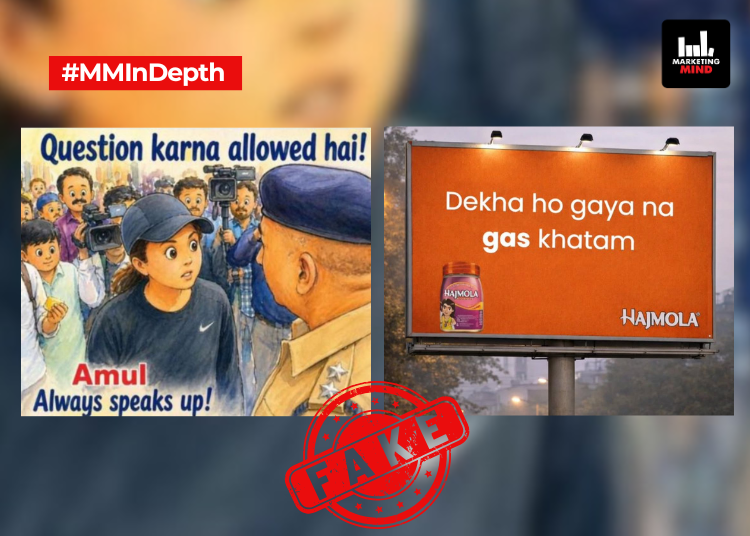
What’s changed is how easily that tone can now be replicated. Amul-style creatives have previously also surfaced around major news moments, many of them unofficial yet believable enough to be shared widely before being questioned. Zomato-style notifications are recreated and passed around as screenshots, often indistinguishable from the real thing. The familiarity that once built trust is now being used to simulate it.
Also, a few weeks ago, Hajmola hoarding referencing the LPG crisis – “Dekho hogaya na gas khatam” – circulated widely as sharp moment marketing, before it became clear that Dabur hadn’t created it at all.
Earlier, brand voice functioned as a moat. Today, it behaves more like a template – open to anyone who knows how to prompt it.
Fake Ads Are No Longer the Outliers
Fabricated advertising used to sit on the fringes. Now it’s increasingly embedded in the ecosystem. Across platforms, AI-generated “spec ads” and unofficial creatives are routinely shared without clear disclosure. Some are portfolio experiments, others are opportunistic takes on trending topics, and a few are outright misleading – but all of them exist in the same visual and cultural language as real campaigns.
In India, this becomes even more complex when layered with moment marketing. The speed of cultural response has always been a competitive advantage, but AI has removed most of the friction from that process. A brand-like reaction can now be produced by anyone in minutes, often reaching audiences before any official communication does.
Regulatory frameworks are still catching up. The Advertising Standards Council of India (ASCI) has laid down guidelines around influencer disclosures and misleading advertising, but the question of AI-generated brand mimicry sits in a grey area. Traditional regulation assumes a clearly identifiable advertiser. Unowned advertising challenges that assumption entirely.
When “Good Enough” Becomes Acceptable
Alongside this, there’s a quieter but equally telling shift in creative standards. AI-generated visuals with distorted elements, inconsistent typography, or outright gibberish text have begun to slip through into published work. Not always at the highest levels, but often enough to signal a change in thresholds.
Globally, brands like Colgate and Samsung have faced criticism for AI-led creatives that felt unfinished or poorly executed – ads that would likely have been rejected in a pre-AI workflow. The concern here isn’t just that AI makes mistakes. It’s that those mistakes are increasingly being accepted, even normalised, in the interest of speed and scale.
The bar hasn’t just lowered, it’s being redefined.
Deepfakes and Synthetic Endorsements Are Scaling Fast
If imitation is one layer of the problem, impersonation is another. AI-generated celebrity endorsements and voice clones are already being used in scam advertising across markets. Public figures have had to issue disclaimers distancing themselves from ads they never participated in. In India, financial scams using familiar faces, real or simulated, have become increasingly common, exploiting trust at scale.
This is where unowned advertising moves from being confusing to potentially harmful. It’s no longer just about whether a brand made an ad. It’s about whether the person in the ad even said what they appear to be saying.
Moment Marketing Has Become a Free-for-All
Moment marketing, once a demonstration of cultural agility, now operates in a very different context. What used to require coordination, judgment, and timing can now be executed instantly by anyone with access to generative tools. The result is an explosion of brand-like responses that blur the line between official and unofficial communication.
What was once a brand responding to culture is increasingly culture imitating brands.
The Real Risk: Advertising Without Ownership
When you step back, a pattern becomes clear. Ads exist without identifiable creators. Brand voices circulate without brand involvement. Influence is generated without accountability.
This is the core of unowned advertising. And it introduces a structural problem: if no one clearly owns the message, no one is responsible for it either.
The long-term risk isn’t just that audiences might be misled. It’s that they begin to disengage altogether. When real ads look artificial and artificial ads look real, the distinction starts to lose relevance. Over time, this doesn’t just create confusion – it creates indifference. Trust, in this context, doesn’t disappear dramatically. It erodes gradually, until it’s no longer a deciding factor.
Closing Thought
For decades, advertising operated on a simple, largely unquestioned contract: when a brand speaks, you know it’s the brand.
Unowned advertising breaks that contract and once that certainty is gone, everything else – creativity, persuasion, effectiveness – becomes secondary. Because before an ad can do anything at all, it has to be believed.
Increasingly, that’s no longer guaranteed.