





Somewhere between the promise of “AI will fix everything” and the reality of messy dashboards, delayed OTPs, and fragmented data pipes, the ad sales ecosystem has been quietly figuring things out. Not in theory, but in production. Not in hype decks, but in CTR lifts, cost savings, and late-night debugging sessions.
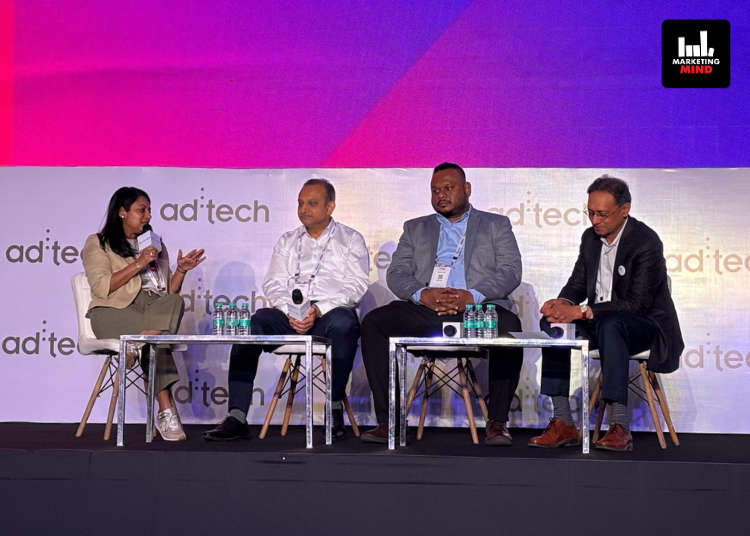
Somewhere between the promise of “AI will fix everything” and the reality of messy dashboards, delayed OTPs, and fragmented data pipes, the ad sales ecosystem has been quietly figuring things out. At ad:tech, a panel moderated by Amit Garg, Founder and CEO, CRMantra, has brought together Puneet Gupta, Chief Operating Officer, Times Internet; Deepak Oram, Senior Vice President – Growth Marketing and Martech, HDFC Bank; and Niti Kumar, Chief Executive Officer, Spark Foundry, to answer a deceptively simple question: who really wins with AI in ad sales?
The consensus has arrived early, and it has been surprisingly unanimous. “When we say who wins with AI in advertising, I think everyone in the ecosystem will win,” Puneet Gupta, Chief Operating Officer, Times Internet, has said, setting the tone. “When we talk about AI in journalism, that’s a debate. But with AI in advertising, I think it’s a given outcome.”
That optimism, however, has not been abstract. It has been built on real products, real performance, and real scale.
“At Times Internet, we have been a very early adopter of AI, possibly among the first 10 accounts of OpenAI in the country,” Gupta shared. “We built something called AdTalk. You can click on a creative and talk to a bot right there and every interaction helps us create cohorts based on what people are looking for.”
The implications have gone far beyond engagement. “We have seen CTR go up anywhere between 30 to 150% when we make static creatives dynamic,” he has noted. “That’s a big win, I think everyone should be doing it.” And it hasn’t stopped at creatives. “We have reduced the classification backlog to real time with about 75% lower cost,” he added. “In every part of the ecosystem, we are bringing in AI to make things faster and improve delivery.”
If publishers have been building the pipes, agencies have been stitching the intelligence layer on top of it.
“AI is almost all-pervasive now,” Niti Kumar, Chief Executive Officer, Spark Foundry, has said. “I cannot remember any meeting where some element of AI hasn’t come in.”
But she has been quick to ground the conversation in fundamentals. “The outputs are only as good as the inputs,” she pointed out. “If the data or even the prompt is generic, the output becomes generic, and then it needs significant human intervention, which defeats the purpose.”
For agencies, the real shift has been happening underneath the surface, in what she calls the “data spine.”
“The Publicis Group has created a product called Connected Identity, which hosts deterministic data across categories, media, and consumption,” Kumar explained. “AI builds on that to give brands insight into the right publishers and partners.” That foundation has been unlocking speed and specificity in ways that weren’t possible before. “We identified a cohort called ‘night owls’ for Eno-people who eat late and face acidity,” she has said. “What would have taken two weeks was done in about 48 hours. That speed is fabulous.”
Execution, too, has been undergoing a quiet transformation. “AI tools are helping drive CPM efficiencies without manual intervention,” she added. “It saves time and delivers outputs much faster.”
But if speed and scale have been the visible wins, the most consequential impact may have been happening deeper in the funnel, where revenue is actually made or lost.
“I would like to talk about how you make both sides succeed,” Deepak Oram, Senior Vice President – Growth Marketing and Martech, HDFC Bank, said. “AI is now changing the game there.”
He pointed to a less glamorous but critical reality. “Sometimes the failure is not in the ad, not in the placement, but in the logistics, like Aadhaar OTP not going through,” he explained. “The entire ad effort is wasted.” That’s where AI has begun to prove its real value. “We now have a bot that reads through the funnel every minute and alerts on WhatsApp if something breaks,” he said. “The savings at scale have been about 10% of hundreds of crores of spend.”
For Oram, this has been the future of AI in ad sales, not just creative generation, but ROI protection. “We should go more in this direction, where AI is used not just to create, but to optimize outcomes.”
And yet, for all the progress, the panel hasn’t shied away from what hasn’t worked.
“If the input is not good, the output is not usable,” Kumar reiterated. “Also, ecosystems don’t always talk to each other, the loop breaks, and you go back to Excel sheets.”
Even for early adopters, some ambitions have taken longer to materialize. “We tried ad slot personalization, defining placement based on likelihood to click,” Gupta said. “It’s taking more time than we thought, it just needs more work.”
And when it comes to brand-building, AI’s limits have become clearer. “Hyper-personalization works,” Oram acknowledged. “But large brand-led campaigns, that haven’t translated very well through AI. For that, we still depend on traditional content.”
What has emerged is a pattern: AI has excelled in optimization, iteration, and efficiency, but has remained less reliable in big, singular brand storytelling.
So what does it actually take to make AI work?
“I think we just need more data,” Gupta said plainly. “Clean data and quantum of data are both important, it’s a long exercise of refining and learning.”
But data alone hasn’t been enough. The real unlock, according to Oram, has been structural. “AI works best in a flywheel,” he said. “Put your creative out, see what works, iterate, and keep improving ROI. That’s where the value is.”
More importantly, he has reframed the challenge entirely. “This is not just coding or creative, it’s an operating model. It’s a culture,” he emphasized. “Just hiring coders won’t give you value. You need change management.” That human layer has perhaps been the most underestimated variable. “There is a little bit of fear, that’s real,” Kumar admitted. “So it’s about education, helping people understand it’s this and AI, not this or AI.”
And changing that mindset has required deliberate effort. “Mindset change is the biggest thing,” Gupta has said. “We run monthly AI hackathons, you have to change the mindset of every employee. It has to start from leadership.”
His analogy has been as vivid as it has been telling. “AI today is in its infancy, if you don’t start to love that AI infant right now, you’ll always be worried about the AI teenager.”
In the end, the conversation hasn’t landed on a single winner. Instead, it has revealed a more nuanced truth: AI has been a multiplier, not a replacement. It has rewarded those who have invested in data, embraced iteration, and reworked their operating models, not just their tech stacks.
Or, as Oram has summed it up with disarming simplicity: “Just experiment, get started today, and start small.”