






There is a moment in Flipkart’s latest campaign where your instinct is to scroll away and yet you do not.
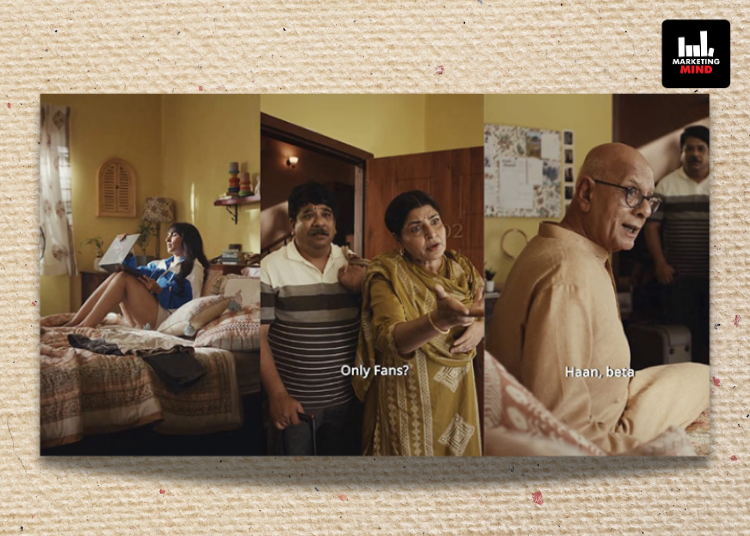
A young woman sits in her room, sweating through the Indian summer. The camera lingers just enough to make you uncomfortable. She begins to unzip her sweatshirt. The framing feels oddly familiar. Then her parents walk in. Her grandfather follows. The conversation takes a turn with phrases like “Only Fans” and “Daddy issues” being thrown around casually in a family setting.
It feels wrong for a second. Then confusing. Then oddly funny.
And by the time the reveal lands, the campaign has already achieved what it wanted – your attention without asking for it.
The “Only Fans” campaign by Flipkart, created by The New Thing, is built entirely on this moment of interruption. It plays with cultural context, misdirection and discomfort before resolving into something as simple as a household needing an air conditioner.
At the centre of it are Viren Noronha, Co-founder of The New Thing, and Shraddha Panday, Director – Content, who have approached this not as a traditional campaign but as something designed to live and breathe on the internet. Interestingly, the idea did not come from a structured brainstorm.
“It started off as a half joke. Someone said what if we made an OnlyFans for ceiling fans and everyone just laughed out loud,” Panday said.
That instinctive laughter became the first filter. Not data, not decks, not frameworks. Just a room full of people reacting honestly. For Panday, that is often where the strongest ideas come from. If it works in a room, it has a shot at working on the internet. But what seemed obvious in hindsight came with its own anxiety.
“The immediate fear was that this seems so obvious, somebody is going to do it,” Noronha said.
In a content ecosystem that moves at breakneck speed, originality is often about timing rather than invention. The team knew they had something culturally sharp, but also something that could easily be replicated. “We pitched this last year and then we just prayed that nobody else would do it for 365 days,” he said.

What followed was not just execution but restraint. The campaign was held, timed, and aligned with the summer moment. Even then, the unpredictability of the internet loomed large. “The internet is rolling dice. You do not know what is going to happen. It can go in any direction,” Noronha said.
But unpredictability, in this case, went beyond just audience reaction. The campaign’s release coincided with an unexpected and sensitive moment online following the passing of Leonid Radvinsky, an OnlyFans founder, which led to reactions no one could have anticipated.
“I think it was very strange because people were attributing the death of the founder to us,” Noronha said.
The situation was as bizarre as it was revealing. A campaign built on wordplay and cultural misdirection was suddenly being discussed in an entirely different context.
“But I think that just goes to show that even the internet is rolling dice. You do not know what’s going to happen,” he added.
That moment reinforced a larger truth about modern advertising. Once a campaign is out in the world, it no longer belongs entirely to the creators. It gets interpreted, stretched and sometimes completely recontextualised by the audience.
That uncertainty is not a flaw in digital culture. It is the defining condition of it.
The “Only Fans” campaign works because it leans into discomfort before resolving it. It deliberately blurs a line most brands would avoid. “As soon as you touch a taboo topic, you know that backlash is coming,” Panday said. But the backlash, in this case, was not only anticipated, it was accounted for. “Nothing happened outside what we expected,” she added.
The reactions split almost immediately along generational lines. “Young people loved it and felt represented,” Noronha said.
At the same time, a different section of the audience pushed back, questioning intent, taste and longevity. That friction became part of the campaign’s visibility. “We use a touchy topic because the shock value keeps you watching,” Panday said.
Because in a feed filled with predictable patterns, interruption becomes the most valuable currency. For the team, success was never just about views. “Earned media became a very important KPI because this was meant to cut through clutter,” Noronha said.
The campaign was designed to travel beyond its original format, to spark articles, reactions, debates and shares. Even criticism around the idea being simplistic did not dilute its effectiveness. “As long as it is selling ACs, it is doing its job,” Panday said.
Noronha addressed the critique with clarity. “The joke may not be the most intellectual but that does not make it bad advertising,” he said.
In a landscape driven by instant consumption, simplicity often travels further than sophistication.
What This Campaign Gets ‘Right’ About the Internet
Beyond the virality, the campaign reflects a deeper understanding of how content behaves today. “Most content strategies are optimised to a fault. The minute something works, everyone starts doing it,” Noronha said. This leads to sameness, and sameness leads to invisibility. “We do not win by doing the same things. We win by doing things that get people talking,” he said.
For Panday, the challenge is especially visible in how brands approach younger audiences. “People start throwing words like rizz and love bombing but this felt like real conversations,” she said. Authenticity, in this case, is not about language. It is about perspective. That perspective is shaped by where culture is consumed. “My Instagram and X timeline is my newspaper,” Panday said.
The team also views formats like meme marketing through a practical lens.
“There is nothing inherently wrong with memes. It is just another media touchpoint,” Noronha said. What matters is not the format, but execution. “You have to either be the first or the best. Otherwise you get lost,” Panday said.
This thinking extends to content volume as well. “Post 100 times or post 7 times, it does not matter as long as it is getting engagement,” Noronha said.
The focus shifts from consistency for the sake of it to performance-driven output. Even storytelling has adapted to this reality. “You have to get attention and then keep it. Every few seconds need moments of delight,” Panday said.
Noronha simplified that idea into a sharper principle. “Every line in your script needs to earn its place,” he said. The conversation inevitably moves to AI, but the conclusion remains grounded. “AI is just a tool. You still have to tell the story yourself,” Panday said. Technology may accelerate creation, but it does not replace insight.
When the Internet Pushes Back
If the campaign understands attention, it is also because the team understands how quickly it can turn.
Noronha shared a moment that shaped this understanding. “I once accidentally tweeted from Anand Mahindra’s account instead of my own and it went south within minutes,” he said. The reaction was immediate, intense and largely out of control. It was a reminder that once content is out, it no longer belongs to the creator.
Panday pointed to a different kind of unpredictability. “People got enraged over something as simple as ‘Punch the Monkey’ video because they projected their own emotions onto it,” she said. The lesson is consistent. The internet does not just consume content. It interprets it, reshapes it and sometimes distorts it.
The Reaction That Closed the Loop
For all the noise around the campaign, one interaction stood out for Panday. “There was this one girl I really liked. I think we would be best friends,” she said. The conversation began with a familiar critique. Questions around whether the campaign was short-sighted, whether it was built only for immediate attention. “She wrote a huge paragraph about how it does not matter if it is fun, if it is giving you sales now, that is what matters,” Panday said.

Then came the counter. “Someone replied saying you are Gen Z, do you even own an AC, did you even buy an AC,” she said. The response was simple. “She said yes. And that kind of concluded the whole conversation quite nicely for me,” Panday said.
In that exchange lay the answer to the larger debate. Not just whether the campaign was seen, but whether it translated into action.
At the same time, Panday recognised the duality of its reception. “It is really fun how this campaign has been a huge success and an absolute shame at the same time depending on which article you read,” she said.
Noronha, on the other hand, found humour in the extremes. “My favorite comment was when somebody said this advertisement should be nominated for an Oscar,” he said.
In the end, the Flipkart campaign does not try to be universally liked. It does not even try to be universally agreed upon. It does something far more difficult. It makes people stop, react, debate and take a side. Because in a world where most content is designed to be scrolled past, the real win is not approval. It is attention that refuses to move.