






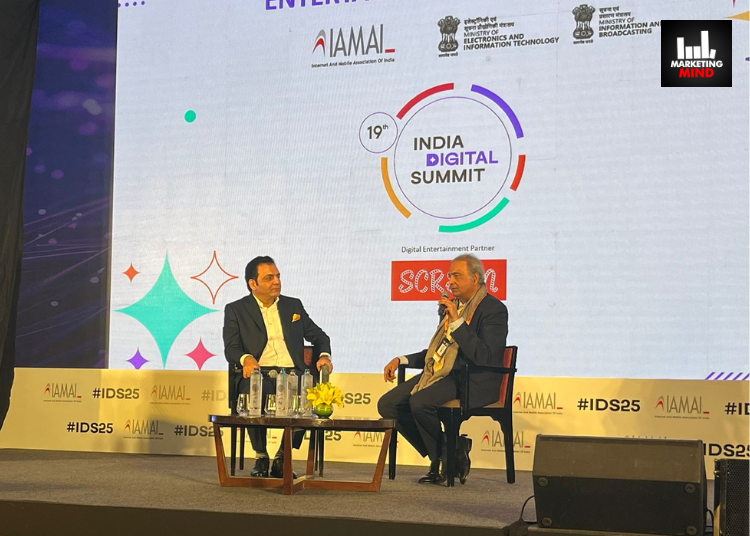
Gaurav Dwivedi, CEO of Prasar Bharati, on Thursday highlighted that as audience preferences increasingly shift towards digital mediums, the pubcaster recognised the need to have a dedicated platform, leading to the creation of their OTT platform WAVES, inspired by the success of DD Freedish.
He emphasised that this new initiative underscores Prasar Bharati’s commitment as a public broadcaster to deliver essential services, including information, education, and entertainment, with a focus on keeping the entry barrier for this OTT platform low.
During the India Digital Summit (IDS) 2025, when asked about social media platforms and the growing influence of AI engines that utilise content produced by both organisations and individual contributors, and the ongoing calls for these platforms to pay a larger share of revenues, Dwivedi shared his perspective, stating, “News gathering is a very sensitive business that should not be left to algorithms. Organisations that invest significant resources, time, money, manpower, and equipment, into collecting news stories from the ground must also have the right to monetise this content through the medium and mode of their choice.”
He pointed out that it is unfair when third parties take this hard-earned work, rehash it, and profit from it without contributing anything of their own.
Furthermore he added, “Additionally, if these algorithms were open to the public and we knew how they functioned, I might be able to accept their role in news dissemination. However, when these algorithms remain closed and inaccessible, it raises concerns about whether they are presenting the news objectively. Whether the intentions behind this process are malicious or simply a mistake, the lack of transparency is a concern. A closed algorithm, in particular, is something I am not happy with.”
When asked about the challenges of fulfilling the mandate of an ideal public broadcaster, Dwivedi emphasised the importance of maintaining a balanced perspective for the audience. He acknowledged that while there are often discussions about external pressures and influences, his extensive experience in the field suggests that such challenges may be overstated. According to him, the primary responsibility of a public broadcaster is to present factual and unbiased information, allowing the audience to draw their own conclusions.
“To explain this better, I like to use an academic analogy. When studying legislation, you have two options, you can refer to the bare act, which is the raw text of the legislation, or you can look at interpretations written by various legal experts. These experts often quote different sources, and the choice of which sources to include or exclude can raise questions. However, when you’re presented with the bare act, you’re left to interpret it on your own, forming your own understanding. If you need more details, you can always explore expert analyses later,” he said.
Furthermore, he went on to explain that similarly, in the context of news, the most important thing is to bring authentic and unfiltered information to the audience first. After that, elements like explainers and contextualisation can be added to help people understand and make informed decisions. This approach ensures that the audience is empowered to form their own opinions without unnecessary bias.
When discussing the shifts in Prasar Bharati’s content strategy, he highlighted that at MyGov, the biggest challenge was convincing digital users that this government genuinely wanted to listen to their perspectives.
“To address this, we introduced questions and even shared draft legislations and rules for public input. Traditionally, as per parliamentary procedures, such matters are sent to a standing committee, which then seeks public opinions. However, MyGov provided users with a direct and user-friendly platform to share their views,” he said.
He added, “We took this engagement a step further by identifying and naming contributors whose inputs were officially considered. This acknowledgment made participants feel valued and encouraged meaningful contributions. At the time, there was a prevailing belief that platforms like X, Facebook, and similar social media channels were primarily used for venting, rather than fostering intelligent discussions. Yet, we found that when users engaged with MyGov, their responses were remarkably thoughtful and well-articulated. This feedback helped us distill audience insights and relay them to relevant ministries, with many of these inputs influencing laws, rules, and procedures.”
Moving on to the content strategy for Prasar Bharati, Dwivedi described the task as both the easiest and the most challenging.
“It is easy because, as a public broadcaster, we do not restrict ourselves to specific types of content. Our mandate is broad and inclusive, aiming to serve everyone, regardless of socio-economic background, language, region, or interests. Every individual in this hall, across India, and even outside India with an interest in the country is a potential audience,” he added.
Furthermore, he pointed out that the challenge, however, lies in balancing this diverse content portfolio to ensure the channels resonate with all audiences. While private broadcasters can target specific segments, Doordarshan’s flagship channel, DD National, must cater to an extensive range of viewers. Their programming must appeal to children, adolescents, homemakers, office-goers, farmers, and people across every corner of the country. Striking this balance is the most complex part of their work.
“Despite this, one principle remains non-negotiable: our content must be suitable for family viewing. If it cannot be comfortably watched while sitting next to one’s mother, it simply does not meet our standards,” he added.
When asked about the audience profile of Doordarshan in the digital age and what the digital age signifies for them, he responded by saying that when it comes to audiences, there is no region in the country where Doordarshan isn’t watched. In terms of satellite distribution, India has an estimated 19 to 20 crore TV households. Out of these, approximately 5 crore households access satellite distribution through DD Freedish, the free-to-air network. This means nearly a quarter of India’s satellite TV audience relies on the platform, spanning all segments of society and regions of the country.
“On the digital front, the global shift toward mobile content consumption began around 2012, with India following suit by 2015-16. The phenomenon of cord-cutting has further accelerated this trend, with an increasing number of people now consuming both news and non-news content exclusively on digital platforms. Recognising this shift, we have gradually expanded our digital presence. Initially, we focused on delivering news through our app, News on AIR, which has been active for eight years, along with distributing content on platforms like YouTube and social media,” Dwivedi said.
He added that however, as audience preferences continue to move toward digital mediums, they saw the need to have a dedicated platform.
“In November, we launched our OTT platform, WAVES. Modeled closely on the success of DD Freedish, WAVES reflects our commitment as a public broadcaster to provide basic services, information, education, and entertainment, keeping in mind that the entry barrier for this OTT platform is not very high. While such content should primarily be offered to the audience for free, there could be some freemium content on the platform as well,” Dwivedi said.