







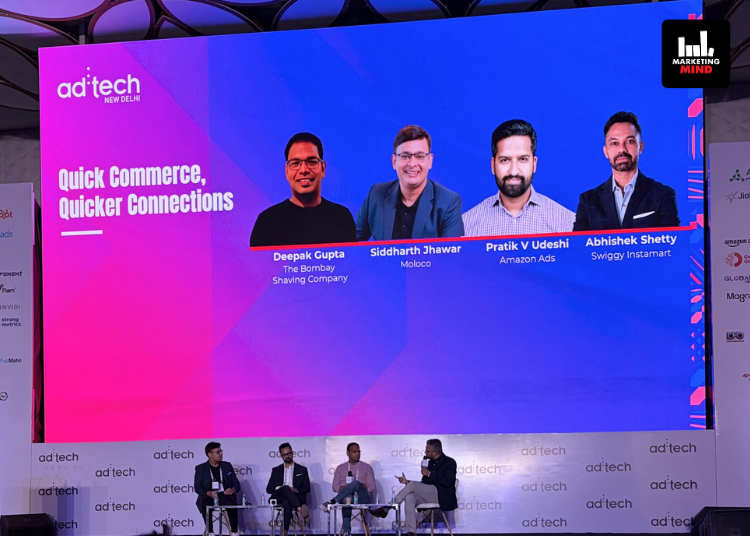
One thing that is a well-known fact for laymen and experts alike is that quick commerce is poised for its next big leap. As the focus turns to the future, industry leaders aligned on a strong growth outlook, underpinned by evolving consumer behaviour and expanding platform capabilities.
Taking a deep dive on this take, the session titled ‘Quick Commerce, Quicker Connections’ at ad:tech 2026 brought together a cohort of brands and marketplaces to offer insights. Siddharth Jhawar, Country Manager of Moloco, steered the conversation as a moderator. He was joined by Abhishek Shetty, Marketing Head of Swiggy, Deepak Gupta, Co-Founder & COO of Bombay Shaving Company, and Pratik V Udeshi, Head of LCS – CPG, Beauty, and Amazon Now of Amazon Ads.
For Swiggy’s Shetty, the category remains in the early stages of its S-curve, with the once-differentiating 10-minute delivery now becoming the baseline cost of entry. He claimed, “I think a lot of the consumers in the next wave are going to come because quick commerce is going to go from about 2 ,000 – 3 ,000 SKUs to about 20 ,000 – 30 ,000 SKUs. I think that’s where a huge part of the growth is going to come. My prediction is to see somewhere around 70% – 80 % growth.” This evolution is expected to shift quick commerce from a convenience-led option to a primary shopping platform.
Adding a brand lens, Bombay Shaving Company’s Gupta noted that quick commerce has shifted gears to emerge as a critical ‘moment of decision’ shaping purchase behaviour. “The way consumer behavior is shifting, a lot of platforms will be forced to move to quick delivery. Our ability to reach newer consumers is much higher compared to the traditional brand because we can innovate much faster with the platform. Our next year’s AOV projection is to grow 150%,” said Gupta.
Meanwhile, Amazon Ads highlighted a deeper behavioural transformation at play. “I would see this as a habit formation change. There is a whole fundamental difference in how customers are shopping and how their weekly baskets have now become sort of daily micro moments,” observed Udeshi. This shift, along with a reduced dependence on legacy distribution, signals that quick commerce is fundamentally reshaping consumption patterns, with the journey still at ‘day one.’
As the discussion deepened, the spotlight shifted to a key strategic dilemma for brands, which circle around balancing investments between owned platforms and the fast-growing quick commerce ecosystem. The question: as consumer attention fragments, where should brands place their bets?
From Bombay Shaving Company’s perspective, the roles of each channel remain clearly defined. Strengthening this position, when it comes to allocation of investments, the spend is gradually tilting towards quick commerce. When asked to split a hypothetical $100 budget for marketing, Gupta said, “50 % of the spend would be for our own website, 35 % on quick commerce. Wherever quick as a feature is there, we see it as a good project. And we will continue to spend 10 -15% on E-commerce.”
Noting this change, he also added, “Because quick commerce has grown rapidly, there is some shift of spend from marketplaces like Amazon, Flipkart, and Myntra, because they are growing at a much faster pace, and consumers are also adopting it.”
Leveraging Moment-Led Marketing
As the discussion moved from retention to platform value, a clear theme emerged—quick commerce is no longer just about speed or transactions, but about owning high-intent consumer moments and turning them into lasting relationships.
From Shetty’s lens, loyalty cannot be built on 10-minute delivery alone, as it is no longer viewed as a differentiator. Instead, consistency becomes the foundation: delivering the right product, in the right condition, every single time. Laying emphasis on this expectation, Shetty quoted, “A wrong 10-minute delivery order is going to cost you a lot more than a right sort of 12-minute order.”
Layered onto this is relevance, where data-driven personalisation helps platforms anticipate needs and create meaningful, contextual experiences that keep consumers coming back.
Udeshi extended this idea further, reframing quick commerce as a space defined by high-intent, short-duration attention windows. He said, “From an Amazon Ads perspective, I think it also allows us the ability to expand that funnel a little bit where through video you can start engaging with the consumer, look at where the intent is and then over time through other aspects bring them closer to the Amazon Now funnel on sort of driving that conversion. So you can build that engagement with the purchase.”
Balancing Revenue And Relevance
As the conversation shifted to monetisation, a key tension came into focus: how do platforms drive high-margin ad revenues without compromising consumer experience or overburdening brands?
Swiggy acknowledged this as a delicate balancing act, tailoring an approach which ensures that the ads stay contextual and value-adding. Such a format works to enhance user journey, surface complementary products, aid discovery, and help increase basket size organically. At the same time, strict guardrails ensure that relevance, product quality, and consumer preference take precedence. “There are some guardrails that we’ve built around this to ensure that we don’t impact the consumer experience negatively. The question always is, how can this product show up in the most organic possible format,” claimed Shetty.
The Power of Signals And Cohorts
As the discussion returned to consumer behaviour, Amazon brought a broader, cross-category perspective, highlighting just how fundamentally shopping habits have evolved in the shift from traditional e-commerce to quick commerce.
“How do you now ensure that you are in the mode of maximizing in front of those consumers? There are these micro moments in a day, right? What do you want to eat this morning? Or India won a match, do you want to order something else? So are you figuring out a way to have presence in these micro moments? And as a brand, if you can maximize on those, then I think it really plays out well for you,” notes Udeshi.
Different Platforms, Different Strengths
Bringing in the brand lens, Deepak Gupta offered a nuanced, platform-by-platform view of the quick commerce and e-commerce ecosystem, underscoring that while scale is levelling the playing field, each platform still delivers distinct strengths.
While early growth saw strong regional skews: Blinkit in the North, Swiggy Instamart in the South, and Zepto in the West. Yet, differentiation persists in how consumers engage on each platform.
Gupta decoded each platform’s strength, as he said, “Blinkit stands out for driving discovery and premiumisation. Swiggy Instamart plays a key role in basket building with strong repeat behaviour and consistent order patterns. Zepto brings in a younger, more impulse-driven audience with creative marketing, and appeals to digitally native consumers. Flipkart Minutes is opening up access to more value-conscious audiences, including those in lower-tier cities, helping brands tap into a different demand segment. Amazon continues to command a more premium, discovery-oriented consumer base, and as it expands further into quick commerce, it offers brands an opportunity.”
The takeaway for brands is clear: quick commerce is not a monolith. Each platform serves a different consumer mindset and use case, making it essential for brands to tailor assortment, pricing, and strategy.
The Road Ahead For Brands
As the session drew to a close, Jhawar posed a final question to the panel: what is the one piece of advice for brands looking to establish a presence on e-commerce platforms?
The starting point, as highlighted by Amazon Ads, is to move beyond a narrow view of platforms as mere fulfilment or conversion channels. “More than logistics and purchase, think of how you are thinking of the consumer, how the consumer is thinking of you across the day, and not just in that moment because that is too short a window to change that perspective on shopping. You have to think about it in that consideration. So think for longer, don’t be present only in a certain moment and think full funnel,” said Udeshi.
Adding on this, Bombay Shaving Company emphasised the importance of capitalising on high-intent moments while also unlocking the creative potential of these platforms. Gupta promotes, “There’s a lot of scope of creative marketing as well as creativity in the assortment you sell on a platform, which was very difficult to do in the past because the richness of data is not as close as D2C.”
Swiggy, meanwhile, brought the focus back to the fundamentals of quick commerce: impulse and immediacy. “We’ve seen a lot of new age brands beating legacy brands. Primarily because they’re thinking impulse first. The second thing is, solve for occasions and micro-moments. You know, festivals, pop culture, etc. are becoming very big reasons for the new age consumer cohorts to buy. The third is experimentation. I think quick commerce gives you the advantage that the feedback loop is much larger. So you can experiment and build on different ideas on quick commerce.”
The takeaway is both simple and strategic: success in today’s commerce ecosystem lies in combining full-funnel thinking with real-time responsiveness: leveraging data, creativity, and cultural context to win consumers in both the moment and the long run.