







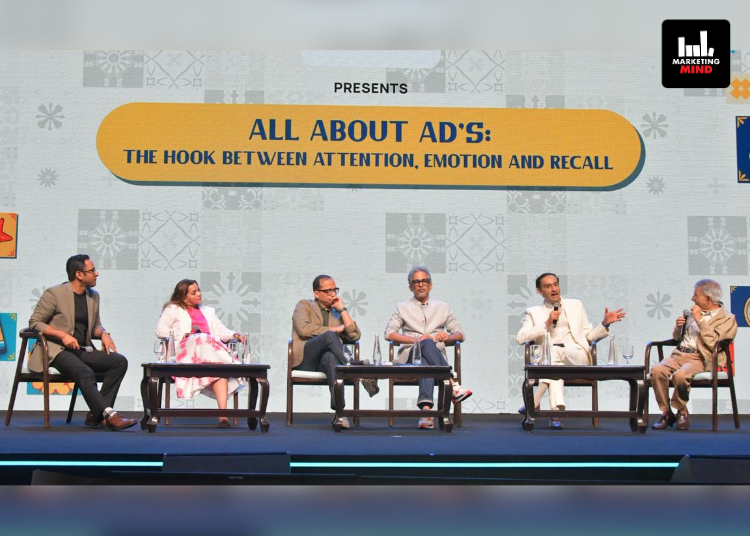
As advertising enters an era shaped by infinite scrolling, instant virality, shrinking attention spans, and AI-led disruption, one question continues to loom large over marketers: what makes people stop, feel, and remember?
That question sat at the centre of a Day 2 panel discussion at Goafest 2026 titled ‘All About Ads: The Hook Between Attention, Emotion And Recall’, where leaders from marketing, media, agencies and consumer brands came together to unpack what storytelling and brand building look like in an increasingly fragmented, fast-moving digital world.
The session featured Darshana Shah, CMO, Aditya Birla Capital; Rahul Kanwal, CEO and Editor-in-Chief, NDTV; Rana Barua, Group CEO, Havas India, SE Asia & North Asia; Rohit Kapoor, CEO, Swiggy and Sam Balsara, Chairman, Madison World.
A recurring theme across the panel was that while formats, platforms, and consumer behaviour may be changing rapidly, the fundamentals of brand building remain deeply human.
Barua noted that AI is creating a new model of storytelling, engagement and conversations with audiences, but argued that technology alone cannot solve for originality.
While AI can facilitate conversations, he stressed that it cannot create original ideas or cultural understanding, adding that “the real idea still comes from humans who understand culture, behaviour and context.” In an era where marketers are navigating social media-led cultural shifts, Barua said brands need to ask themselves whether they want to be a meaningful brand or a desirable brand, because “if a brand has no emotional connection or meaning in people’s lives, no amount of marketing will work.”
Meanwhile, Shah echoed the idea that while storytelling still matters, the rules of engagement have fundamentally changed. She pointed to media fragmentation and shrinking attention spans, saying consumer behaviour today revolves around scrolling, streaming, searching and shopping, forcing marketers to constantly unlearn and relearn.
Shah said brands today need a strong hook immediately because attention spans have reduced drastically, even as branding continues to be about what a brand stands for in the consumer’s mind. She added that content today drives memorability and stickiness, especially with younger audiences, and that commerce and content are now deeply interconnected, shifting the focus from quarterly campaigns to weekly relevance and engagement.
Balsara, the concern lies in how performance marketing is increasingly overshadowing long-term brand building.
He argued that consistency is what makes campaigns memorable over time, cautioning that many brands today are becoming overfocused on performance marketing at the cost of brand building. While acknowledging that performance marketing is important, Balsara said it cannot replace branding completely, adding that the ideal strategy lies in balancing the two. He also observed that while campaigns earlier could run for years, ads today need to refresh far more frequently, sometimes changing every month. AI, he noted, can help reduce content production costs and improve speed, but “human creativity still remains irreplaceable despite AI advancements.”
Kanwal brought the lens of internet culture and virality into the conversation, pointing out how cultural moments today can emerge instantly from social media and become massive movements overnight.
Referring to examples like the Cockroach Janta Party and Melody’s viral cultural moment, he said these moments have shown that brands today need to know how to quickly ride unexpected viral moments, often generating branding that money cannot buy. According to Kanwal, storytelling is shifting from traditional campaigns to hooks and real-time engagement, while the advertising world itself is moving from campaign-led storytelling to culture-led storytelling. He also noted that AI and prompt engineering are challenging traditional creative hierarchies, with younger creators now able to compete with seasoned professionals using AI tools.
Kapoor brought a brand-builder’s perspective, arguing that while virality may move fast, strategy cannot afford to. He said people today forget quickly and forgive quickly in the era of virality, but stressed that strategy should remain consistent even when execution becomes chaotic and fast-moving.
Kapoor added that brands need to focus on what does not change in human behaviour, even as trends come and go. He challenged broad assumptions around Gen Z, saying it is not one homogeneous audience but made up of many different identities, while noting that Swiggy’s communication strategy focuses on speaking to Gen Z because “everyone aspires to feel younger.” Kapoor also stressed the importance of guardrails, saying clear guardrails give teams freedom to experiment creatively at speed, even as brands are built over years while trends are built in days.
Across the conversation, one idea remained constant: while AI may accelerate execution, reduce costs, and democratise creativity, emotion, cultural relevance, consistency, and human insight continue to remain at the heart of memorable advertising. In a world where every ad may only have a shelf life of days, the challenge for brands is no longer just visibility – it is creating something people stop for, feel, and remember.