







There have been moments when numbers have quietly followed us through life. We have remembered birthdays, exam scores, lucky numbers and anniversaries. Some numbers have faded with time, while others have stayed etched in memory. But every once in a while, a number has stepped out of the ordinary and carried the weight of something much bigger.
On World Day Against Child Labour, The Hindu Group has sparked exactly that kind of conversation.
Created by independent creative agency Talented as part of The Hindu Group’s ‘Care Community Conversation’ initiative, the print campaign has arrived on World Day Against Child Labour with an idea so simple that it has almost hidden its own brilliance in plain sight. There have been no screaming headlines or dramatic visuals. Instead, the ad has trusted the power of observation and invited readers to pause for a second look.
And that second look has changed everything.
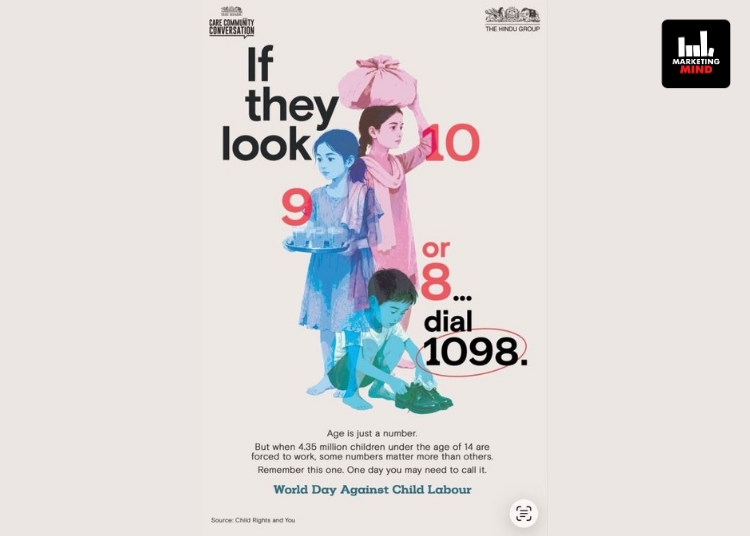
The creative has featured three children engaged in chores far beyond their years. One child has carried a load overhead, another has balanced a tray, while a third has crouched down to polish shoes. Their ages, 10, 9 and 8, have not merely appeared as numbers. Together, they have formed something far more urgent: 1098, India’s child helpline number.
Just like that, ages have transformed into hope.
The ad has carried a line that has lingered long after the page has been turned: “Age is just a number. But when 4.35 million children under the age of 14 are forced to work, some numbers matter more than others. Remember this one. One day you may need to call it.”
There has been something quietly devastating about the way the campaign has played with a phrase most of us have casually thrown around. “Age is just a number” has suddenly acquired a different meaning. In this case, age has become a reminder of stolen childhoods, interrupted dreams and responsibilities that should never have rested on young shoulders.
What has made the execution particularly striking is its ability to say so much without overwhelming the reader. The imagery has felt almost like a faded memory, with translucent silhouettes and soft colours creating a haunting contrast against a harsh reality. The children have not appeared as statistics. They have appeared as stories waiting to be rewritten.
At a time when attention has become increasingly fragmented and messages have fought desperately for eyeballs, The Hindu has demonstrated that powerful communication does not always have to shout. Sometimes, it only needed to whisper.
Because hidden between the ages of eight, nine and ten has been something far more precious than numbers. It has been hope. And like a number scribbled on the back of a hand before stepping out, 1098 has now found a place where the best campaigns always hope to live, not just on paper, but in memory.