






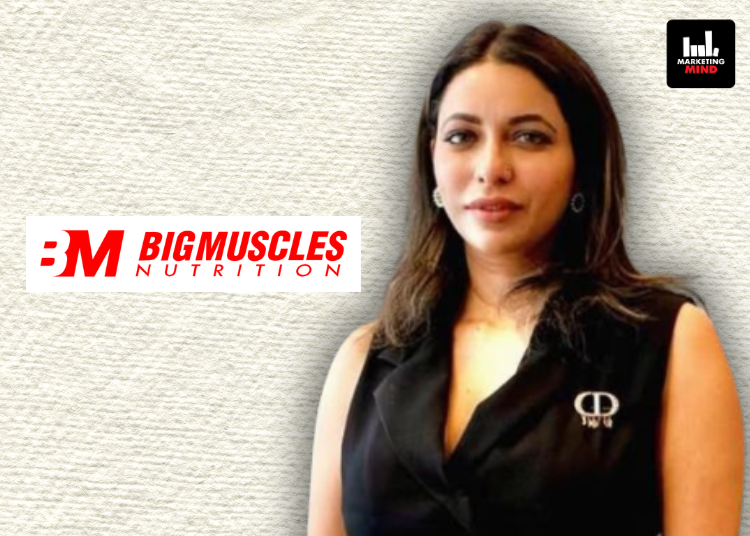
If you’ve ever thought protein marketing begins and ends with six-packs, gym mirrors and oversized tubs, Co-Founder of BigMuscles Nutrition Jitika Gupta, is quietly rewriting that playbook.
When BigMuscles Nutrition entered the market in 2009, the biggest challenge wasn’t convincing people to buy protein. It was convincing them that protein wasn’t steroids. Today, the conversation has completely changed. Consumers scrutinise ingredient labels, compare formulations, watch experts dissect products online and expect complete transparency before making a purchase.
For Gupta, Co-Founder of BigMuscles Nutrition, the evolution of the consumer has demanded an equally dramatic evolution in marketing.
“As the industry has changed, our marketing has also had to change. Earlier, we were educating people about what a protein supplement actually is and why it is not steroids. Today, consumers already know that. They understand ingredients, fillers and formulations. So our communication has to evolve with them.”
That shift, she said, is exactly why brands cannot afford to stay attached to what worked a decade ago. “If the audience changes and I still keep promoting the same thing in the same way, I become stagnant. Marketing has to grow with the audience. Otherwise, the brand stops growing.”
For BigMuscles Nutrition, that evolution is visible far beyond advertising campaigns. It has influenced product development, packaging, positioning and even the audience the brand wants to speak to.
“The perception earlier was that protein belongs only to gym-goers. That is no longer true. Protein is for everyone. Someone playing a sport, someone going to work every day, someone simply trying to complete their nutrition requirement also needs protein.”
That thinking has pushed the company to transition from bold, bodybuilding-focused packaging towards cleaner, lifestyle-oriented branding.
“People earlier looked at our packaging and immediately associated it with gyms. Today, we want people to see protein as part of their everyday lifestyle. That’s why we’ve moved towards cleaner labels, cleaner formulations and packaging that appeals to a much wider audience.”
The decision wasn’t driven merely by aesthetics. “The audience has become smarter. People read labels now. They understand emulsifiers, thickeners and fillers. So we also have to grow. If consumers want cleaner products, we should be ready to provide them.”
Interestingly, Gupta doesn’t see independent creators analysing supplement labels as a threat. Instead, she believes they accelerate category growth. “Whenever someone educates consumers, we actually become happy because it pushes the entire industry to become better. The more educated the audience becomes, the stronger the industry becomes.”
She added that brands shouldn’t resist informed consumers.
“If people understand they don’t want unnecessary fillers, then as manufacturers it’s our responsibility to improve our formulations. We manufacture in-house, so we can respond quickly. We have our own R&D and quality teams. If consumers want cleaner products, we are here to give them exactly that.” That openness towards criticism stems from a larger philosophy of authenticity, something Gupta believes remains one of the biggest marketing challenges in the nutrition category.
“The biggest challenge in our industry is authenticity. Consumers constantly question whether products are genuine.”
To build trust, BigMuscles has introduced batch-wise transparency. “We now have QR codes on every product. Consumers can scan them and directly access the lab reports for the exact batch they’ve purchased. Every batch is tested in our own laboratory. Authenticity cannot just be claimed anymore; it has to be demonstrated.”
While product credibility remains the foundation, Gupta has believed that communication has become equally important.
“Earlier our campaigns mostly showed bodybuilders lifting weights and drinking protein afterwards. Today, our stories look very different. You might see someone doing Pilates, someone carrying a protein shake to the office or someone including protein in their everyday routine. That is how our marketing narrative is changing.”
That transition, however, comes with its own challenge.
“Our brand name is BigMuscles Nutrition. Naturally, some people still associate it only with bodybuilding. So we’re consciously transitioning towards becoming a lifestyle brand without losing our core identity.”
One area where the company has also evolved significantly is women-focused communication. “When we started, almost our entire communication was directed towards men because that was the consumer base. Today, far more women consume protein than they did ten years ago, so naturally our marketing has expanded.”
Yet Gupta refuses to fall into stereotypical gender marketing. “We’ve never believed that women need a pink protein box or men need a blue one. Protein is protein. The product inside doesn’t change because of gender.”
Instead, the differentiation lies in storytelling. “We create different campaigns, work with different creators and collaborate with female voices who explain the product in a way that resonates with women consumers. Communication changes, not science.”
Celebrity partnerships have also played an important role in that journey. “We’ve worked with Ranveer Singh, Hardik Pandya, Nora Fatehi and Natasha. We were among the first brands in this category to invest heavily in celebrity marketing. At a time when the industry wasn’t thinking beyond gyms, we were building mainstream brand visibility.”
According to Gupta, that early bet changed the competitive landscape. “When we started doing large-scale marketing, many brands in the category weren’t investing in it. Over time, the industry followed. We realised very early that if we wanted protein to become mainstream, marketing also had to become mainstream.”
Influencer marketing, however, is a more nuanced conversation. “I personally don’t blindly trust influencers, regardless of the category. Money can make people say many things, and that’s something audiences are becoming increasingly aware of.” Despite that, influencers remain central to BigMuscles’ strategy.
“They are still the voice of the brand because they answer questions consumers genuinely have. People want to know when to consume protein, how much to take, whether one scoop is enough and how to include it in their routine. Influencers explain these things in a much more relatable manner than product packaging ever can.”
As a result, digital dominates the company’s media mix today. “Nearly 80% of our ad spends goes towards digital. Consumer behaviour has shifted online, so naturally our marketing has followed. Social media, digital platforms, quick commerce and e-commerce have become major focus areas.”
The remaining spend supports offline education. “The other 20% goes into gym sampling, trainer education programmes, offline activations and consumer awareness initiatives because physical experiences still matter.”
Quick commerce, Gupta believes, is simply another touchpoint rather than a replacement for retail. “We have to be present everywhere. Consumers may want to experience the product in-store but compare prices online or choose ten-minute delivery for convenience. Being available across every platform is simply part of modern brand building.”
Reflecting on the category’s journey, Gupta believes the industry’s biggest transformation has been moving from awareness to informed choice. “When we started, we were explaining what protein is. Today, consumers ask about ingredient quality, sourcing, lab reports and formulations. That itself tells you how much the category has evolved.”
Ultimately, Gupta has believed marketing isn’t about louder campaigns but sharper listening. “The audience keeps changing, industries keep changing and brands have to change with them. If consumers evolve and marketing doesn’t, the brand gets left behind.”