



The Indian home entertainment market is no longer a battle between television and streaming. Consumers today move seamlessly between live television, OTT platforms, smartphones and connected devices, often within the same day. As viewing habits become increasingly fragmented, companies are being compelled to rethink not just the content they offer, but also the way they deliver it.
For Dish TV India, this shift has translated into a broader transformation of its own business. Once synonymous with satellite television, the company is steadily expanding into an integrated entertainment ecosystem that combines Pay TV, OTT aggregation, connected devices and digital services under one umbrella.
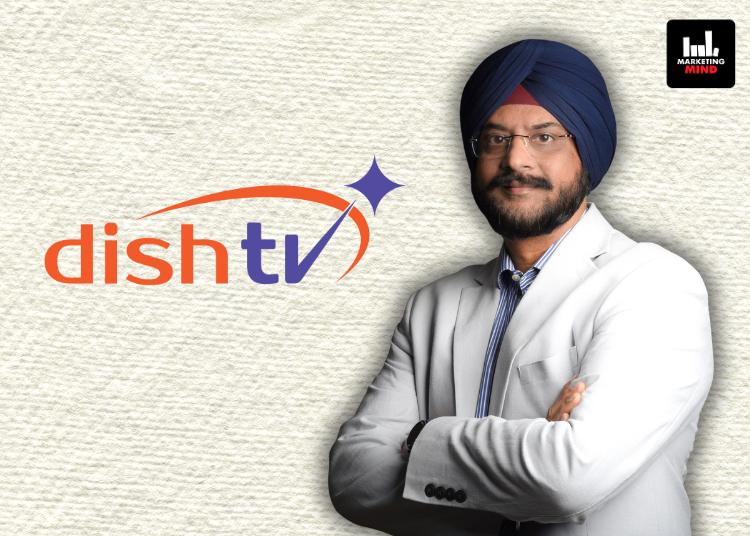
Speaking to Marketing Mind, Sukhpreet Singh, Chief Revenue Officer, Dish TV India, reveals how the company’s focus has evolved from operating a DTH platform to becoming a content-first business that enables consumers to access entertainment across screens, formats and technologies.
From DTH Operator To An Integrated Entertainment Ecosystem
Dish TV’s journey began over two decades ago as India’s first Direct-to-Home platform, fundamentally changing the television viewing experience by expanding content choices and improving picture quality. Today, however, the company views itself through a much broader lens.
“Our endeavour has been to provide content from everywhere to all kinds of screens,” Singh said. “Whether it’s linear TV channels, OTT, the big screen television or mobile phones, any content on any screen is our job.”
That philosophy has taken the company beyond its DTH roots. “From being a pure satellite TV services operator, our journey has been towards becoming a multi-technology content aggregator and distributor,” he said.
The launch of the VZY ecosystem is central to that evolution. “The VZY app has all the content, and the app is available on VZY televisions. If you have a VZY TV, it becomes a gateway to the entertainment world.”
The rationale behind this integration is simple. “Wherever the content is from and whichever screen you want to view it on, we should be able to provide it,” Singh affirmed.
AI, Data & Partnerships Are Redefining Customer Experience
While technology has transformed content delivery, Singh believes the biggest change has been behavioural.
Television was once a one-way medium, where broadcasters determined what audiences watched and when they watched it. Streaming has fundamentally altered that equation.
“The biggest change is that it has become a two-way street. Customers now pull whatever they want to watch, whenever they want to watch it,” he explained.
That shift has made customer data significantly more valuable. Instead of programming for broad audience segments, entertainment companies now rely on viewing behaviour, recommendation engines and consumption patterns to personalise experiences.
“The game has shifted from serving mass audiences to serving micro segments,” Singh noted, adding that content discovery has become just as important as content creation itself.
This data-driven approach is supported by an extensive partner ecosystem. Dish TV works with technology providers that power its digital platforms, device manufacturers such as CloudWalker, broadcasters and OTT services, many of whom are simultaneously collaborators and competitors.
Also read: How Dish TV Watcho & Cloud TV OS Are Making Smart TVs Smarter With Deeper Integration
“Our business is full of collaborations,” Singh said. “In many ways we compete with some people, and we also collaborate with them on other aspects.”
For Singh, partnerships are no longer optional. As entertainment consumption spans devices, operating systems and content libraries, interoperability between technology providers has become central to delivering a seamless customer experience.
Reinventing Pay TV In The Streaming Era
While the industry often frames the future as a contest between television and streaming, Singh believes that narrative oversimplifies the Indian market.
“Even today, more than 100 million Indian homes are into Pay TV,” he said. “If you look at television alone, more than 150 million households are watching linear TV. India is still very much a. I don’t see that disappearing in the next three or five years.”
Instead, he believes the country’s entertainment landscape is becoming increasingly hybrid. “Most households, especially in urban India, are becoming hybrid. They have a TV connection, but they also watch streaming content on their televisions and on their mobile phones,” he said.
He explained that viewing behaviour now changes depending on the context. “If you’re 25 years old, you’re watching a lot of individual content on your mobile. When you’re watching with your family, you’re watching television. Consumers are not choosing one over the other, they’re consuming both.”
That is precisely why Dish TV no longer defines itself by the technology it operates.
“We see ourselves as entertainment providers and experts in providing content,” Singh said. “Whether it is an app, a set-top box, a television or a website, these are all simply tools to enable content.”
Looking ahead, Singh expects broadband penetration and streaming to accelerate, but alongside television rather than replacing it.
“The acceleration of streaming is going to happen. Hybridisation is going to accelerate. But television is definitely going to still be around in a major way,” he added.
Marketing Beyond Sporting Moments
For Dish TV, marquee sporting events remain critical opportunities to acquire customers, re-engage inactive subscribers and showcase new offerings. However, Singh said campaigns are designed differently across the company’s various businesses.
“Our FIFA marketing strategy has been different across different product lines,” he explained. “For DTH it’s different, for the VZY OTT app it’s different, and for television it’s different.”
One of the company’s key propositions during the tournament has been its “Sports Always On” offering. “By giving sports always on, it is primarily driven by FIFA,” Singh said. “If you are a Dish TV customer, or if you want to become one, sports is always on for you.”
The tournament has also become a customer retention tool. “There has been a lot of content marketing to bring deactivated customers back into the fold using special offers and packages around the World Cup,” he noted.
Beyond advertising, the company has invested heavily in retail experiences and regional activations.
“There is always a demand for televisions whenever a mega sporting event like this happens,” Singh said. “So there is a lot of in-store marketing, digital marketing with influencers and launch events.”
Regional India Is The Next Growth Frontier
While Dish TV recently introduced specialised South India packs, Singh said the move wasn’t merely about geography. Rather, it was driven by distinct consumption patterns.
“It’s not so much of a demographic insight,” he said. “The business logic is that South India is still a predominantly Pay TV market. It is also a market where sports is consumed extensively.”
Football, alongside cricket and even wrestling, has created a unique entertainment ecosystem in the region. “The basic need of the South Indian customer is to watch content in their first language along with sports,” Singh explained. “We wanted to make that accessible at a very good entry price.”
The company also recognised another behavioural insight that shaped its offering. Most households in the South are multilingual, a fact that prompted Dish TV to introduce modular language add-ons.
“Customers can start with their primary language and sports, and then add another language for Rs 50. Add a third language for another Rs 50. It’s built around the way people actually consume content.”
For Singh, localisation goes beyond language. “This is based on the consumption habits that exist in the South and the kind of flexibility customers need,” he pointed out.
The Battle For Attention Will Be Won By Ecosystems
As technology giants, broadcasters, OTT platforms and hardware manufacturers compete for consumers’ attention, Singh believes the winners will not necessarily be those with the biggest catalogue or the latest technology.
“I think ecosystems will win,” he said. “It is not individual technologies.” He expects the entertainment industry to continue consolidating over the next few years.
“There were more than a hundred OTT providers. Now there are fewer because industries always go through consolidation. The players who execute better become stronger.”
At the same time, he believes consumer behaviour will only become more fragmented.
“Regional content consumption is going to rise further. Long-form and short-form content will both continue because people consume different formats at different times.”
Ultimately, Singh argues that companies need to think beyond individual platforms. “An integrated system where I am providing content from various sources, that is what is going to succeed,” he emphasised.
Summing up his outlook, Singh said, “It’s going to be the acceleration of broadband and streaming. It’s going to be hybridisation. And it’s going to be ecosystems that win versus individual, isolated technologies.”