






For decades, the Chief Marketing Officer (CMO) was viewed as the custodian of advertising, brand campaigns and consumer communication. But in today’s hyper-accelerated business landscape where D2C brands scale overnight, AI is reshaping consumer intelligence, and every growth decision is scrutinised for immediate returns, the role has quietly evolved into something far more influential.
The modern CMO, increasingly, sits at the intersection of growth, capital allocation, consumer insight and long-term enterprise value.
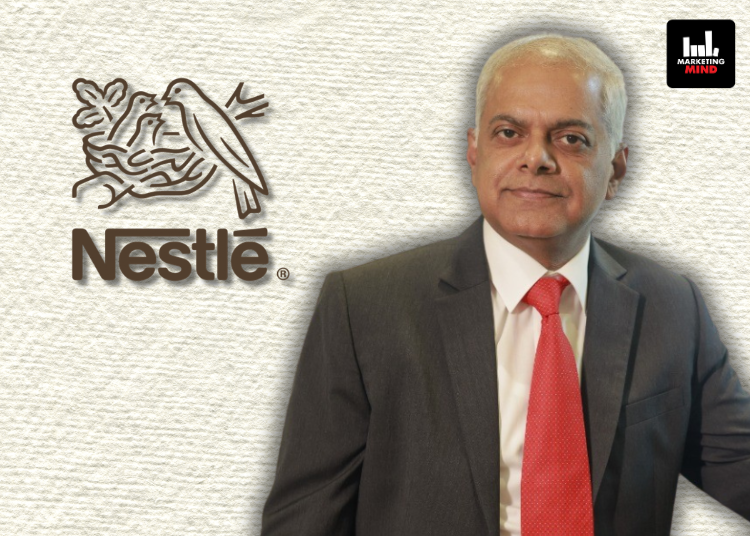
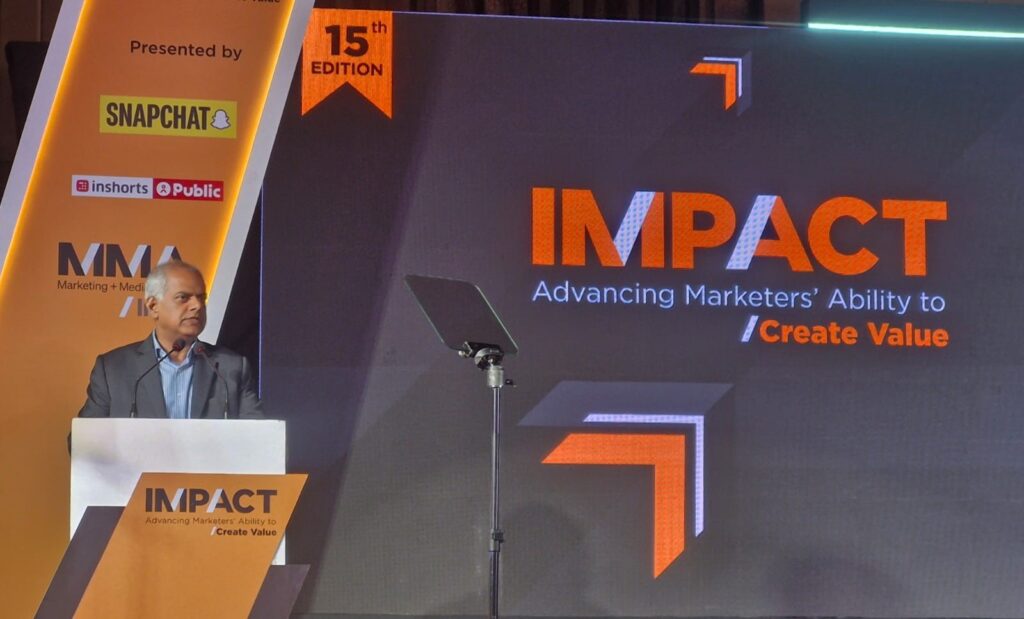
At a keynote address during the 15th MMA IMPACT India 2026, Manish Tiwary, Chairman and Managing Director, Nestlé India and Market Head, Nestlé South Asia Region, shed light on why the marketer’s role today extends well beyond communications and campaigns.
Going Beyond Job Titles
Tiwary does not believe the most influential person in a company is defined by designation. “It’s not about the function you are in, it’s about who represents the consumer.” For him, that responsibility most naturally belongs to the marketer, not because marketing owns advertising, but because it sits closest to the consumer.
“The only opinion which matters is the consumer’s. The day internal opinions start trumping the voice of the consumer, the company is in danger.” It is an argument Tiwary has repeated for years. Because the role of a CMO has evolved into something far more commercially consequential.
“The CMO is like my CFO. It’s just that they are nicer to people and usually have a more expensive taste in single malts,” he said with a laugh.
While the joke lands quickly, the point underneath it is serious. “For people who represent the consumer in the company, the role of a CMO is not very different from the role of a CFO,” he observed.
The Net On The Tennis Court
To explain the CMO’s role inside an organisation, Tiwary reaches for a sporting analogy. “If you play tennis without a net, you can hit the ball anywhere and think you’ve played a good shot,” he explained. That net is what the CMO brings into the boardroom.
“If I give a brief to my CMO saying I want 40% growth, without the net it’s very easy to do. Or if you say just get me profits, it impacts you in the long term. The CMO is the person who balances growth and profit. That balance is the net.”
It is why Tiwary views marketing less as a creative support function and more as an operating discipline, one that forces companies to reconcile short-term financial pressure with long-term brand health.
Advertising Is Not A Cost
Tiwary recalls a recent earnings interaction where a reporter asked whether rising advertising spends were becoming a concern. “Do you find anything odd in that statement?” he asked pointedly. “Why would a CPG company call advertising a cost? The moment you start with that mindset, you are in the wrong place,” he added.
For Tiwary, consumer businesses fundamentally run on two assets: people and brands. This is the reason why marketing investments cannot be viewed through the same lens as operational expenditure. “Our companies are only about people and brands. And the CMO is the person who decides how those investments are deployed,” he noted. That deployment, however, has become exponentially more complex.
Tiwary describes returning to marketing conversations after time spent in the technology industry and finding an ecosystem transformed, where traditional measurement systems no longer hold the same certainty.
“The old advertising system is gone. Earlier, you wrote one brief, gave it to the agency and built one piece of communication. Today, every platform has innovative boutique solutions, every channel behaves differently, and if you try to measure everything, you’ll spend more time measuring than actually landing the work,” he added. Which is where instinct, or, in Tiwary’s words, ‘tribal knowledge’, starts mattering again.
Why Research Alone Is Not Enough
For all the advances in consumer data, Tiwary believes companies increasingly risk mistaking research for understanding. “A good CMO does not depend only on research to represent the consumer. Sometimes companies get bogged down researching every element of the mix. Then you lose the feel for the consumer,” he explained.
The distinction matters deeply to him. To exemplify this belief, he pointed to Nestlé’s pet care business, where some of the most valuable signals emerge organically from pet owners posting online about their pets’ preferences and behaviours.
“It’s not just a research report which they bring to the table. The CMO brings their understanding of the consumer voice. And that’s where engagement is changing. Smaller communities and smaller conversations are where salience is now being built,” Tiwary pointed out.
But even as tools evolve, Tiwary believes the core principle remains unchanged: consumer proximity matters more than internal hierarchy. “Tenure gives you muscle, but if that voice starts overruling the consumer voice, you are going to fail,” he laid out.
The Empty Chair
Among the many stories Tiwary shares, one stands out most vividly. “There was an organisation where they would leave a chair empty in meetings. That chair belonged to the consumer,” he recalled vividly. Over time, the practice disappeared. But the symbolism stayed with him.
Because in many companies the consumer is often the first voice to quietly disappear from strategic decision-making, especially during periods of inflation, margin pressure or geopolitical uncertainty.
“The first instinct becomes: let’s take prices up. I call that intellectual laziness. Because before trying anything else, you’ve already decided to increase prices,” he decoded. “If you spoke to your consumer who is managing her entire budget of Rs 100, she has far more important things to take care of.
In such cases, margins are internal metrics. And companies that obsess over internal metrics while losing touch with external realities eventually drift into irrelevance.
“The loudest voice in the management committee should be the voice that represents the consumer,” Tiwary said matter-of-factly. For him, that is ultimately the real mandate of the CMO. Not campaigns, communication, or even advertising. But ensuring the consumer never leaves the room.