






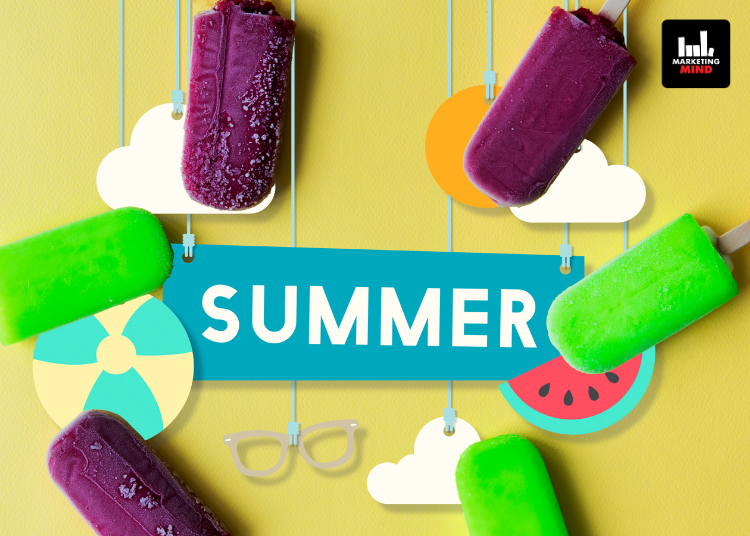
When summer arrives in India, it does not just raise the mercury, it rewrites the business playbooks for an entire category. Ice cream brands, from legacy giants to nimble new-age disruptors, build their annual strategies, launch calendars, and marketing warfare around a window that can account for a significant portion of the annual revenue. But summer 2026 is shaping up to be something more than a seasonal peak.
It is being fought on new terrain: quick commerce platforms that have turned impulse into an algorithm, a consumer palate that has moved decisively toward premiumisation and health, and a digital media ecosystem that makes every hoardings and Instagram reel count.
In conversation with Marketing Mind, major ice cream players shed light on how the industry will take shape in the 2026 summer, as the annual demand is already rising, along with the temperature. Mohit Khattar, CEO of Graviss Foods (Baskin Robbins); Vedansh Goyal, Founder of 1.5 Degree; Roli Shrivastava, VP Marketing at Hocco; Pashmi Shah Agarwal, Co-Founder and CMO at Get-A-Way Ice cream & Desserts, and Shamika Erande, Assistant General Manager Marketing at Walko Food Company (NIC Ice Creams, Grameen Kulfi, Mimo) shared what they are expecting, investing, and launching as the heat rises.
The Growth Outlook: Summer As The Year’s Defining Chapter
There is an old rule of thumb in the ice cream industry: summers make or break the year. That remains true. What is changing is the scale and the speed.

Get-A-Way’s Agarwal said, “The industry number is 40–50% of annual revenue concentrated in summer. The category overall is tracking at 18–20% YoY. Quick commerce has structurally altered how ice cream is discovered, decided on, and delivered.” Speaking of the brand’s growth, she stated, “For Get-A-Way, the concentration is just as sharp but the growth trajectory is in a different league entirely. We are looking at upwards of 200% growth YoY this summer.”

Walko Food Company, which houses brands including NIC Ice Creams, Grameen Kulfi, and Mimo Ice Creams, expects the category to hold its structural strength. “For Summer 2026, we expect the ice cream category to deliver strong double-digit growth YoY and Walko is expected to cover with a greater lead as it has in the previous years,” Erande added. She also clarified, “The category remains structurally strong, with summers continuing to act as the primary demand accelerator and revenue peak period for the industry.”

Shrivastava flagged the geography-specific nature of the category. “Different geographies behave very differently. Gujarat still has a very long summer, whereas Maharashtra behaves differently. Every geography is different, but summer as a season becomes very crucial for the ice cream category. The kind of portfolio that we have at HOCCO, it is also in sync with the changes in consumer behavior that happen across regions,” she observed.

For plant-based player 1.5Degree, the numbers signal an even sharper spike. “Based on our recent performance, where weekly orders grew by 71.4% WoW and outperformed the 4-week average by 134.1%, we expect this momentum to translate into a 3x–4x growth in sales,” said Goyal.
The Ad-Spend Race: Investing Into the Season
If summer is the revenue engine, advertising spend is the fuel — and brands are spending more than ever to be seen, clicked on, and ordered from.

For Baskin Robins, Khattar noted, “Conservatively, we estimate the ad spends to be up by 20–25% over the last year.” Get-A-Way has gone further, leaning harder into the summer window. “Get-A-Way has increased ad spends by 50% YoY, while the category average sits at 15–25%. The brand went higher because the ROI case is simply undeniable in summer,” Agarwal explained. “Every rupee deployed in this window works harder than it does in any other month. Our campaigns are always live, optimising on real performance data instead of seasonal bursts,” she further added.
Walko is optimising its incremental investment toward digital channels and quick commerce platforms. “The primary aim is to amplify digital, influencer-led marketing, and quick commerce platforms, where we see the highest efficiency in driving better conversions,” Erande explained. “We are also strengthening on-ground activations and visibility in key consumption markets,” she added.
For 1.5 Degree, this year marks the first major ad-spend cycle for its physical outlets, with a clear concentration on Zomato and Swiggy. “Currently, inorganic (ad-driven) orders account for 41.7% of our total volume, and we intend to scale this aggressively to capture the high-intent summer audience,” Goyal said.
Selling Moments, Not Just Products
Increased budgets alone do not make a season. Brands are recalibrating what they say and how they say it: with a clarity of purpose that goes beyond category advertising.
“The brief at Get-A-Way was very direct: Do not sell ice cream, sell the moment. A post-gym ice cream stick is not the same as a late-night dessert jar, which is different from a family tub on a Sunday afternoon. Each of those carries its own emotional signature,” quoted Agarwal.
1.5Degree.co is pivoting from functional messaging to lifestyle positioning. “Lunch and Snack-time orders have grown by 200% and 166.7% WoW respectively. Our key strategy is shifting from ‘delivery-only awareness’ to a ‘premium lifestyle’ experience. We are doubling down on day-part integration, positioning our outlets as the go-to destination for high-quality, mid-day indulgence,” Goyal affirmed.
At Hocco, the media shift is as notable as the message. “The brand leans heavily on Instagram, YouTube, and influencer partnerships, while retaining a firm belief in the power of OOH done with intent,” revealed Shrivastava. “I feel if hoardings are done right they can create the kind of impact that is required when it is the time to create differentiation in the market. Even if I take 50 in a city, I am able to create an impact,” she explained.
Walko’s portfolio spans multiple brands and formats. “We have NIC Ice Creams and Grameen Kulfi for the delivery-first channel, Mimo Ice Creams for the impulse category, and Meemee’s Ice Creams for indulgence. This diversification allows us to aim at penetrating extensively through zonal and digital advertising, while covering a larger base, over last year,” Erande explained.
Short-Term Goals, Long-Term Architecture
For most ice cream brands, summer is the primary customer acquisition funnel for the entire year. The ambition of the season, therefore, stretches well beyond the quarter.
“Our short-term objective for summer remains easy and convenient availability of our products coupled with the successful introduction of our new products and keeping the brand top of mind,” explained Khattar.
“The peak season is Get-A-Way’s single largest opportunity to build a retained consumer base. Every summer conversion feeds the year-round funnel. A consumer who picks up a Get-A-Way cone on Blinkit today, because the right product showed up at the right moment, and that cone delivers on taste and on health, that consumer comes back in July,” said Agarwal.
1.5Degree.co has set precise measurable targets for the season. “We want to stabilize our average customer rating at 4.8 or above while establishing flagship locations. The long-term goal is to build the brand as the premier ‘guilt-free’ name in plant-based desserts, using a summer when 92.3% of users are currently new or lapsed as a critical acquisition funnel,” claimed Goyal.
Media Vehicles and Market Strategy: The Digital-First Consensus
Across the board, brands have converged on a digital-first stance. The interesting divergence lies in the details, which platforms, which audiences, and how they integrate quick commerce as both a logistics and a marketing channel.
“We largely follow a digital-first approach when it comes to building visibility for our brand. This essentially stems from our target audience who actually spends disproportionate time on social and digital platforms, while allowing for real-time optimisation and message customisation,” noted Khattar.
“Get-A-Way is a digitally native brand, as it is the founding architecture. Quick commerce platforms are now media channels. The online shelf space, listing creative, the placement at the point of impulse, all of it is equally strategic. We invest across the full digital funnel with one principle: real-time optimisation over fixed planning. The algorithm is always on,” decoded Agarwal.
1.5Degree’s 91.7% orders come from Zomato, which tells its own story. “We are also doubling down on South Delhi and Gurugram, where we have clocked 157.1% WoW order growth,” added Goyal. “Key growth drivers include the rising temperatures in North India and our operational efficiency, maintaining a high availability of 97.6% to ensure we never miss a seasonal opportunity,” he added.
Walko, meanwhile, is working in a different geography entirely. “The adaptive shift of online deliveries that was seen by the metro cities earlier is now echoing with the Tier I and Tier II cities too. Our 350+ location network allows us to layer customer profiling and micro-targeting across regions for immediate conversions” said Erande. “Summers are business-critical, contributing roughly 40% of annual sales. We deploy a significant amount of the year’s marketing budget in this season to maximise visibility and conversion.”
Shrivastava also noted, “Quick commerce has become a very important channel that we have all realised. It’s an impulse category. Instant gratification, instant feedback.” She also noted a significant shift in the consumer patterns, explaining, “The traditional party-pack brick, which was the sign that a brand had truly arrived in a household, is giving ground to individual impulse formats like cones and candies, driven by both personal flavour preferences and the ease of on-demand ordering.”
For Baskin Robbins, Khattar explained, “Premiumization and convenience are the two big trends that will drive both consumer interest and action as well as brand interest and action over the next few years. More expanded choices, unconventional flavours and formats as well as dessert choices that are more individualistic are set to rule.”