







For decades, jewellery advertising has mastered the art of selling emotions. Engagements, weddings, anniversaries and milestones have long shaped the category’s storytelling, while the product itself often remained secondary to the occasion it symbolised. But as consumers become more informed and discerning, jewellery brands are discovering that desire alone may no longer be enough.
Increasingly, the challenge is to build aspiration while also helping consumers understand why a product deserves that aspiration.
This shift is prompting brands to move beyond conventional narratives of celebration and status towards conversations rooted in craftsmanship, authenticity and product value. Whether it is educating consumers about diamonds, creating stronger emotional relevance for self-purchase, or building brand affinity through genuine consumer insights, storytelling in the category is gradually becoming as much about understanding as it is about emotion.
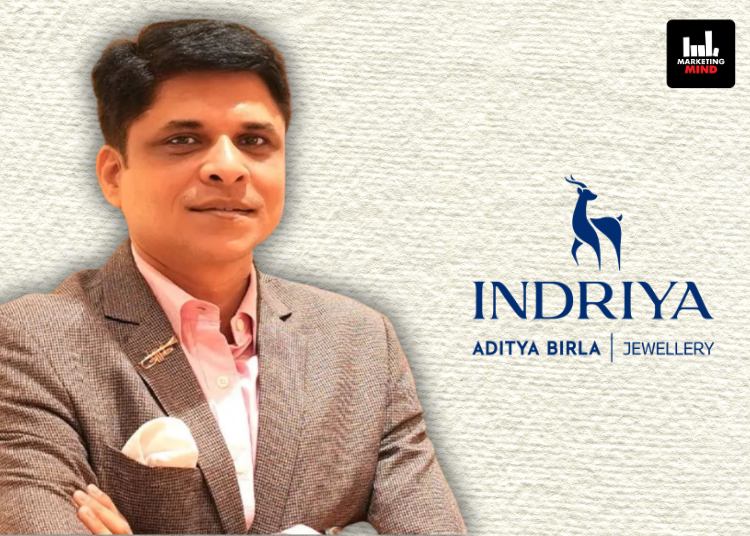
In a conversation with Marketing Mind, Shantiswarup Panda, Head of Marketing and Visual Merchandising at Indriya, spoke about why the brand chose to put the spotlight on a diamond’s sparkle instead of its designs, in its new campaign, how jewellery storytelling is evolving beyond occasions, why authenticity remains luxury’s strongest currency, and why he believes hyperlocal consumer understanding will define the industry’s next phase of growth.
The Insight That Sparked A New Campaign Narrative
Over the last couple of months, while talking to customers, we realised something important. Every film and every campaign that we create is based on a consumer truth. That’s precisely why our campaigns are loved by customers and why they drive such strong engagement.
Through these conversations, we found that while women buy diamond jewellery for its design, assortment and for specific occasions, they also buy diamond jewellery primarily for the sparkle and the magic that it brings.
However, in all our conversations, we realised that nobody in the industry is really talking about sparkle.
At that point, we had two choices: either talk about the collection and the design, or talk about the diamond quality itself and the sparkle. We felt it would be very interesting to shake up the industry a bit and create awareness around an aspect that is central to why women buy diamonds in the first place.
That’s why we decided not to talk about our designs, which are already well established and something people know us for. Instead, we chose to talk about the sparkle and the value it brings. That’s how this entire idea came into picture and how we ended up creating an entire campaign around sparkle.
By the way, this is not new. Sparkle has always been the reason why women buy diamonds. However, it has never been a normal part of the conversation while buying and selling diamonds. We simply want to bring it back to the centre of the discussion.
How Jewellery Storytelling Is Evolving Beyond Occasions
Diamonds are typically associated with big celebrations and milestone moments. Interestingly, that is also the reason why lab-grown diamonds will not come out of that space. Whether you’re celebrating your 25th anniversary or an engagement, these are precious moments that people want to commemorate with something equally special and precious. That’s simply the consumer nature.
In our storytelling, we have taken a leaf out of this insight to create diamond stories around such emotions. However, if you look at our diamond films from last year and the one before that, the entire narrative is centred around a woman and her diamond jewellery. It’s not about anybody else outside that relationship.
Diamonds and jewellery are so close to a woman’s heart that she gets serenaded and is drawn into the diamond itself. For instance, when we launched our diamond campaign last year with the collection called ‘Aasmaniyat’, there was only one woman in the film. It wasn’t about whether she was at a party or in any particular setting. It was about her and her connection with the jewellery, as she was serenaded by coloured stones and white diamonds.
The entire storytelling is aimed at creating desire and drawing consumers to consider diamonds for purchase. India is a gold-heavy market, so the question is: how do you create and draw more people towards buying diamonds? Desirability is what we are attempting to build.
The Shift From Prestige To Personal Expression
As for younger consumers seeking authenticity and individuality over status signalling, I don’t think this fundamentally changes what aspiration looks like in the luxury category.
Most responsible luxury and lifestyle brands have always wanted to stay authentic; this isn’t a new phenomenon. In fact, brands that are authentic become a core part of consumers’ lives. If you are not authentic, consumers will figure it out sooner or later. They will recognise that it is merely a marketing gimmick or simply a claim that doesn’t stand.
When you are authentic, consumers understand that authenticity and reciprocate it with a great deal of brand love, affection and affinity towards the brand.
That’s why most of our campaigns are based on some consumer truth. It’s not just a story; it’s rooted in an innate need, whether stated or unstated by the consumer. That’s what gives the communication its own insight and reason to exist.
Our brand and communication have always been that authentic. Consumers relate to it by saying, “This happens with me,” “This is so true,” or “This is exactly how I feel.” That’s when they start loving the brand because they believe this brand truly understands them. This is a code we have lived by throughout our entire existence, and we will continue to do so.
Beyond Attention: Building Stories That Last
There are a couple of ways to look at this. Many brands use multiple celebrities because there is recognisability-you can identify three, four, five or even more known faces.
At Indriya, however, we believe the core idea has to be strong and capable of standing on its own feet. Only then do we add known faces that can enhance memorability and aspiration. We don’t believe in taking a weak story and strengthening it simply by adding a celebrity.
That’s how we differentiate ourselves. Our core campaign idea has to be rooted in a strong insight. After that, whether we choose a celebrity or a non-celebrity really doesn’t matter. A celebrity certainly adds attention and improves recall value, but the idea itself has to be powerful.
We evaluate every campaign on its own merit and only then do we add another layer to it. This approach has worked very well for us. We’ve done many campaigns with Aditi, and we’ve also created several regional campaigns without a known face. Everything works because the communication is ultimately based on an insight.
The Challenge Behind An Underpenetrated Category
While the category remains underpenetrated, many consumers don’t even consider buying diamonds. For a new jeweller like us, the easiest thing to do is gain share from others. If you’re already a diamond buyer and a customer of, say, Jeweller A, we can try to attract you to Indriya by offering better value, greater trust and a superior experience.
Winning share is easier because you’re not debating whether or not to buy a diamond-you’ve already decided to purchase one. We’re simply encouraging you to switch brands.
However, as an incumbent with this campaign, we also want to expand the market and invite non-buyers of diamonds, especially gold jewellery buyers, into the category.
That’s why it’s important to put a stake in the ground and say that even our entry-level diamonds are the most sparkling diamonds. It’s not only about a one-carat solitaire, which many women in this country cannot afford. It’s also about the smallest diamonds people buy-whether it’s a one-pointer or a two-pointer. Even that small diamond is the sparkliest one available in the market.
With this campaign, we want to shift the needle in terms of how Indians buy diamonds and, more importantly, how they perceive and evaluate diamonds.
What The Industry Needs To Stop And Start Doing
One thing I would like people to leave behind is the tendency to dismiss something by saying, “This is just marketing.” People often say it jokingly, but marketing’s job is not to create something that isn’t true.
Marketing’s role is to be a force multiplier-to take a message far and wide. If brands focus on what is consumer-based, insight-based and fact-based, this kind of disrespect or denigration of marketing won’t happen. Marketing is nothing but taking a true proposition to customers and connecting them to a marketplace.
If people avoid gimmicky tactics, it will be good for everyone and, most importantly, it will serve customers well.
The other thing brands should embrace is a deep understanding of the hyperlocal consumer. Every catchment has a rich culture, with its own practices, customs, festivals, lifestyles, ethnicities and tastes. Jewellery is one category that can serve every catchment and every socioeconomic segment extremely well.
For us, the intent is not to be India’s jeweller. We want to be South Delhi’s jeweller, Noida’s jeweller, Gurugram’s jeweller, Goregaon’s jeweller, and so on. That hyperlocal approach is a practice we have built very strongly into our brand.
Whether it’s the assortment in our stores, the backgrounds and ethnicities of our staff, the languages they speak, or the way we run hyperlocal campaigns, we have embedded this DNA of being native into everything we do.
I think that has served us very well, and it’s something that most brands-especially in categories like jewellery and food-can do exceptionally well.