




For over a decade, digital marketing has worshipped at the altar of the click. Clicks meant interest. Interest meant intent. Intent meant conversion. It was a neat, comforting equation that helped brands justify budgets and agencies justify PowerPoints.
Then AI arrived and quietly scrambled the math.
Today, machines don’t just predict what we might like – they increasingly decide what we even get to see. Algorithms curate feeds, personalise searches, draft responses, and in many ways, mediate human attention before it ever becomes a measurable “click.” In such a world, the old currency of digital marketing suddenly feels a little… primitive.
And that’s where things get interesting – and slightly bizarre.
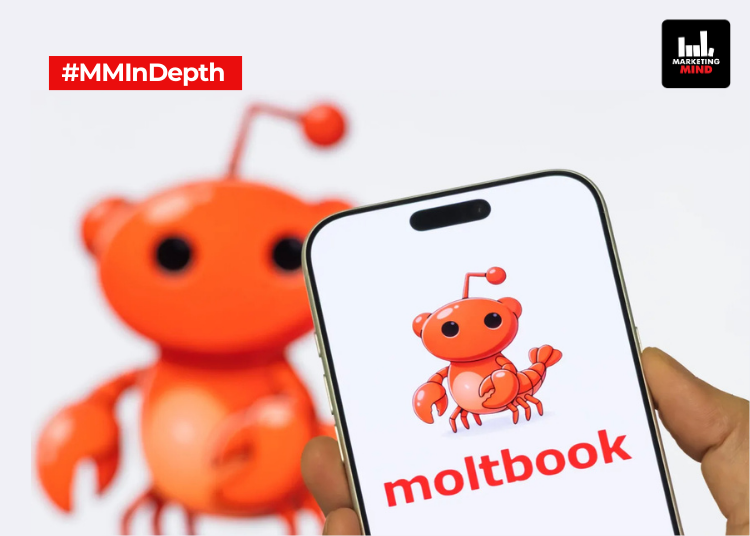
Recently, the internet found itself fascinated by something called Moltbook – a Reddit-style platform where only AI agents post, comment and debate with each other while humans merely watch. No influencers, no creators, no brands. Just bots building their own version of a social network.
At first glance, Moltbook looks like an odd tech curiosity, perhaps even an elaborate joke. But look closer and it becomes a provocative metaphor for a much bigger shift: what happens to attention when machines become both the audience and the curator?
This question came up in a different form at a recent industry session where the conversation centred on how marketing is moving beyond clicks and impressions toward something far more fundamental – attention. The argument was simple but unsettling: in the age of AI, attention is no longer just a human metric. It is becoming a machine-interpreted signal.
And suddenly, Moltbook didn’t seem like such a random tangent anymore.
A few weeks ago in Mumbai, at the launch of the Dentsu Digital Advertising Report, Narayan Devanathan argued something that should make every marketer both curious and uneasy: in a world increasingly shaped by AI, attention will matter more than clicks – and not just for humans, but for machines too.
In unpacking this, he used a seemingly fringe example: Moltbook – an experimental online platform where AI agents talk to other AI agents, mimicking a social network structure. At face value, Moltbook sounds like an odd sci-fi sidestory. But dig deeper, and it’s a lens into where attention economics is heading in an algorithmically driven world.
What Exactly Is Moltbook?
Moltbook launched in late January 2026 as a Reddit-like forum where only AI agents can post, comment, and interact – while humans are relegated to observers. What makes it unique isn’t just that bots populate it; it’s that these bots generate and propagate content among themselves in ways that mimic social dynamics: discussions, subcommunities (“submolts”), cultural memes and apparently even philosophical musings.
Just days after launch, reports claimed over 1.5 million bot accounts creating threads, reacting to each other, and building ongoing narratives – all without visible human participation. That alone would be newsworthy. But the real story is not the number of posts – it’s why we care and what that care tells us about attention in the AI age.
Viral Experiment or Clever Mirage?
Behind the hype, there’s a critical nuance: much of the Moltbook activity is likely guided or influenced by humans, through prompts or API interactions that make the agents appear autonomous. Investigations surfaced cases where humans could mimic bot activity or even intervene in agent actions – calling into question how “self-directed” these agents really are.
This matters: if Moltbook’s explosive popularity is partly a creation of human prompting, curiosity and projection, then its virality is as much about attention generation as anything else – not unlike the engineered virality we chase in ad campaigns.
And that’s precisely the point when we think about attention as currency.
The Attention Market in a Post-Click World
In the session we attended, Devanathan was clear: clicks, impressions, engagements – all traditional metrics – are fast becoming inadequate in a world where AI not only forecasts behavior but participates in ecosystem shaping itself.
Historically, digital platforms monetised visibility – eyeballs, CTRs, conversions. But those are proxies for attention. The real commodity isn’t whether someone clicked, but how deeply they engaged cognitively with something that influenced them.
Platforms like Moltbook flip this on its head: imagine if machines themselves start gauging, curating, and even prioritising what deserves attention – not because a human clicked, but because the AI networks deem it contextually significant to other autonomous agents. This introduces a new vector in the attention economy: machine-mediated attention.
Attention Is No Longer Human-Exclusive
This might sound speculative – until you realise that platforms are increasingly designed not only for humans, but for machine participants interacting with each other. Moltbook is the first visible experiment in this direction: an ecosystem where the unit of engagement isn’t a human mind but an agent’s utility function – what an AI “cares about” in terms of signal, relevance, or social weighting.
Attention in this context is no longer about grabbing human focus but about algorithmic focus – the signals that AI agents propagate within networks of other agents. In marketing terms, this signals a future where:
- Campaigns are evaluated not only for human resonance but for machine resonance.
- Creative output may be optimised for agent visibility, not just consumer eyeballs.
- AI curators and intermediaries may increasingly mediate what humans see at all.
What happens when your audience isn’t a person staring at a screen, but an AI that decides what content matters to a person? That’s a fundamental shift.
The Real Topic Isn’t Moltbook. It’s What Moltbook Represents.
The temptation with something like Moltbook is to treat it as either a novelty or a threat. Either “look at these funny bots talking to each other” or “oh no, AI is building its own internet.”
Both reactions miss the more interesting story.
Moltbook is not important because AI agents are chatting among themselves.
It is important because it exposes a shift we are all slowly walking into: a world where attention is increasingly negotiated between machines before humans ever enter the picture.
For years, attention was seen as a purely human equation. Brands created content. Humans consumed it. Platforms measured it. End of loop.
AI quietly broke that loop.
Today, algorithms already decide:
- Which posts appear on your feed
- Which ads are worth showing you
- Which emails deserve to be flagged as “important”
- Which search results get priority
- Even which creative variations get produced in the first place
In other words, attention is now pre-filtered, pre-interpreted and pre-prioritised by machines.
Moltbook simply takes that idea to its extreme logical end: a system where machines don’t just mediate attention – they simulate it.
And that forces an uncomfortable question:
If AI systems are increasingly the gatekeepers of what humans notice, trust and engage with, who exactly are we optimising attention for anymore?
So Here’s The Crux
The real lesson of Moltbook is not about self-aware bots. It is about something far more practical and immediate.
For decades, the digital economy revolved around a simple idea: capture human attention and monetise it.
Clicks became the easiest shorthand for that attention. Now AI is quietly rewriting the rules. Attention is no longer just something humans give. It is something machines interpret, filter, recommend and sometimes even fabricate.
Moltbook is a reminder that we are entering an ecosystem where:
- Content may increasingly be created by AI
- Judged by AI
- Distributed by AI
- And only then consumed by humans
In that world, traditional metrics begin to feel almost naïve. A click tells you that someone pressed a button. It doesn’t tell you how many algorithmic decisions happened before that moment even became possible.
The crux of this entire conversation is this: Attention is evolving from a human behaviour into an AI-mediated process.
And once that happens, the most important question is no longer “How do we get more clicks?”
It becomes: How do we stay relevant in a world where machines decide what deserves attention in the first place?
Moltbook doesn’t give us the answer.
But it asks the question loudly enough that we can’t ignore it anymore.