






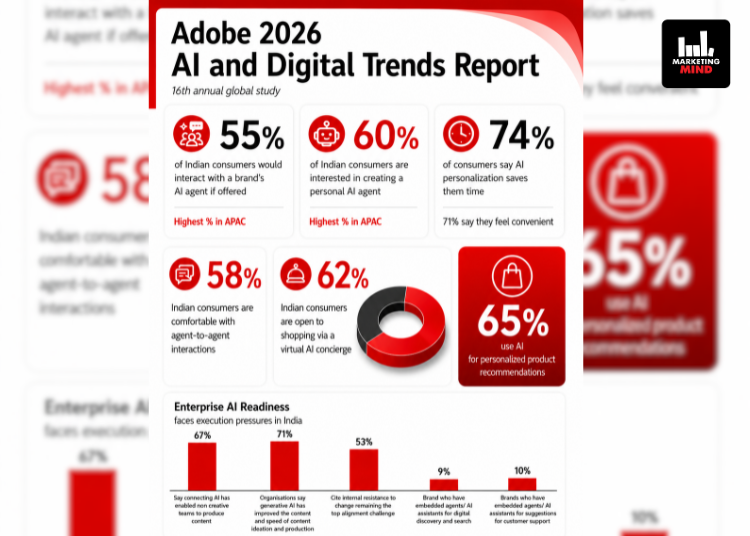
Indian consumers are showing the strongest appetite for agentic AI in the Asia-Pacific region, with 60% expressing interest in creating a personal AI agent, according to the latest findings from the Adobe 2026 AI and Digital Trends Report.
The report, released on June 25, is based on responses from 7,000 consumers and business leaders globally and examines how businesses are approaching AI adoption and digital transformation, alongside changing consumer attitudes toward AI-powered experiences.
According to the study, India leads the region in consumer openness toward AI agents. More than half (55%) of Indian consumers said they would be willing to interact with a brand’s AI agent, while 58% said they are comfortable with agent-to-agent interactions. Additionally, 61% said they would be comfortable allowing an AI agent to interact with a brand’s human representative on their behalf.
The findings suggest that Indian consumers are increasingly embracing AI across their shopping and customer service journeys. Around 65% of respondents reported using AI to search for personalised product recommendations, while 60% use AI-powered tools for instant customer support. Another 62% said they are open to making purchases through a virtual AI concierge.
Trust emerged as a major factor influencing AI adoption. The study found that clear labelling of AI interactions was the most important reassurance for consumers, cited by 21% of respondents. The ability to switch to a human representative at any point ranked second at 17%.
While 74% of consumers said AI-driven personalisation often saves them time and 71% described such experiences as convenient, the research also revealed concerns around transparency. Around 61% of respondents said they would stop engaging with a brand if they discovered they were interacting with AI when they believed they were speaking with a human. Meanwhile, 76% said AI-powered interactions should feel human rather than robotic.
On the enterprise side, the report suggests that while enthusiasm around agentic AI is growing, large-scale implementation remains limited.
Only 10% of Indian organisations have embedded agentic AI into customer support functions, while 9% have adopted it for brand discovery and search. Enterprise-wide deployment remains relatively low, with just 7% of organisations using agentic AI at scale for marketing content creation and customer support, and only 4% deploying it extensively for customer onboarding and education.
Businesses also continue to face significant operational challenges in scaling AI initiatives. Data integration and quality issues were cited as the biggest barrier by 69% of executives, followed by talent and skills shortages (65%), unclear return on investment (62%), and technology infrastructure limitations (48%).
Despite these hurdles, organisations are already reporting benefits from generative AI adoption. Around 71% of businesses said generative AI has improved the speed and volume of content ideation and production, while 67% said it has enabled non-creative teams to produce content more effectively.
“India is emerging as one of the most receptive markets for agentic AI in Asia Pacific, creating new opportunities for brands to deliver more personalised and effective customer experiences,” said Anindita Veluri, Director of Marketing, Adobe India.
The report also highlights a growing disconnect between consumer expectations and how organisations measure AI success. While consumers tend to evaluate AI experiences based on trust, transparency, and whether their needs are effectively met, many businesses continue to prioritise efficiency gains and cost reduction metrics.
“At the same time, consumers expect these interactions to be transparent, intuitive and human-centric. As organisations move from experimentation to scaled adoption, strong data foundations, governance and trust will be critical to unlocking the full value of AI.” she added.
“Consumer behaviours are shifting across Asia Pacific, with AI already rising in brand discovery and now set to play a greater role in purchasing journeys. Many consumers are comfortable with agentic AI, but say adoption relies on defined transparent contexts with options for human support,” said Duncan Egan, Vice President of Enterprise Marketing, Asia Pacific and Japan, Adobe.
“For many organisations, AI is already delivering meaningful improvements to experience delivery and customer growth. Early results from generative AI are translating into accelerated agentic adoption. However, while enthusiasm for agentic AI is high, most brands still need to build the data, governance and orchestration capabilities that will allow these efforts to scale.” he added.