







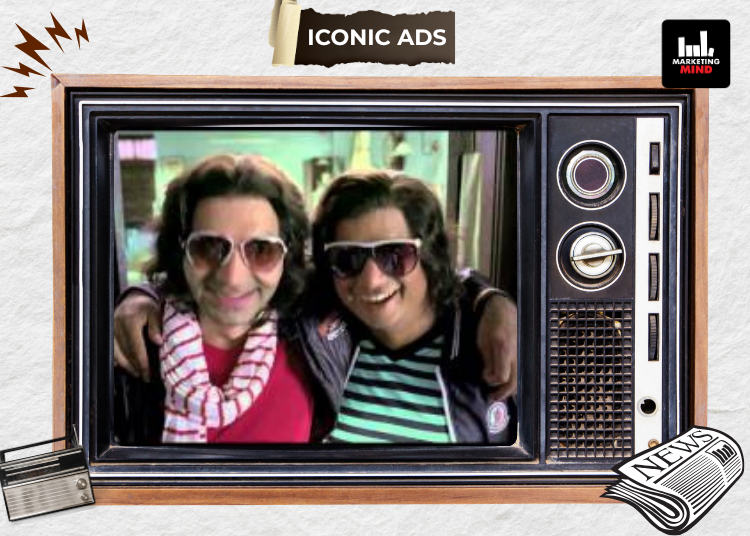
Picture a narrow tailor shop. The soft hum of a sewing machine fills the room. The tailor looks up as two boys walk in, unhurried and drifting.
Ramesh and Suresh place a pair of trousers on the table. “Pitaji ki patloon ek bilang chhoti kar do.” (trim father’s shorts by an inch). The instruction hangs in the air. Clear… and yet, not quite.
Before the tailor can respond, a Cadbury 5 Star is unwrapped. They take a bite. And just like that, something shifts. Their shoulders relax. Their eyes lose focus. Words dissolve before they’re spoken. The room is still the same, but they aren’t fully in it anymore. They stand there, quiet. Present, but far away.
The tailor shrugs it off and gets to work. He measures the trousers, folds the hem, and makes a neat, careful cut. He looks up, expecting a nod. Nothing. Maybe it needs to be shorter.
Another snip. Still no response.
He pauses, glances at them again. They haven’t moved. Haven’t reacted. Just standing there, lost in their own slow, chocolate-filled haze. So he cuts again. And then again.
Each cut is a little more uncertain than the last. Each silence stretches longer. At some point, the trousers stop looking like trousers. The length keeps disappearing. Logic quietly fades. But the scissors don’t.
And through it all, the boys remain exactly the same: distant, detached, untouched by what’s unfolding right in front of them. The tailor finally stops. What lies on the table is no longer what they brought in.
It’s much shorter now. Almost unrecognisable. He looks up one last time. Ramesh and Suresh are still there, chewing, staring, somewhere else entirely. Somewhere between that first bite and the final cut, something very simple has happened: They got lost.
When doing nothing became the idea
When this ad aired around 2009, it didn’t feel like a typical chocolate commercial. Created by Ogilvy & Mather for Cadbury (now part of Mondelez International), it leaned into a counterintuitive thought. Most ads tried to show excitement, energy, or joy. This one did the opposite.
The now-iconic line “Jo khaaye, kho jaaye” wasn’t just a tagline. It was a behaviour the film demonstrated with almost stubborn commitment. There was no rush to land the joke. No over-explanation. Just a gradual, almost hypnotic build-up where inaction became the punchline.
The rise of Ramesh–Suresh
What truly made the film stick was the creation of Ramesh and Suresh — characters who weren’t extraordinary in any way. They weren’t heroes or exaggerated caricatures. They felt like people you’d actually know. And that’s what made their indifference funny.
The campaign quickly expanded into multiple spin-offs, from the equally memorable “Uncle ji ki kursi” to absurd scenarios like bank robberies and everyday mishaps, all built on the same core idea: people so lost in their 5 Star that the world could unravel around them.
Each film followed a similar rhythm, but never felt repetitive, because the humour came from context: how far could “doing nothing” go?
A quiet cultural imprint
Over time, words like “bilang” became part of pop culture recall. The scenes became instantly recognisable. And Ramesh–Suresh turned into enduring advertising characters, a rare scenario in an industry where most faces are forgotten as quickly as they appear.
But beyond the humour, the ad gave people something subtler. It evoked a feeling they recognised but hadn’t quite articulated. That moment when you drift. When the world continues, but you don’t fully participate.
And somehow, that small, silly story about a pair of trousers captured it perfectly. Because beneath the absurdity, the charm, and the perfectly timed snips, it offered something simple: The idea that sometimes, it’s okay to just get lost.