







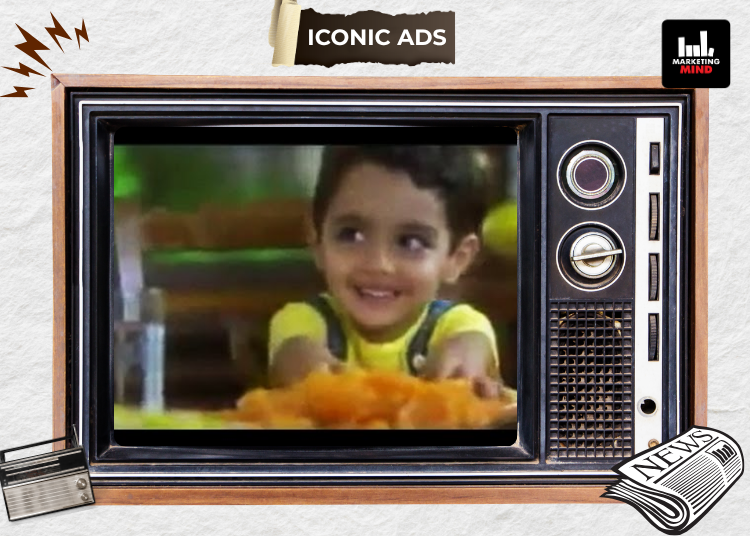
There have always been days when the world has felt dramatically unfair, when doors have been shut a little louder, when scoldings have echoed a little longer, and when running away has felt like the most cinematic solution to life’s tiniest problems. And somewhere, in the collective memory of India, one little boy has already done it for all of us.
Because long before we have drafted angry goodbye notes or packed imaginary bags, Babloo has quietly slung a tiny knapsack over his shoulder and has walked out, leaving behind not just his home, but also one of advertising’s most delicious turning points.
Created by Mudra Communications (now DDB Mudra), the Dhara “Jalebi” ad emerged from their Ahmedabad branch in the late 1980s as a masterclass in emotional storytelling. Interestingly, the script has not been written by a conventional creative, but by Jagdish Acharya, who was then the VP of Account Management.
And as legend has it, the ad has almost been something else entirely. It has originally featured kachoris, until Acharya’s mother intervened with a line so simple, it has become historic: children don’t like spicy food, and not everyone knows kachoris, use jalebi. That instinct has not just changed a script; it has shaped a cultural memory.
Directed by Namita Roy Ghose and Subir Chatterjee of White Light Moving Picture, the film has unfolded like a short story, gentle, observant, and quietly profound.
It has begun with silence. Not the peaceful kind, but the kind that sits heavy in a home where a child has decided he has had enough. Babloo, in his bright yellow t-shirt and dungarees, has walked away with all the determination his tiny frame can carry. The world has wronged him, he believes. Everyone has scolded him. No one has understood him. And so, like every great tragic hero, he has decided to leave home forever.
At the railway station, the vastness of the world has suddenly dwarfed him. He looked small, almost swallowed by the bench he sits on. And just when the story has seemed to lean toward heartbreak, it has gently pivoted.
Enter Ramu Ji, not with authority, not with reprimand, but with something far more persuasive: affection wrapped in temptation.
“Babloo! Tum ghar chhod ke ja rahe ho?” (Babloo! Are you leaving home?)
“Haan! Sab gussa karte hain.” (Yes! Everyone gets angry with me.)
And then, almost casually, like a magician revealing nothing yet everything,
“Achha… par mummy ne toh aaj ghar par jalebi banayi hai.” (I see… but your mother has made jalebi at home today.)
That one word, jalebi, has done what logic, persuasion, and authority never could.
“Jalebiii?!” In that moment, rebellion had melted. Anger has dissolved. And childhood, in all its beautiful fragility, has returned.
What follows has not just been a resolution, it has been a homecoming. Babloo has hopped onto a bicycle, joy spilling out of him, racing back not just for sweets, but for belonging. His mother’s smile has waited, warm and knowing, beside a plate of glistening jalebis.
“Toh kya teh kiya aap ne?” (So what have you decided?)
“Jana toh hai…” (I do have to go…)
And then his father joined the conversation and said, “Magar 20–25 saal baad…” (But after 20–25 years.)
And just like that, the storm has passed, not with drama, but with sweetness.
What this ad has achieved is something most brands spend decades chasing. Dhara has not sold oil. It sold a feeling, Anokhi Shudhata (Unique Purity). Not of ingredients, but of emotion. The purity of a child’s impulse. The purity of a mother’s love.
It has reminded us that sometimes, the strongest ties are not forged in grand gestures, but in the simplest offerings, a favorite sweet, a familiar voice, a home that has always been waiting.
Even today, when the word jalebi is uttered with that same wide-eyed wonder, it has carried with it the echo of Babloo’s return. The ad has not aged; it has ripened, like memory does.
Because somewhere between leaving and staying, between anger and affection, between station and home, a plate of jalebi has always been enough to bring us back.