





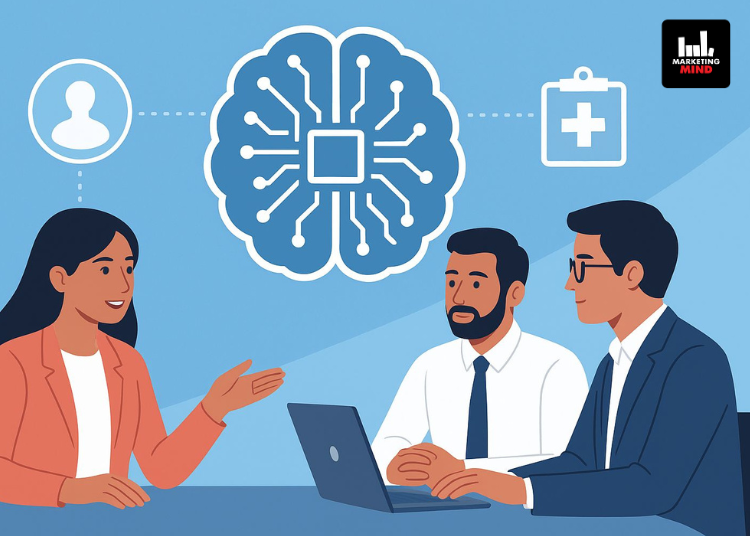
As digital engagement grows and audiences fragment across formats and devices, personalisation has become a core expectation. At CLICK 2025, the session “Real-Time Personalisation: Secret to X Engagement Personalisation at Scale!” explored how AI, predictive analytics, and human insight are shaping marketing strategies and driving engagement at scale.
The discussion was moderated by Praatiek Siingh, Director – North at Gnani.ai, and featured Dr Ashish Bajaj, Chief Marketing Officer at Narayana Health, and Brijesh Munyal, Co-founder and CEO of Ethinos Digital Marketing. Together, they shared practical lessons and real-world insights applicable across industries.
Bajaj opened the conversation by highlighting the challenges of personalising communications for diverse audiences. Using healthcare as an example, he explained that each user journey is unique, and reaching individuals meaningfully is far from straightforward.
“Healthcare for each user or there are 8,000 of us partners, which are individual and very difficult to humanise, that’s the personalisation. So if you talk about those touches, we actually work on those touches,” he said.
He illustrated how predictive AI was used with ECCs. “We have also sat down on more than 700 ECCs that we were able to predict 99% equity, which at that time ECC was looking absolutely normal, but the problem would have come from 10 years to 15 years down the line, and we were 99.3% ahead.”
Bajaj emphasised the role of human judgement alongside AI. “The effort of our internal, in-house team in terms of figuring out the right ways of utilising the technology with the power of the doctor, and with the patient,” he noted.
Munyal focused on nudging, the practice of sending timely prompts that guide users without overwhelming them. “It’s important, I think all of us appreciate nudging if we are in the buying cycle of a specific product or in a specific zone. But if it’s an old nudge, take your blood test, take your CPC test, then there is a big issue. There is a lot of intelligence in nudging. It’s a hybrid world,” he said.
Both panelists warned against over-personalisation. Bajaj illustrated how excessive familiarity or data use can backfire. “When personalisation fails, it’s going to overdo it. By overdo, I mean, of course, you know my birthday, you know what I do, you will stop,” he said.
Munyal echoed this sentiment, noting that the best-intentioned efforts can alienate users if overdone. “Whenever you overdo personalisation, it’s definitely not going to work. As a consumer, I’m not going to like it. You as a marketer might love it, but it fails if you push too much data,” he said.
Brijesh argued that traditional segmentation models are no longer relevant in India’s evolving digital landscape. “The old marketing playbook is dead where we used to define a target as a 30-year-old male or female from a certain background. Somebody who has grown up in Delhi for 40 years is very different from somebody in Bombay for 40 years — you cannot classify them as one person. It’s about subcultures now.”
He linked this to the surge of smartphone penetration and the shift brought by Jio’s entry.“With 80 crore smartphones in India, we now have to carefully find our customers. In the pre-Jio era, anyone online was an affluent customer. Post-2018, that’s no longer true; many wealthy people are busy working and not online, while others without the same affluence are actively consuming content. So we need sharper filters and parameters to really know who our customer is.”
Bajaj added that the ultimate value of personalisation lies in its ability to connect to measurable business outcomes. “The good thing is that, for instance, let’s say for us as a team, we know what our direct attribution to the business is. We don’t call ourselves marketing itself, we call ourselves marketing and growth. We take very specific accounts in terms of these types of investments,” he said.
Munyal underscored that analysis must go beyond surface metrics. “A lot of people still do observations and call it analysis. CTR going from 5% to 10% is observation, not analysis. You have to truly understand the impact, context, and timing,” he explained.
The panel discussed practical examples of campaigns where AI was used to predict audience behaviour, optimise timing, and refine messaging in real time. Bajaj stressed the importance of human guidance in this process. “Machines can generate data, but humans guide the journey, and that’s what creates meaningful engagement,” he said.
They also highlighted content timing and emotional context as critical components of effective personalisation. Bajaj shared, “We ran a brand campaign on happy content versus sad content. When I’m watching happy content, I’m digesting it. When I’m watching sad content, my brain is not open. You start seeing an ad at the wrong time, it doesn’t work,” he said.
Ultimately, the panel emphasised that successful personalisation requires a hybrid approach. AI drives scale, speed, and prediction, while human insight ensures relevance, subtlety, and authenticity. As Bajaj concluded, “You need AI to predict, automate, and optimise. But at the end of the day, humans guide the journey.”
The discussion left marketers with a clear message. Personalisation at scale is achievable, but only when technology is applied intelligently and complemented by human understanding.