



As the advertising and marketing ecosystem continues to operate in a state of flux shaped by rapid technological shifts, evolving client expectations and tighter business cycles, the 19th edition of Goafest comes at a time when industry gatherings themselves are being reassessed for relevance. Ahead of the festival, organisers have outlined the thinking behind this year’s edition, which is anchored around the theme ‘Reset for Growth’ and reflects broader conversations around how the industry is recalibrating itself across creativity, business priorities and participation patterns.
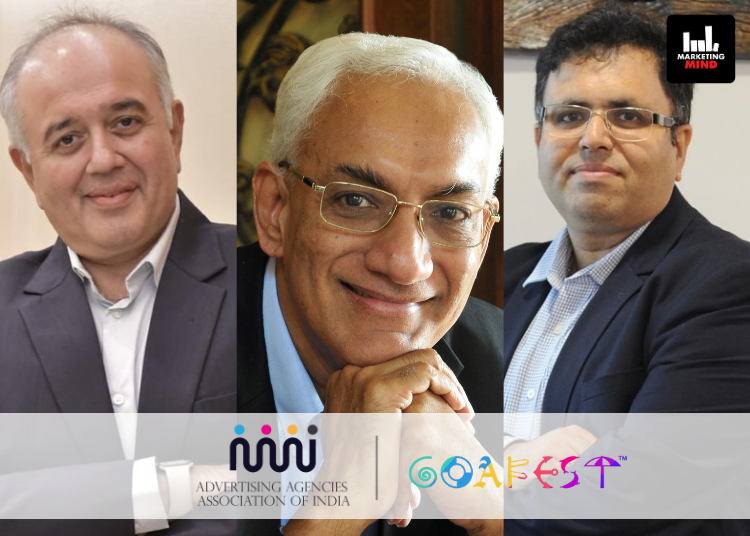
In a conversation with Marketing Mind, Srinivasan K Swamy, Executive Group Chairman of R. K. Swamy and President of Advertising Agencies Association of India; Mohit Joshi, Co-Chair of the Goafest 2026 Organising Committee and CEO, Havas Media Network India and Jaideep Gandhi, Vice President, AAAI and Chairman of the Goafest 2026 Organising Committee, explained the thinking behind this year’s theme and described “reset” less as a slogan and more as a reflection of how most organisations today are already operating.
On Goafest’s role within this changing landscape, they mentioned that the festival itself has been evolving year after year rather than remaining static, especially at a time when broader conversations in the industry have often centred on how legacy platforms need to continuously adapt to stay meaningful.
Inside the Thinking Behind ‘Reset for Growth’
Highlighting this year’s Goafest theme, ‘Reset for Growth’, Joshi said, “Essentially, if you look at it, the overall environment is extremely dynamic right now, and the industry continues to remain in a state of flux. In a rapidly changing world like this, the key question for every company is how to grow, and how to keep recalibrating targets and guidelines to ensure year-on-year growth. That, today, is the core agenda across sectors.”
In fact, companies can barely plan beyond three months now – sometimes not even beyond a month. As a result, every organisation, irrespective of the sector it operates in, requires a reset. Some of these resets are being driven by geopolitical conditions, some by climate environments, and others by the rise of AI.
Furthermore, he went on to say, “That is precisely why we felt it was absolutely important to acknowledge that in such a dynamic environment, businesses must continuously keep shifting their course in the sea to ensure they are moving in the right direction. Which is why the focus has to be on continuously resetting for growth, because growth ultimately remains the objective – without which survival itself becomes difficult.”
Adding to this, Gandhi emphasised that consumer expectations are evolving, trends are shifting, clients’ expectations from agencies are changing, and even our expectations from the media industry are transforming.
“With every aspect of the ecosystem undergoing change, a reset became necessary for all of us to come together on a common platform, align our understanding, and decide how we want to move forward. That is essentially the idea behind the reset,” he said.
Goafest 2026 will feature a packed three-day schedule with over 25 sessions, including keynote conversations, panel discussions, live performances, and special events. The festival will also host more than 12 curated masterclasses and workshops spread across two days, designed to bring deeper learning and hands-on industry insights.
The event will bring together over 50 speakers, including industry leaders, creators, marketers, media professionals, business heads, athletes, and entertainers. It will also see participation from more than 40 sponsors and partners across media, technology, digital platforms, FMCG, broadcasting, publishing, and AdTech.
On the cultural and entertainment front, performances by Sukhbir Singh and Neeti Mohan will be part of the lineup, adding to the festival experience.
Goafest 2026 will also continue its focus on industry-led initiatives and intellectual properties such as Advertising Rocks, Advertising Plays, GoaFresh, and GoaCast. Also, as part of GoaFresh, participation will include leading academic institutions such as the Indian Institute of Management Ahmedabad, Indian Institute of Management Calcutta, Indian Institute of Management Kozhikode, S. P. Jain Institute of Management & Research, Mudra Institute of Communications Ahmedabad, Symbiosis Institute of Media & Communication, Whistling Woods International, MET Institute of Mass Media, Loyola College, and Xavier Institute of Communications.
What’s Driving Delegation Interest This Year
Swamy drew attention to the last few years, highlighting a clear shift in participation patterns, with a growing presence of small and medium agencies participating in large numbers. All of this, in a way, reflects the new ecosystem that has emerged.
“Goafest today is, in that sense, a confluence of this evolving ecosystem and is no longer dominated solely by large network agencies. While there continues to be a strong participation from big network agencies, there is now an equally healthy representation from owner-driven agencies as well,” he said.
Furthermore, Swamy went on to say: “What’s also interesting is the output ratio. If you look at it, large agencies may submit around 200 entries and secure about 8 wins, whereas a small agency might submit just 8 entries and still secure 2 wins. The comparison isn’t linear because the scale is very different, but it clearly shows how the efficiency and impact ratio for smaller agencies is significantly higher.”
That’s an important shift to acknowledge – that while larger volumes may come from bigger agencies, the contribution and success ratio of smaller agencies is increasingly significant and cannot be overlooked.
Beyond Scale: What’s Really Changed at Goafest
Gandhi mentioned, “As I always say, adding scale to scale is in itself a massive challenge. This year, however, our entire focus is centered around clients. You’ll see a much stronger client presence throughout the event. More than 50 CXOs, CEOs, and CMOs from leading brands and companies will be joining us. That, truly, is the center of attraction this year.”
Offering a slightly different perspective on this, Swamy pointed out, “In my view, Goafest itself needs to evolve because the environment around us has fundamentally changed. The world we lived in five years ago is vastly different from the one we inhabit today.”
“That shift is also the reason why we decided to reset Goafest. The reset is essentially our response to a changing world and a changing environment. And in order to align ourselves with this new reality, almost every aspect of Goafest has evolved alongside it. Whether it is the scale of masterclasses, the nature of the events surrounding Goafest, or the overall experience being curated, everything today is markedly different from what it was five years ago,” he added.
Furthermore, Swamy noted that he would not call it a dramatic transformation overnight, but Goafest has certainly been evolving with the times and that, in many ways, is its biggest strength. It is not about waking up one morning and declaring it a “new and improved” Goafest. Instead, it has consistently improved year after year.
“Every edition has introduced new elements, and each year we have added another layer of differentiation to make the experience more engaging and interesting for people who come to participate in Goafest,” he noted.
What’s Driving the Dialogue at Goafest 2026
According to Gandhi, with the theme centred around ‘Reset for Growth’, the focus this year will be on reimagining creativity, brand building, sports marketing, and the rise of new sports, while covering the entire 360-degree landscape of the advertising, marketing, and media industry through the lens of reset.
“A key shift this year will also be the stronger presence of clients on stage, with more client voices and perspectives becoming a central part of the conversations and discussions,” he highlighted.
Building on his point, Joshi pointed out, “This marks a very welcome change, especially at a time when there had been growing conversations around clients not participating enough at Goafest. Addressing that has been a key focus this year, with the team actively working towards ensuring greater client involvement and much wider participation across the festival.”
The Festival’s Role Amid Industry Transformation
Swamy asserted that this year’s agenda has been designed to strongly reflect the industry’s evolving landscape, with several sessions and discussions centred around new-age technology, AI, and the broader shifts currently shaping the ecosystem.
Concerns, conversations, and opportunities emerging from the technology side have already been embedded into the agenda as well as the masterclasses being conducted during the festival.
“The masterclasses, too, are focused on addressing the current evolution the industry is witnessing, ensuring that the conversations remain relevant to today’s products, audiences, and market realities. The team has also been proactively engaging with multiple stakeholders to ensure that the festival meaningfully addresses the needs of today’s generation and the rapidly changing demands of the market,” he added.
Adding to that, Joshi underscored several initiatives that have been introduced over the years, including Advertising Rocks and Advertising Plays. But, as he mentioned, one of the most meaningful additions has been GoaFresh, which was instituted last year with a strong focus on the younger generation and emerging talent entering the industry.
He went on to say, “The initiative aims to ensure that Goafest remains relevant to the youngest generation currently stepping into marketing, advertising, and media. As part of this effort, the team has been engaging with leading institutes such as Indian Institute of Management Ahmedabad, Calcutta, and Kozhikode, SP Jain Institute of Management and Research (SPJIMR) and Mudra Institute of Communications Ahmedabad (MICA) to identify fresh talent and guide them towards opportunities within the industry.”
What began as an initiative last year has now been scaled up significantly, further strengthening Goafest’s efforts to connect with and nurture the next generation of marketing and media professionals.
Expanding on his point, Gandhi said, “This year, more than 20 institutes are expected to send over 30 students to Goafest, with the number likely to rise to nearly 40 by the time the festival begins. The initiative is being seen as a significant step towards bringing young talent closer to the industry and creating stronger learning opportunities for the next generation.”
According to him, Goafest, according to the organisers, is viewed not just as a festival but as a larger industry responsibility, especially since it is driven by an industry body.
“The larger objective is to consistently upgrade the industry through knowledge-sharing, skill development, and meaningful conversations, which is also why the masterclasses have continued to scale up over the years,” Gandhi said.
He added, “Goafest also serves as a common platform where multiple industry associations come together under one roof. In many ways, that was the original vision behind the festival when it was started by Sundar sir – to build it into a central hub for the Asia-Pacific advertising, marketing, and media ecosystem.”
When asked how brands and sponsors are approaching Goafest today compared to a few years ago, and whether the focus has shifted from visibility-led to more business-led expectations, Gandhi said, “I would describe it as partnership-led, built on collaboration at its core. There is no client on the other side sponsoring it in the conventional sense; it is entirely driven through partnerships. The underlying belief of the festival is that everyone involved is working together, as one collective ecosystem.”