






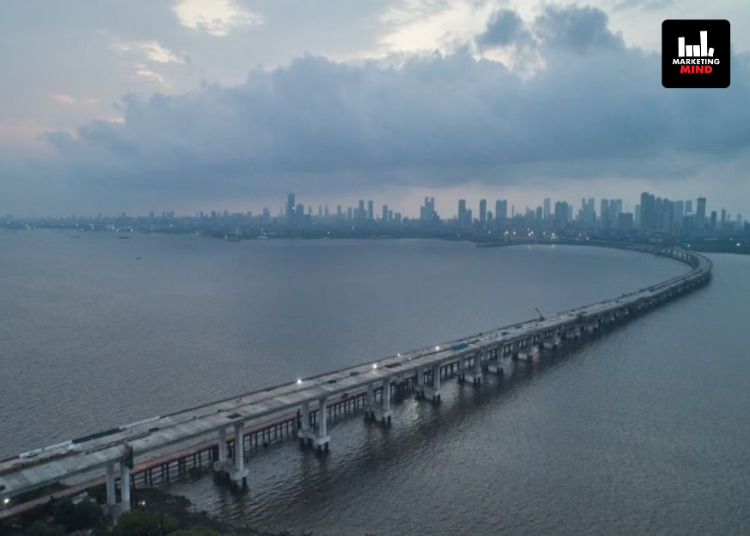
The Mumbai Metropolitan Region Development Authority (MMRDA) has explored additional revenue streams for the Mumbai Trans Harbour Link (MTHL) as traffic on the 21-km sea bridge has remained below projections. The authority has planned to monetise advertising space along the corridor and lease optical fibre cable (OFC) infrastructure to telecom and internet operators.
The authority has invited bids to monetise advertising space on hoardings and kiosks along the bridge and has expected to earn at least Rs 2.5 crore annually from the initiative, as per media reports. It has also planned to licence optical fibre cables running along the bridge to telecom and internet operators to boost non-fare revenue.
Opened to traffic in January 2024, the bridge has generated Rs 32.26 crore in toll revenue in its initial months of operation. In the financial year 2024–25, toll collections have risen to Rs 182.11 crore, while between April 2025 and December 2025 the collection has stood at around Rs 160 crore.
However, traffic volumes have remained significantly below projections. The last detailed data released by MMRDA has shown that the bridge recorded an average daily traffic of 22,689 vehicles in its first year of operation.
The sea bridge was inaugurated by Prime Minister Narendra Modi on January 13, 2024, and was expected to see nearly 40,000 vehicles per day in its first year, according to projections from a study conducted by MMRDA and the Japan International Cooperation Agency.
Officials have said toll revenue has also reflected the lower-than-expected traffic. Average daily toll earnings have been around Rs 27 lakh to Rs 30 lakh, about 30% lower than projected estimates.
Authorities have attributed the shortfall to incomplete approach infrastructure, including the Sewri-Worli Connector, the link to the Mumbai-Pune Expressway, and connectivity to the upcoming Navi Mumbai International Airport.
To augment revenue, the authority has planned to allow advertising across nearly 4,100 sq m of space on the bridge. This includes 11 illuminated hoardings measuring 40×40 feet, both digital and static, as well as nearly 1,212 smaller kiosk hoardings measuring 3×6 feet along the divider. Additional advertising space measuring 80×30 feet will also be created at toll plazas. Advertising rights have been proposed to be awarded for 10 years to the bidder offering the highest revenue share.
MMRDA has also explored monetising two 50 mm OFC ducts along the bridge, which can be leased to telecom and wireless internet providers to improve network connectivity across the corridor. Officials have not disclosed the expected revenue from OFC licensing.
Similar monetisation measures have also been explored on Metro Lines 2A and 7.
Commuters have cited high toll charges as a factor behind the lower traffic volumes, with many continuing to use the Vashi and Airoli bridges. The toll for cars on the full Sewri to Chirle stretch has been set at Rs 250, while travel between Sewri and Shivaji Nagar in Ulwe costs Rs 200.
The return fare has been priced at Rs 300, with a daily pass costing Rs 500 and a monthly pass priced at Rs 10,000. The toll for the Shivaji Nagar-Gavhan stretch has been set at Rs 50 and Rs 75 for a return trip.