





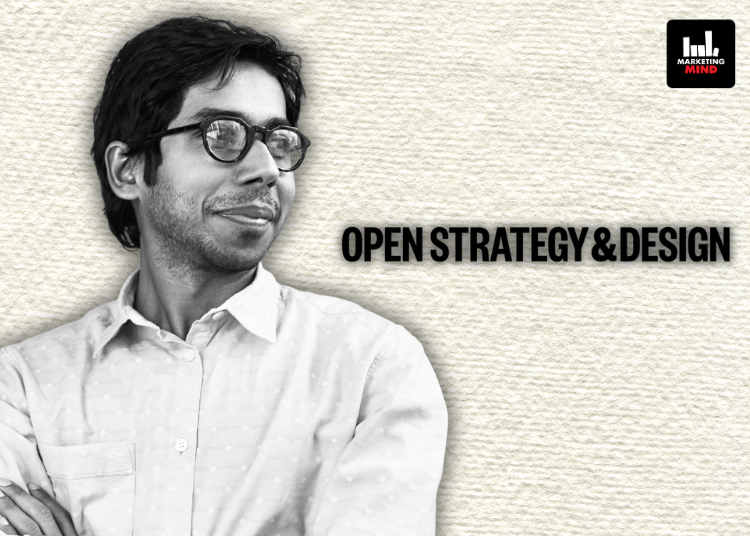
In the age of endless rebrands – where every brand’s midlife crisis begins with a new font and ends with a press release – OPEN Strategy & Design is playing an entirely different game. For them, branding isn’t a beauty treatment; it’s a brain surgery. “Strategy-first” isn’t just a principle, it’s their operating system. And if you ask Asparsh Sinha, Managing Partner at OPEN, the real magic happens way before the logo file hits Adobe Illustrator – it begins with asking why a brand deserves to exist in the first place.
Because let’s be honest – in today’s attention-deficit market, better isn’t better anymore. Different is. And OPEN’s belief in that has quietly shaped some of the most interesting brand transformations in India’s luxury and lifestyle space.
From decoding why mass brands are eyeing the “missing middle” to turning rebrands into full-blown business resets, the firm doesn’t just create visual identities – it builds conviction.
In this conversation, Sinha unpacked what “strategy-first” truly means in practice – the why-before-what mindset that separates timeless brands from forgettable ones. From rethinking legacy names to designing for a generation that scrolls faster than it remembers, he shared why the best brands aren’t made to look new – they’re made to matter.
OPEN calls itself a ‘strategy-first’ design company – how does this philosophy play out in the earliest stages of a project?
Essentially, there’s a difference between the business of design and what we do as a brand consultancy. The business of design often focuses on obsessing over visual identity- logos, names, packaging. But for us, the starting point is very different. We are not just asking what the visual identity of a brand should be; we are asking why this brand- whether new or undergoing a rebranding- will succeed in the market.
That question of why doesn’t begin with stats, it begins with business. For instance, if I’m helping Ananya Birla enter fragrances or cosmetics, the first step is to identify the real opportunity in that category. We then form a differentiated point of view on the category itself, which gives us conviction that the brand will work. This is where brand design diverges from visual design- because brand design is first about strategy, point of view, and clarity on what exactly we are building in the market.
I’m not starting with “What will the logo look like?” or “What should the brand name be?” I’m starting with “Why should this brand exist?” Once that is clear, everything else- visual identity, packaging, retail or online experience, communication, even go-to-market strategy- flows from that foundation.
Internally, our philosophy is simple: better is not better, different is better. Much of marketing falls into the incremental game of trying to prove superiority- “I’m better at this”- which rarely creates a breakthrough. But when you enter a category with a differentiated starting point and a distinct perspective on what you’re building, every effort works harder and delivers greater impact. That is what we mean by strategy first.
What kind of brands do you mostly work with?
We have done extensive work in the luxury and premium lifestyle space, which began almost by accident since some of our earliest clients were jewelry brands. Over time, we realised our timing was right, as India has become- and will continue to be- a market driven by premiumisation. As a result, many brands now approach us whenever they want to upgrade or elevate themselves.
India is still a very nascent market, and in the coming decade the real story will be about the “missing middle.” Most Indian brands have traditionally operated in the mass and mass-premium segments, because that’s where the volumes have been.
On the other end, luxury is largely dominated by global brands. But there’s a growing section of consumers who want more than mass yet not as premium as luxury. This space of accessible luxury is where the action will unfold, and you’ll see category after category tapping into it.
What sets you apart from your competition?
Most of marketing today, especially digital marketing, is very reactive. It often feels like a constant race to copy each other.
This happens largely because there is no differentiation at the source. For example, if you were doing digital marketing for Apple, you would know exactly what to do because you understand what Apple as a brand stands for. Apple has clarity in its tone of voice, body language, and visual language, which sets it apart.
But when marketers don’t have something fundamentally different to guide them – which is the brand itself – it isn’t really their fault if they end up copying each other. The result is a lot of noise, with everyone saying and doing the same thing.
What’s the biggest misconception clients have when they come to you for a rebranding?
Many people think rebranding is just about changing the logo, colour, or typography. For them, it’s a cosmetic job- branding as something superficial, like cosmetics. But in reality, branding defines the very operating system of a company. It sets the direction for everything. Once that direction is clear, it answers fundamental questions- what business we are in, what we should be called, how we should look, what the retail experience should feel like, and even the kind of people who should work with us.
That’s how modern global brands operate. Take Airbnb, for instance. It’s one of the best case studies of a brand being placed at the center of everything. In the company’s early days, when its idea was copied in Europe, they had to build a team there overnight. Since tourism without Europe is incomplete, it was critical. At that moment, CEO and founder Brian Chesky gave his team a one-line brief: “We want missionaries, not mercenaries.” That single line shows the clarity of thought a brand must have.
Branding, therefore, isn’t just about Airbnb’s logo- it’s about the story and clarity behind it.
Why are more brands revisiting their logos and identity systems today?
Many legacy brands were built in an era when marketing worked very differently. Brands like Amul grew in a time with less clutter, TV-led communication, and emotionally driven storytelling, which allowed them to establish very strong equity. That luxury is not available to newer brands today.
In the current landscape, building a brand is far more difficult- you’re competing for seconds and even milliseconds on digital media. Adding to the challenge, digital marketing is heavily skewed towards performance and conversions, so most spends go into those areas. As a result, creating memory and building strong brand equity becomes an uphill task.
This is why sharper branding has become critical. We often tell clients, especially D2C founders, that while they work extremely hard to build their businesses, much of their money actually fuels platforms like Facebook, Google, Amazon, or retail aggregators. The problem is that these platforms control the algorithms, and any change can directly impact sales. In such cases, founders are essentially working at the mercy of these landlords.
What they often overlook is the only real “free media” they own- their brand. That is the one asset that cannot be taken away. But because digital sales are seductive and results seem immediate, founders tend to ignore long-term brand building. The truth is, the tap can be turned off anytime, and digital ROI is already declining as competition grows and effectiveness goes down. It’s like being on a treadmill- constantly running but not building anything sustainable.
This is also why many companies turn to rebranding, hoping a sharper identity can help create memory when their marketing struggles to do so. In the golden age of FMCG, metrics like TOM (top-of-mind recall), top-three brand mentions, and share of voice gave marketers clear indicators. Today, that clarity is gone, making the game much tougher. The belief now is that a logo or visual identity must serve as a “holder of meaning.” But if there is no meaning behind it, then no matter how much you change the logo, nothing substantial will happen.
How to get rebranding right?
So, the first question has to be very simple: why are we doing this? The basic question is whether a rebrand is needed – what problem are we solving?
Take the Cafe Coffee Day rebranding as an example. The brand was built when the category was nascent. It created aspiration and introduced the idea of cafes in India as cool social hangouts. But with Starbucks and the rise of indie/specialty players, the benchmark for experience and what a brand can be has shifted. The category has evolved and the consumer now has very different expectations. Yesteryear’s answer is no longer exciting – and that’s a genuine reason to rebrand.
Fifteen or twenty years ago there was a clear reason to choose Cafe Coffee Day. Put a Cafe Coffee Day, a Starbucks and a Third Wave side by side and pricing is not a factor anymore. The core problem is: there needs to be a good answer today. We need a new, compelling answer.
So how do we find it? First, understand the category as it is today: map who’s playing where and the strengths of each player. Treat the brief almost like creating a new brand – identify a space that can be uniquely ours. Then validate that space against cultural and consumer shifts to see if it’s the right move. I won’t touch visual identity or the new experience until that answer is nailed down. The test is simple: tell me an answer that, if I hear it, makes me want to go back – if it passes that test, we start changing things.