






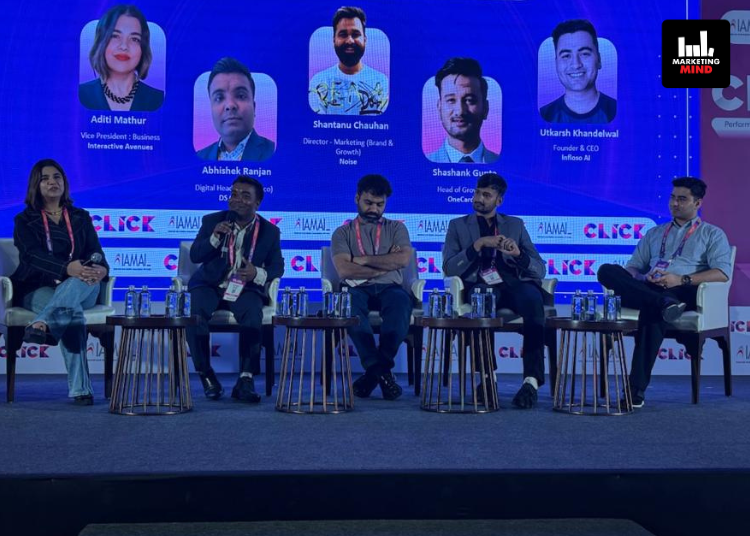
On day two of CLICK 2025, when the conference spotlight shifted to emerging technologies in marketing, the panel on “AI-powered content creation: Reinventing storytelling in digital advertising” drew one of the largest audiences of the event.
Moderated by Aditi Mathur, VP – Business at Interactive Avenues, the session brought together voices from across the marketing spectrum: Abhishek Ranjan, Digital Head at DS Group; Utkarsh Khandelwal, Founder and CEO at Infloso; Shantanu Chauhan, Director of Marketing (Brand and Growth) at Noise; and Shashank Gupta, Head of Growth at OneCard.
What emerged was a vivid portrait of AI’s dual role: a tool for efficiency and experimentation, and a canvas for narrative expansion. But one theme ran through the conversation: technology may accelerate content, but it cannot replace human judgment.
For Ranjan, AI began as a productivity tool but quickly became a creative partner. “When we first started experimenting, the expectation was simply efficiency. Automating routine creative tasks, generating variations faster- that was the entry point,” he said. “But very quickly we realized that the bigger value is not in saving time, it’s in reimagining the narrative itself.”
Ranjan described how AI allows DS Group to produce hundreds of personalized ad variants across languages, tones, and emotional appeals. “Earlier, you had a TVC and maybe one or two digital edits. Now, with AI, I can have hundreds of personalized versions—different languages, different tones, even different emotional appeals. It is like telling the same story a thousand different ways, each one tuned to the person watching.”
Yet he stressed the human check remains essential: “At the end of the day, advertising is about human emotions. Machines can generate, but they cannot feel. So we constantly ask: is the output meaningful? Does it resonate? That check has to stay with the marketer, not the algorithm.”
Khandelwal framed AI as a bridge between creators and brands in a high-speed ecosystem.
“We are in an ecosystem where a creator can shoot, edit, and publish content in minutes. For brands, the expectation of speed is the same,” he said. “AI helps us bridge that. From predicting which influencer’s content will resonate to auto-generating campaign creatives, we are able to match brand briefs with creator outputs faster than ever.”
Infloso uses AI to analyze performance and forecast outcomes. “If a brand wants to target Gen Z in Tier-2 cities with an aspirational lifestyle narrative, we can not only suggest the right creators but also generate sample content frameworks in minutes. That gives both sides—brand and creator- more confidence before the first rupee is even spent.”
But Khandelwal warned that AI cannot manufacture authenticity: “The biggest challenge we face is authenticity. An AI can tell you what format works best or even draft a script, but if the influencer does not believe in the message, the audience sees through it instantly. So our philosophy is AI for speed, humans for soul.”
For Noise, the challenge is standing out in a category where new products launch every quarter. Chauhan explained how AI enables testing of narratives before campaigns go live.
“AI can simulate how different hooks perform across different cohorts. Does a performance angle work better for young professionals? Does a lifestyle aspiration work better for students? This insight allows us to spend our media dollars more effectively,” he said.
He also highlighted cost efficiencies. “Earlier, we were limited by the budget of one big hero film, a few edits. Today, I can have hundreds of micro-stories running in parallel. Each one is crafted to feel personal. And because it’s AI-assisted, the cost doesn’t balloon. In fact, it often comes down.”
Chauhan added a note of caution: “The real craft lies in choosing which stories to tell and when. That curation is still human.”
For Gupta, marketing in fintech is about trust and relevance.“Financial products are trust-driven. You cannot blast generic ads and expect users to sign up for a credit card. Every message has to be relevant, timely, and compliant. AI gives us the ability to deliver that at scale,” he said.
OneCard leverages AI for dynamic personalization: “If a user is exploring travel spends, they will see content about our offers on flight bookings. If someone is focused on rewards, the story shifts to cashback. This is not just retargeting—it is narrative personalization in real time.”
Compliance is central: “In fintech, you cannot afford to make a misstep with messaging. AI helps us run checks for tone, language, even potential bias, before the content goes live. It is like having a built-in compliance partner.”
Gupta emphasised outcomes: “At the end of the day, if the content does not lead to action, it has failed. AI helps us move closer to that action by ensuring the right story reaches the right person at the right time.”
Moderator Mathur concluded that AI is no longer an isolated tool; it is now embedded across the creative workflow, from idea generation to execution to compliance.
“Machines can generate, but they cannot feel,” Ranjan had said. For marketers, the takeaway is clear: AI can accelerate storytelling and expand scale, but the story itself remains human.
Across industries, the conversation at CLICK 2025 day 2 highlighted a common thread: brands that combine technological leverage with human judgment will be the ones to tell richer, more resonant stories in an era of infinite content.