






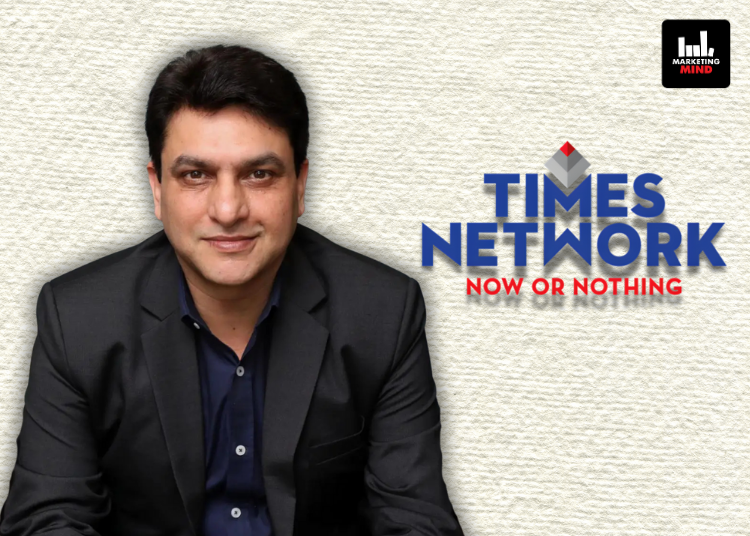
For years, the media industry has been caught in the television-versus-digital debate, but as audiences splinter and advertisers prioritise outcomes over platforms, that question has lost relevance. Against this shifting landscape, Ashish Sehgal, the newly appointed CEO of Times Television Network and Chief Growth Officer at Times Media and Entertainment, shared how the network is reimagining growth, content strategy and credibility.
“There is no competition between TV and digital,” Sehgal said early into the interaction, setting the tone for what lies ahead. “It’s a collaboration. It’s an and world. The consumer is sitting everywhere.”
That consumer-first philosophy underpins Sehgal’s vision for the network. Drawing from his experience across entertainment, news, and large-scale media businesses, he believes the future lies in one integrated newsroom, a single editorial engine that creates content once and disseminates it intelligently across platforms.
“If the consumer has to be addressed, you have to use multiple platforms rather than one,” he explained. “The idea is how do we create one single newsroom which addresses across platforms, and that content is disseminated to various platforms in the way it should be.”
According to Sehgal, the strategy itself isn’t new, it’s the emphasis that is. “The strategy is not new. We are just emphasising it in our way,” he said. “My experience earlier will help bring all platforms together and synergise content across them.”
He illustrated this with a simple but powerful content logic: “You can create a long-form narrative on television. Within that, there are high points that can go on social media. YouTube consumers may want even more elaboration. So you create the same content, but for different platforms.”
From Mass Entertainment to Thought Leadership
Sehgal’s move from a largely entertainment-led environment to a news-first organisation does require a shift in mindset, but not a reinvention.
“I have handled newsroom businesses earlier as well, so it’s not very new for me,” he said. “But yes, there is a mindset shift in how you look at content, content creation, and running the overall P&L.”
He pointed out a fundamental difference: “In entertainment, you are talking to a mass consumer. In news, you are talking to thought leaders, opinion makers.” As a result, the nature of content changes. “Here, the content is more advocacy-driven rather than advertisement-driven.”
What remains common, however, is the importance of understanding the consumer. “The biggest insight is consumer mindset and consumer behaviour,” Sehgal said. “In entertainment, a lot of consumer studies go into content creation. In newsrooms, many times the narrative starts from a journalist’s point of view, not the consumer’s.”
At the same time, news carries a heavier responsibility. “Whatever you say today becomes the narrative for tomorrow,” he noted. “That responsibility has to be taken very seriously. Newsrooms are not just content creators; they are trend creators and the fourth estate.”
That responsibility extends to digital as well. “TV is regulated, digital is not,” he said. “So how do we create credibility even on digital platforms? That is the endeavour of Times Network today.”
Elections, Economics and the Role of News
With 2026 shaping up to be an election-heavy year, Sehgal acknowledged that elections are good for news channels, but with a caveat.
“Yes, elections are good for news channels,” he said. “But the responsibility is even bigger. You have to take the government’s agenda to the consumer and the consumer’s voice back to the government.”
Platforms like India Economic Enclave play a crucial role in that ecosystem. “These forums help set the agenda for budgets and policy-making,” he said. “It becomes our responsibility to take the good parts and the bad parts of government policy to the consumer and create a balance.”
Commercially, elections bring spending, but Sehgal believes the real opportunity lies in insight. “When you sit in a newsroom and understand policy, you get an insight into which sectors and industries will move,” he explained. “That helps us engage those industries better.”
Reach, Relevance and Revenue
When asked about the classic media trinity- reach, relevance and revenue- Sehgal returned to his core belief.
“Reach will come from one single newsroom and how that content is disseminated across platforms,” he said. “We are not restricted to TV reach anymore. We are addressing digital reach, demographics, and psychographics.”
But revenue, he stressed, must come with responsibility. “There will be a lot of money available,” he said. “But revenue generation has to come from responsibility as well.”
On TRPs and Right Journalism
Sehgal didn’t dismiss ratings, but he refused to be defined by them.
“TRP is important,” he said. “We will not ignore it. But we will not sell our business only on the basis of ratings.”
What matters more is what the network stands for. “As Times Network, we stand for credibility and right journalism,” he said. “That is what we will showcase to advertisers as well. And many advertisers already support us for that, not just for ratings.”
When asked to define right journalism in one phrase, Sehgal didn’t hesitate. “Voice of the nation,” he said. “If you are the voice of the nation, you are talking for everybody.”
Beyond Ratings: The Experiential Economy
Sehgal is also clear that growth today lies beyond FCTs and ratings. “Life is totally beyond FCT and ratings,” he said. “The event you are attending today is beyond ratings.”
He sees enormous potential in Times Group’s experiential and IP-led ecosystem. “The experiential economy under the Times umbrella is huge,” he said. “From the Global Business Summit to the India Economic Conclave, there is a lot to be done.”
At the same time, he approached his new role with humility. “I have come to Times because I am learning,” Sehgal said. “I will bring my expertise to do it better- but there is already a lot being done here.”
As the conversation wrapped up, one thing became clear: Ashish Sehgal’s vision isn’t about disruption for the sake of it. It’s about integration, responsibility, and credibility, with the consumer firmly at the centre.
And if his philosophy holds true, the future of Times Network won’t be defined by platforms at all, but by purpose.