






Marketing Mind
Newsletter
  • Home
  • Advertising
  • Marketing
  • Media
  • Business
  • What’s Buzzing
  • AdAura Awards
  • More
    • All
    • Case Studies
    • Celebrating Women Leaders
    • Guest Posts
    • Podcast and Video
    AI Didn't Change What Agencies Make, It Changed What They're For

    AI Didn’t Change What Agencies Make, It Changed What They’re For

    The Hunger To Keep Improving Is What Drives Me: Jitika Gupta

    The Hunger To Keep Improving Is What Drives Me: Jitika Gupta

    Campaigns Don't Build Brands, Customers Do

    Campaigns Don’t Build Brands, Customers Do

    How AI Agents Are Helping Brands Run Hyper-Local Campaigns At Scale

    How AI Agents Are Helping Brands Run Hyper-Local Campaigns At Scale

    Confidence Is Something You Build By Doing Things That Scare You: Priyanka Arora On Embracing Uncertainty

    Confidence Is Something You Build By Doing Things That Scare You: Priyanka Arora On Embracing Uncertainty

    Why Global Pop Culture Is The New Local Marketing

    Why Global Pop Culture Is The New Local Marketing

No Result
View All Result
  • Home
  • Advertising
  • Marketing
  • Media
  • Business
  • What’s Buzzing
  • AdAura Awards
  • More
    • All
    • Case Studies
    • Celebrating Women Leaders
    • Guest Posts
    • Podcast and Video
    AI Didn't Change What Agencies Make, It Changed What They're For

    AI Didn’t Change What Agencies Make, It Changed What They’re For

    The Hunger To Keep Improving Is What Drives Me: Jitika Gupta

    The Hunger To Keep Improving Is What Drives Me: Jitika Gupta

    Campaigns Don't Build Brands, Customers Do

    Campaigns Don’t Build Brands, Customers Do

    How AI Agents Are Helping Brands Run Hyper-Local Campaigns At Scale

    How AI Agents Are Helping Brands Run Hyper-Local Campaigns At Scale

    Confidence Is Something You Build By Doing Things That Scare You: Priyanka Arora On Embracing Uncertainty

    Confidence Is Something You Build By Doing Things That Scare You: Priyanka Arora On Embracing Uncertainty

    Why Global Pop Culture Is The New Local Marketing

    Why Global Pop Culture Is The New Local Marketing

No Result
View All Result
Marketing Mind
No Result
View All Result
Home Media

Commerce Will Become Media’s Third Revenue Stream: JioStar’s Kevin Vaz As Indian Ad Market Faces Pressure

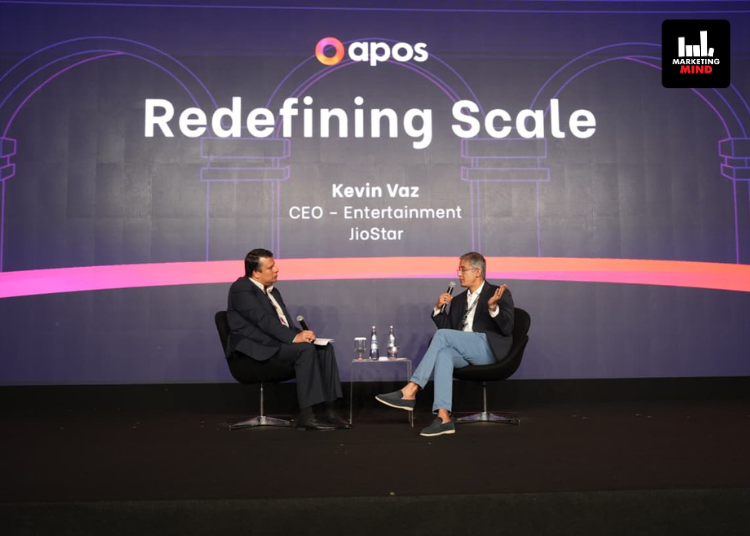
At APOS 2026, Kevin Vaz, CEO - Entertainment, JioStar, discussed why scale is no longer defined by audience reach alone, how technology and content are converging, the rise of commerce as a revenue stream, and what the future of entertainment looks like in a multi-screen, AI-driven world.

MM Desk by MM Desk
June 17, 2026
in Media
A A
Commerce Will Become Media's Third Revenue Stream: JioStar's Kevin Vaz As Indian Ad Market Faces Pressure

For much of the streaming era, success in media has been measured by scale. Subscriber milestones, monthly active users, viewing hours, and market share became the metrics that defined winners and losers. As platforms raced to attract larger audiences, scale often came to mean one thing: reach. 

But as the industry matures, that definition is beginning to evolve. In markets where audiences consume content across multiple screens, formats, and languages, the challenge is no longer simply attracting viewers. Rather, it’s keeping them engaged, serving them personalised experiences, and creating new ways for them to interact with content.

That shift formed the backdrop of a fireside chat titled ‘Redefining Scale’ at APOS 2026, where Kevin Vaz, CEO of Entertainment at JioStar, shed light on how the industry’s understanding of scale is changing. 

India’s media landscape offers a unique lens through which to view this transition. Home to more than 1.4 billion people and one of the world’s most dynamic streaming markets, the country has become a proving ground for new models of content consumption. 

Against this backdrop, Vaz reflected on the journey of JioStar since the merger of JioCinema and Disney+ Hotstar in November 2024, and what that experience has taught him about building at scale.

“What they don’t understand, what they don’t see, is the complexity,” Vaz said. “We are getting two highly successful companies together, each with their own technology, content, consumer base, and cultures, and bringing them together.”

Within three months, the two services were consolidated into JioHotstar, creating one of the world’s largest streaming platforms.   

Rethinking scale in the streaming era

Today, JioHotstar reports more than 500 million monthly active users, over a billion app downloads, and 260 million paid subscriptions. It also claims 100% pin-code coverage across India.   

Yet Vaz was quick to steer the conversation away from metrics alone. “Scale is not about how many people you reach. Scale is defined as what is the impact you have on people’s lives after you reach them,” he noted. 

For him, the bigger achievement has been creating a seamless experience across a vast content ecosystem. 

“A consumer got access to nearly 300,000 hours of content,” he said, “and they got it in a very seamless manner, in the way they wanted it, and consumed it on the screen that they wanted.”

Technology as a growth driver

The conversation then turned to a question many media companies are grappling with: are they content businesses powered by technology, or technology businesses that happen to distribute content? 

For Vaz, the distinction is increasingly irrelevant.

“The distinction behind looking at JioStar as a technology or a content company — those lines have blurred,” he said. “Clearly, for us, we see JioStar as a technology company that also delivers content.”

While storytelling remains the foundation of entertainment, technology is becoming essential to how stories are discovered, distributed, personalised, and experienced.

“Storytelling will always be at the core of everything that we do. But it will require technology to make sure how this storytelling is transmitted, personalised, experienced — and how you do this at scale.”

That thinking has informed JioStar’s investments in AI-powered discovery, its partnership with OpenAI, and the development of new content formats designed for evolving consumer habits.

From the sofa to the checkout

If technology is changing how audiences consume content, commerce could change how media businesses monetise it.

One of the most animated parts of the discussion centred on the convergence of entertainment and transactions. According to Vaz, the industry is moving beyond an era where advertising and subscriptions are the only meaningful revenue streams.

“The industry has always had just two revenue streams — advertising and subscriptions. Commerce is something we think would be a really big third revenue stream as we go forward.”

He argued that audiences increasingly want to engage with content beyond simply watching it.

“Engagement is not only about this passive viewing of content. Today, engagement is about coming, following your stars, interacting with them, posting memes, trying to understand more about the characters you love. And lastly, it’s also about trying to see how you get into commerce.”

JioStar has already tested that proposition through integrations that allow sports viewers to order food via Swiggy and Instamart without leaving the platform, alongside experiments in shoppable entertainment and branded commerce experiences.

A multi-platform consumption model 

Underlying many of these initiatives is Vaz’s long-held belief that India is an “AND” market.

Consumers do not choose between television and digital, long-form and short-form, or mobile and connected TV. Instead, they move fluidly between them throughout the day.

“From a consumer point of view, he comes to get entertained,” Vaz said. “He could come and watch a movie with his family in the morning. Immediately after that, in his free time, watch something on his vertical. In the evening, come and watch a match.”

Connected television has emerged as one of the fastest-growing segments of that ecosystem, with JioHotstar now reaching more than 85 million connected TV homes.

The launch of Tadka, JioHotstar’s micro-drama offering, reflects the same philosophy. Designed for mobile-first consumption, the format attracted close to 100 million users within weeks of launch, according to Vaz.

From passive viewing to active engagement  

As the conversation drew to a close, Vaz was asked what entertainment might look like five years from now. 

While acknowledging the difficulty of predicting the pace of technological change, he was clear on one point: audiences will become increasingly active participants rather than passive viewers.

“The future of entertainment is not passive,” he said. “Entertainment will change from being a passive consumption to being a much more active, involved consumer.”

In that future, content, commerce, community participation, gaming, and social interaction will become increasingly interconnected. Consumers will not simply watch, but they will engage, interact, transact, and participate within the same ecosystem.

For Vaz, that evolution brings the conversation back to where it began. The future of scale will not be determined solely by how many people a platform reaches, but by how deeply it becomes embedded in their everyday lives.


Related Posts

Digital Policy, Cyber Security, OTT Platforms, Content Moderation, IT Rules, Online Safety, Data Protection, Internet Regulations, Digital Education, Cyber Hygiene
Media

Govt Disables 50 OTT Platforms Over Obscene Content Violations

by MM Desk
July 23, 2026

The Government has disabled 50 OTT platforms for public access in India over the last two years for displaying obscene...

Centre Mandates Faster Takedown Of Child Sexual Abuse Content On Social Media
Media

Centre Mandates Faster Takedown Of Child Sexual Abuse Content On Social Media

by MM Desk
July 23, 2026

The Government of India has reinforced its digital safety framework by tightening compliance requirements for social media platforms and other...

Latest

Mehak Jaini Joins McDonald's India (West & South) As Head Of Marketing

Mehak Jaini Joins McDonald’s India (West & South) As Head Of Marketing

July 23, 2026
When The Streets Speak, Should Brands?

When The Streets Speak, Should Brands?

July 23, 2026
Digital Policy, Cyber Security, OTT Platforms, Content Moderation, IT Rules, Online Safety, Data Protection, Internet Regulations, Digital Education, Cyber Hygiene

Govt Disables 50 OTT Platforms Over Obscene Content Violations

July 23, 2026
Centre Mandates Faster Takedown Of Child Sexual Abuse Content On Social Media

Centre Mandates Faster Takedown Of Child Sexual Abuse Content On Social Media

July 23, 2026
Every marketer talks about building awareness, few have to build it without talking about the product. India's alcobev industry has spent decades navigating that paradox. Direct product advertising isn't permitted, making surrogate advertising only one part of the marketing equation. The bigger challenge has always been earning something no media budget can buy: consumers who become advocates for the brand. For Debasree Dasgupta, Chief Marketing Officer, Pernod Ricard India, that's the category's biggest truth. “Consumers will always be your biggest advertisers,” she said. It's a philosophy born out of necessity. But it has also shaped how alcobev brands think about marketing itself. “The principles of marketing are the same whether it's personal care, beauty or alcobev. What changes is the complexity.” That complexity, according to Dasgupta, isn't just about navigating regulations. It's about understanding consumers, managing a diverse portfolio, and ensuring brands continue to grow despite having fewer traditional marketing levers than almost any other consumer category. India remains one of the world's most tightly regulated alcohol markets, where brands have to navigate different state regulations, on-trade and off-trade ecosystems, and restrictions on advertising products directly. For marketers, that has meant learning an entirely different language of brand building. Marketing hasn't changed, The rulebook has Dasgupta's own career has prepared her for exactly that. Rather than following a straight path, she has moved across FMCG, health and hygiene, beverages and now alcobev, picking up different lessons along the way. “I think the beauty is that I didn't have a linear career path, and I think it was very deliberate and intentional.” Each company, she said, has added a different layer to her understanding of marketing. “Unilever taught me to be extremely consumer-centric and always keep the consumer at the heart. Reckitt taught me commercial discipline, that marketing needs to lead to commercial and business growth. PepsiCo was about how brands stay relevant in culture.” Bringing those experiences together at Pernod Ricard has reinforced one belief. “The principles of marketing remain the same.” The environment, however, certainly doesn't. While referring to India as one of the markets where alcohol advertising is prohibited, she said, “The regulatory landscape is quite complex. That's the piece that one needs to wrap their minds around as you navigate and ensure that you're able to drive business growth.” That complexity extends well beyond regulation. “At a portfolio level, it's important for us to understand what is delivering the present and what will deliver tomorrow,” she said. “Where is growth coming from today, and where will growth come from in the future?” When consumers become the media channel Perhaps the biggest difference between alcobev and traditional consumer goods lies in how brands create awareness. Unlike an FMCG company, Pernod Ricard cannot advertise its alcohol products directly. “So the disadvantage that we have versus CPG is we cannot advertise products,” Dasgupta said. “We are in compliance with the guidelines that exist today.” Instead, the company builds visibility through compliant brand extensions such as packaged drinking water, while investing in passion points like cricket, music and digital platforms. “For us, the brand extension is a compliant business in itself and we can advertise that. We continue to double down on social, digital and influencer marketing for those businesses.” Furthermore, Dasgupta went on to say, “What we rely on is on-premise advocacy. We rely on sampling. We ensure that our liquids are extremely high quality so that when the moment of truth happens, consumers really love the product.” That has also meant new launches take longer to build. “Awareness build-up is much slower because consumers discover the product at the point of sale. That's very different from an FMCG brand.” Which naturally raises another question: if brands can't advertise products, who does the selling? “The consumers will always be your biggest advertisers,” Dasgupta said. “If you walk into an outlet and see someone drinking, it gives you confidence in the brand.” Word of mouth, she believes, becomes one of the category's most powerful marketing channels. “In a category where you can't advertise the product, consumers become your champions.” That consumer-first philosophy also shapes how global brands are adapted for India. For marketers outside the alcobev industry, the constraints may seem daunting. For Dasgupta, they've simply reinforced a timeless lesson. When the product can't do the talking, the brand, and ultimately the consumer, has to.

Consumers Are Our Biggest Advertisers: Pernod Ricard India’s Debasree Dasgupta On Surrogate Advertising

July 22, 2026
ANHAD Group Appoints Adil Altaf As CEO To Lead Real Estate Vertical

ANHAD Group Appoints Adil Altaf As CEO To Lead Real Estate Vertical

July 22, 2026
Facebook X-twitter Instagram Youtube Linkedin
Discover the latest trends in Marketing, Advertising, Startups & Media.​
  • About Us
  • Millennial Achievers
  • Contact Us
  • Privacy Policy
  • Become a Guest Contributor
  • About Us
  • Millennial Achievers
  • Contact Us
  • Privacy Policy
  • Become a Guest Contributor

To Advertise & Collaborate With Marketing Mind, Contact Us Here.

Subscribe to our newsletter for exclusive content.

By continuing you agree to our Privacy Policy & Terms & Conditions


©2026 All rights reserved. Digi Giant LLP

To Advertise & Collaborate With Marketing Mind, Contact Us Here.

Subscribe to our newsletter for exclusive content.

  • About Us
  • Contact Us
  • Become a Guest Contributor
  • Terms & Conditions
  • Privacy Policy
Facebook X-twitter Instagram Youtube Linkedin

©2024 Copyright. RVCJ Digital Media Pvt Ltd

Welcome Back!

Login to your account below

Forgotten Password? Sign Up

Create New Account!

Fill the forms bellow to register

All fields are required. Log In

Retrieve your password

Please enter your username or email address to reset your password.

Log In
No Result
View All Result
  • Home
  • Advertising
  • Marketing
  • Media
  • Business
  • What’s Buzzing
  • AdAura Awards
  • More

© 2026 All rights reserved. Digi Giant LLP

This website uses cookies. By continuing to use this website you are giving consent to cookies being used. Visit our Privacy and Cookie Policy.