





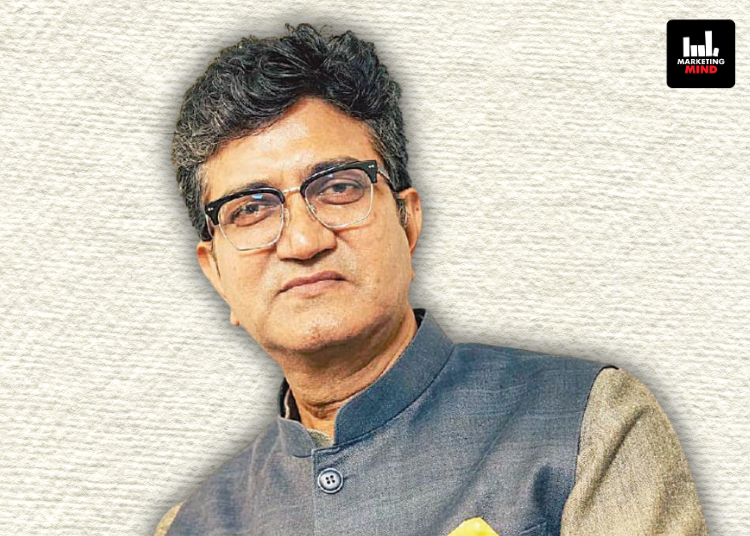
There have been interviews, and then there have been conversations that arrived with the quiet intimidation of legacy. Sitting across Prasoon Joshi, Chairman, Omnicom Advertising, India and Chairman Prasar Bharti at Goafest 2026 has felt somewhat like standing before a living anthology of Indian advertising itself, one that has shaped not just campaigns, but collective memory.
The man who once made an entire nation hum “Thanda Matlab Coca-Cola”, who has lent emotional cadence to some of Indian cinema’s most soul-stirring lyrics, and who has continued to straddle poetry, policy, storytelling, and advertising with unnerving ease, has still spoken with the curiosity of someone perpetually fascinated by people.
And perhaps that has been why his answers have not arrived wrapped in jargon or trend forecasts. They have arrived like distilled observations. Sparse, precise, and quietly expansive.
Having taken charge of the unified Omnicom Advertising Group in India, a move widely regarded as one of the most consequential leadership developments following the Omnicom–Interpublic Group merger, Joshi found himself steering an even larger creative ecosystem at a time when the advertising world has been undergoing profound reinvention. Yet, despite the scale of the responsibility, the essence of his worldview has remained rooted in emotion, culture, and human truth.
When asked to describe advertising in 2026 in a single word, his response has been strikingly economical.
“Transformation.”
No embellishment. No sermonising. Just one word carrying the weight of an industry currently negotiating algorithms, fractured attention spans, synthetic creativity, and an audience increasingly allergic to pretence.
And yet, for someone who has witnessed advertising mutate across decades, Joshi has not sounded cynical about where the business is headed. If anything, his observations at Goafest 2026 have revealed an unusual optimism, particularly about the generation entering the industry today.
Reflecting on the atmosphere at this year’s festival, he added, “Vibes are very young, which I like. I did a session with youngsters and there were so many fresh questions in their head.”
That fascination with curiosity has been telling. In an ecosystem where AI-induced anxiety has practically become its own subculture, Joshi appeared more interested in how young professionals are responding to disruption than in the disruption itself.
“Also, once I have seen the fear of AI, and what I like in youngsters, they are basically looking for the opportunity,” he added. “There is no dystopian or utopian here. It’s an optimistic view, which is there in them, which is great.”
“Genuine emotions and authenticity is what is going to be the future,” he said. “People will look for what is more genuine, what is more authentic. Even other ways of information are going to go through that phase. That’s what is going to happen.”
For an industry increasingly engineered around optimisation dashboards, virality templates, and algorithmic mimicry, the statement has almost sounded rebellious. Joshi’s career itself has repeatedly demonstrated that campaigns endure not because they are loud, but because they are emotionally truthful. Whether through rural-rooted storytelling for Coca-Cola, socially conscious narratives for Nike, or emotionally textured work across Indian advertising, his creative philosophy has rarely relied on spectacle alone.
And what, according to him, deserves retirement?
“The clutter,” he answered. “People will be overwhelmed with so much of things bombarded and beaming at them. So I think there will be more choices.”
It has perhaps been the most quietly accurate diagnosis of the modern attention economy. Audiences today are not merely consuming content; they are defending themselves from it. The future, as Joshi sees it, may therefore belong not to whoever speaks the loudest, but to whoever understands restraint, sincerity, and emotional precision.
Toward the latter half of the conversation, the discussion has shifted to recognition and awards, particularly the significance of The ABBY Awards powered by The One Show in today’s advertising ecosystem. Joshi’s response has carried the calm pragmatism of someone who has spent decades around accolades without allowing them to become the axis of his work.
“We should be very clear that advertising awards are not the target for anyone,” he said. “They are a by-product of what you do. So winning an ABBYs is great as long as you remember what you did it for.”
The sentiment has felt increasingly pertinent in an era where award culture often risks becoming performative theatre. Joshi’s framing has restored perspective: creativity cannot begin with trophies in mind. The work must first matter to people.