






For years, the average internet user operated on a simple assumption: someone, somewhere, was accountable for what they were reading. That assumption is now under daily assault. With over half of all content indexed in some categories now synthetic, the quiet erosion of trust has begun, not just in individual articles, but in the very act of clicking.
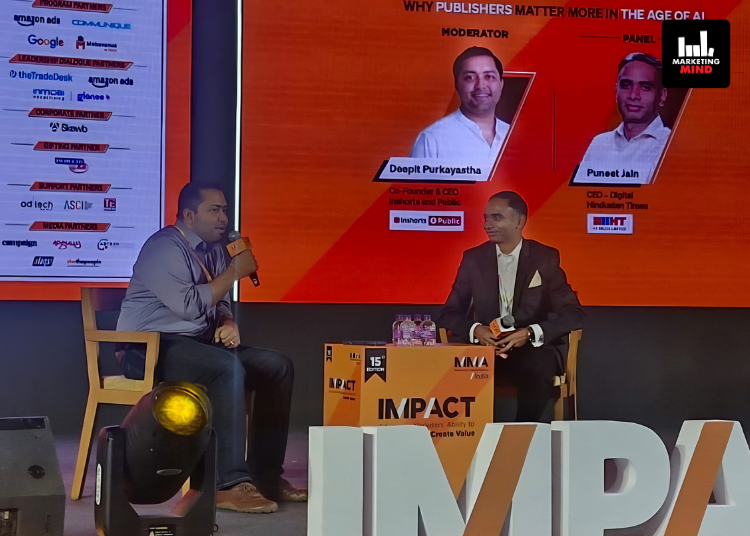
At the panel discussion titled ‘The Future of Discovery: Why Publishers Matter More in the Age of AI’ during 15th MMA IMPACT India 2026, Hindustan Times’ CEO – Digital Puneet Jain, and Inshorts & Public’s Co-Founder and CEO, Deepit Purkayastha, argued that AI is forcing a fundamental reset. Their conversation moved from the grey area between fake news and truth, to why trust cannot be borrowed indefinitely, to three sharp questions every marketer must stop being lazy about.
When Every Click Becomes Suspect
Purkayastha opened with a blunt diagnosis: “With more AI, content creation is becoming easier. Opinionating on social media is becoming easier. And there is zero accountability.” He pointed to synthetic content that pretends to be trusteworthy, but actually is not credible at all.
He also noted, “This is not always fake news. It is often a borderline opinionated kind of hate speech or just validates your thought process and kind of makes you live in an echo chamber.” Between fake news and the truth lies a growing grey area where the entire trust initiative is now being built.
Jain added the scale. “More than 50% of the content indexed in some categories is now synthetic content,” he noted. But volume is not the real problem. “It erodes the baseline notion of a reader who comes across the piece that someone accountable created. Once the reader’s trust is eroded, they start doubting everything. And it impacts the entire category. It also impacts everyone around the industry,” said Jain. Once that foundation cracks, the harm spreads beyond a single article. Jain also distinguished helpful from harmful AI, where he observed, “Assisted curation that summarizes or surfaces content well is something wonderful. But synthetic content carrying ads? It generates distrust.”
AI Doesn’t Create Trust. It Consumes Trust
Early in the AI cycle, Jain noticed something unsettling about how large language models operate. “We saw that when a reader asks a question to an AI, the tool gives a confident answer. That confidence stems from the underlying content created by decades of trusted journalism by publishers like us,” he claimed.
“AI doesn’t create trust, it consumes trust,” emphasised Jain, noting that the intelligence powering these answers is borrowed from the content created by publishers. Purkayastha agreed, noting his platforms, InShorts and Public, only partnered with certain kinds of creators. “Whether it is the old legacy media players or new age digital voice players, we place a lot of premium on making sure that the right content creators, who have the right voice, and fact-checking mechanisms, are present on the platform,” he said. The reasoning behind this filter is simple: Trust is something that you can’t play with.
Inside Hindustan Times, AI is not replacing journalists. Inquiring about this move, Purkayastha steered the conversation with the necessary question, wherein he asked, “What sort of guardrails are you putting in place to make sure trust doesn’t get compromised, while you are increasing content output?” Jain outlines three areas. “First is to augment the editorial process. Second is building superior user experience. Third is advancing our advertising products,” he said.
From Trust to Action: The Missing Intelligence Layer
Trust brings a reader to the door. Intelligence helps them walk through it. Purkayastha framed the challenge as a question. “Where does it show up in the brand conversations? Where does it show up in driving results for them?”
In response, Jain noted that marketers already understand the value of trusted platforms. “The relevance of a trusted platform which has its own levels of credibility and being preventive is equally important.” he shared. Adding another perspective, he also said, “What also needs to be done in addition to this layer of trust is to complement it with a layer of intelligence. Brand outcomes happen when the user moves from trust to an action which leads to an outcome.”
Jain also revealed that legacy publishers, much like Hindustan Times, have now built first-party datasets. Elaborating on this, he explained, “These sets have a large number of talking users which sort of are engaging in an environment of trust and contextuality. And we are able to complement this by the right amount of targeting. So when a user trusts the platform, then the user is willing to engage in different ways and generate a lot of first-party data for the platform.” That data then feeds into what he calls the intelligence layer, helping brands target and achieve better outcomes.
Three Questions Every Marketer Must Stop Being Lazy About
When asked what questions marketers should stop being lazy about while making media decisions, Jain acknowledged the difficulty of the job upfront. “It’s a very difficult task for a marketer to sort of figure and separate the weak from the sharp. The way the consumption of digital is growing, it’s very difficult to figure out what is the right or wrong impression, despite the growing availability of the instrument,” he noted.
However, his first question for any marketer making media decisions is direct. “Firstly, they need to ask the question, the impression they are getting, is it coming from synthetic content, or is it verified content created by an accountable person? Proven research now shows that credible content allows you to transfer trust from one brand to another while synthetic content which appears truthful, which appears fluent, actually takes away the trust,” he noted sharply.
The second question is about engagement quality. “What is the level of engagement our impression or our digital ad is creating for them? Not just the level of viewability or clicks, but is this a quality user who is engaging with the brand and improving the brand?” The third question is about playing the longer game, wherein he mentioned, “Performance sort of products can be at times a trap, because it gives you instant results. But does it help you build a brand in the long term, which sort of expands your talent, or stakes your products to more audiences and drives your feed?”
Purkayastha added a related point on brand safety. “The existing infrastructure of brand safety was built for the digital era. Which means that any content which is adjacent and falling into the negative emotion category is termed as not brand safe. It was never built for this era where it is more synthetic and memory-heavy. There is a need to urgently upgrade that brand safety to take consequences,” he affirmed.