






There was a time when brands spoke and consumers listened. Today, brands suggest, and influencers translate, reinterpret, and sometimes completely rewrite the script. Somewhere between a 30-second TVC and a 15-second Reel, the balance of power has quietly shifted.
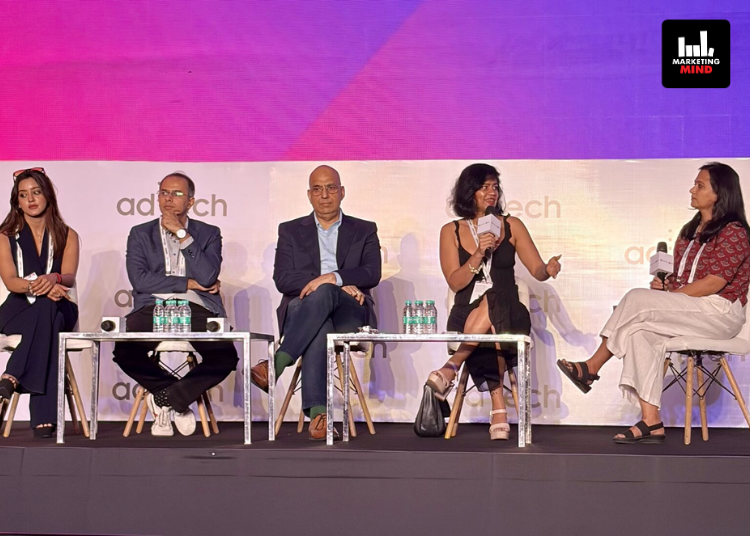
At ad:tech, this evolving dynamic has taken center stage in a conversation that has felt less like a panel discussion and more like a reality check. Moderated by Lakshmi Balasubramanian, CEO and Co-Founder, Greenroom Network, the session “The Creator-Brand Compact: Redefining Influence” has brought together a sharp mix of voices, Varun Sethuraman, Head of Marketing Communication, Nestlé India; Aarti Samant, Creator, Coach and Co-Founder, Sorted Digital; Rajiv Dubey, Vice President Marketing, Dabur India; and Insha Ghai, Lifestyle Content Creator, to unpack a question the industry can no longer avoid: in a world where everyone has influence, who really holds it?
Because while influencers have promised scale, relatability, and cultural currency, they have also introduced a new kind of chaos, one where briefs clash with authenticity, algorithms dictate creativity, and virality often outruns strategy. And yet, brands, especially legacy ones, haven’t just adapted, they have learned to coexist, recalibrate, and sometimes even push back.
What has unfolded is a layered conversation on influence itself, not just who wields it, but how it works, where it breaks, and what it will take for brands and creators to move from transactional partnerships to something far more enduring.
Balasubramanian opened the discussion by questioning where influencers truly sit within the marketing funnel, a question that has long been answered too simplistically. Sethuraman resisted that neat categorisation entirely. “There’s no stereotype on how we work, across the funnel depending on the need of the brand,” Sethuraman noted, pointing out that while influencer marketing continues to drive top-of-funnel awareness, its role in nudging consumption is equally significant. “I would call them ageless. Who wouldn’t want to have a Maggi when it’s raining?” Sethuraman added, anchoring strategy in instinctive, everyday triggers rather than rigid frameworks.
For Sethuraman, cultural presence has emerged as the real metric of success. “Cultural conversations is where most brands would want to be present, we are blessed to have brands that are both part of culture and conversations,” Sethuraman observed, reframing effectiveness as participation rather than just performance.
Samant shifted the lens from scale to depth, making a compelling case for community as the most undervalued lever in modern marketing. “Building meaningful communities is one of the most underrated strategies. The clever brands get it right,” Samant said, before drawing a vivid distinction: “Paid marketing is like fireworks and building a community is like a fireplace.” The metaphor has lingered, as Samant has broken it down into a tangible framework, shared beliefs, unwritten rules, inside jokes, and rituals. “When all of these come together, the community feels the connection and they become the flag bearers,” Samant explained, underlining how true influence often travels peer-to-peer rather than brand-to-consumer.
That idea of connection, however, has collided with the realities of execution, a tension Ghai has articulated with candour. Reflecting on over a decade in the ecosystem, Ghai has traced the evolution from rigid scripts to storytelling-first briefs. “Brands have started realizing the importance of storytelling, the hook in the first few seconds is everything,” Ghai noted. And yet, the promise of creative freedom remains inconsistent. “It’s there on paper but when it comes to execution, there are approvals, to and fros, it goes back to how exactly the brand wants it,” Ghai added, capturing the friction that continues to define brand-creator relationships.
Samant has built on that friction, pointing to a recurring contradiction in modern briefs. “All briefs start with ‘don’t make it sound like an ad’, and then the FOMO kicks in, ‘where is my brand?’” Samant said, advocating instead for a more logic-driven approach to content. “Optimize for watch time, if you are forcing the brand too early and people scroll, the money is wasted,” Samant explained, making it clear that in the algorithm economy, “hook and watch time is everything.”
While creators and new-age brands grapple with speed and structure, Dubey brought a long-term perspective shaped by legacy scale. “Our brands are present in about 80% of households, they cut across most of the population,” Dubey noted, dismantling the obsession with neatly segmenting Gen Z and millennials. “What cuts ice with different generations is the communication that you have with them,” Dubey added, emphasising that relevance is less about the product and more about how its story evolves.
For Dubey, chasing trends has never been the answer. “Instead of catching the trend, understand the consumer better,” Dubey said, grounding the conversation in a principle that predates digital altogether. “Consumer will still be the center of the universe, we are in for an infinite business,” Dubey remarked, positioning longevity as the ultimate KPI.
That long view has also shaped Dubey’s take on volatility, whether it is viral spikes or cultural backlash. “Positive trends don’t last too long, negative also doesn’t last too long,” Dubey observed, adding a line that has cut through the noise: “Brands last longer than their pursuers.” In an ecosystem increasingly driven by reaction, Dubey’s stance has been almost contrarian. “Reacting is dangerous and silence is the best policy,” Dubey said, reinforcing the idea that endurance often outperforms immediacy.
The conversation sharpened further around the rise of de-influencing, a trend that has blurred the lines between honesty and strategy. Ghai remained sceptical of its long-term value. “Very temporary, it’s better to tell people what you use rather than what not to use,” Ghai said, bringing the focus back to credibility. Samant, however, flagged a more troubling shift. “Some companies are now paying de-influencers to smear campaigns and that’s in really bad taste,” Samant pointed out, calling for a more responsible evolution of the space.
Even as influencer marketing continues to scale, questions around saturation have surfaced. Sethuraman acknowledged the growing sameness. “It is getting commoditized, there is a sea of sameness,” Sethuraman noted, while maintaining that the space remains in flux. “It will evolve and there is no rule book,” Sethuraman added, echoing a sentiment that has quietly underpinned the entire discussion.
Balasubramanian steered the conversation back to fundamentals, moments, culture, and consumer behaviour. Sethuraman summed it up with characteristic clarity: “You chase where the consumer goes, if they are doom-scrolling, you’re there, if they are watching sport, you’re there.” The implication has been simple but powerful, platforms may change, formats may evolve, but behaviour remains the constant.
And perhaps that has been the thread tying it all together. In a world of collapsing attention spans and expanding creator ecosystems, influence hasn’t disappeared, it has simply become more distributed, more unpredictable, and far more human.