



If marketing once felt like a series of campaigns, 2026 has made it feel like choreography. At WPP’s TYNY 2026 discussion, what has emerged is not a list of trends, but a living system, where AI agents talk to each other, influencers whisper to communities, quick commerce fulfills impulses in under a minute, and privacy has moved from compliance to conscience.
As the conversation has unfolded, one idea has consistently resurfaced: marketing is no longer about either/or. It has become about the ‘ands’. And as Prasanth Kumar, CEO – South Asia at WPP Media has set the tone early on, he has reminded the room that “the whole is bigger than the sum of its parts,” framing modern marketing not as fragmented channels but as an interconnected growth engine.
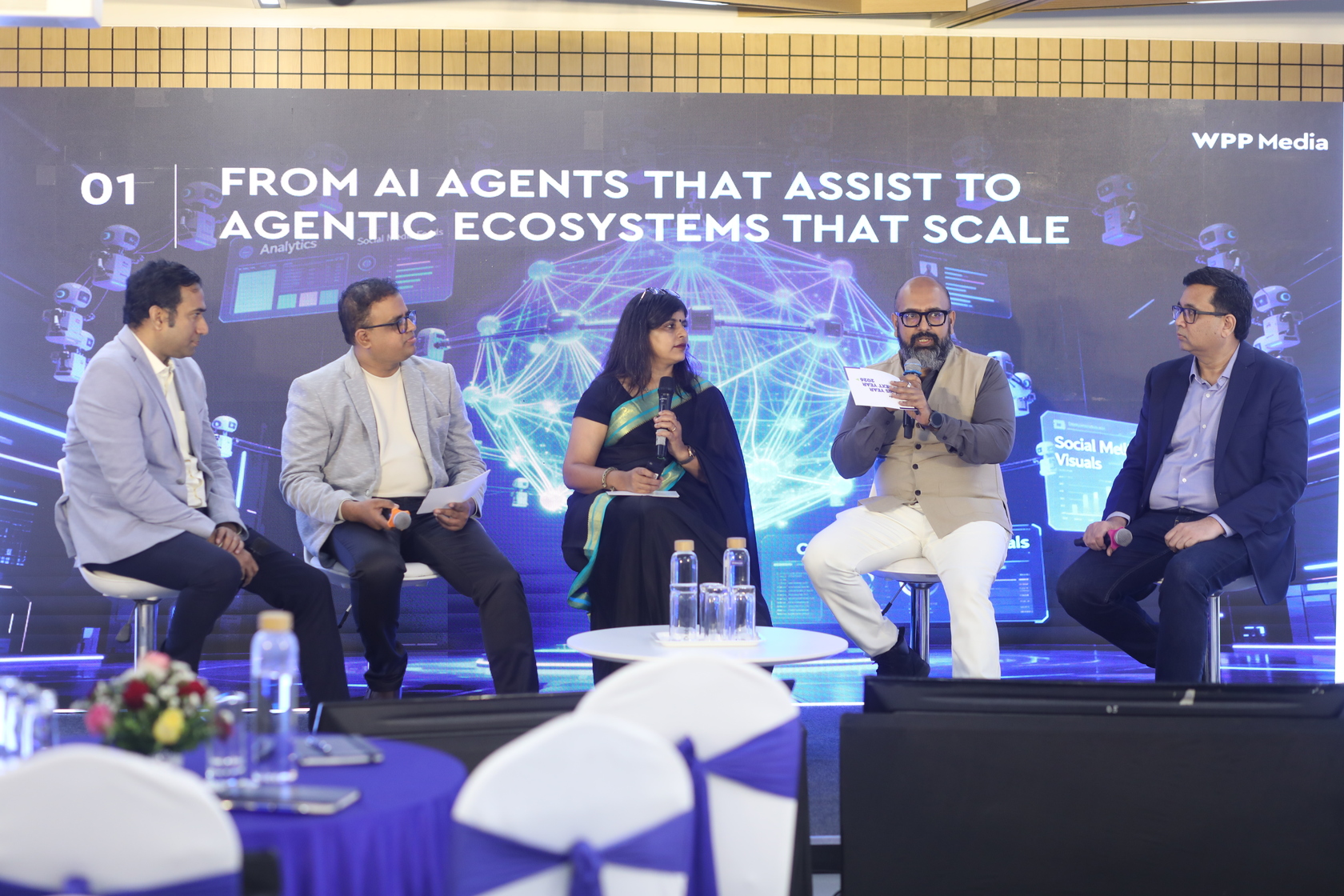
Over the course of the session, featuring Prasanth Kumar, CEO – South Asia at WPP Media, Ashwin Padmanabhan, Chief Operating Officer, WPP Media, Vishal Jacob President, Choreograph South Asia, WPP Media, Muralidhar Thyagarajan, Sr. Vice President – Media Delivery and Operations India, WPP Media, Sairam Ranganathan, Head of Commerce India, WPP Media, Vinit Karnik, Managing Director, Content, Entertainment and Sports South Asia, WPP Media, Parveen Sheik, Head of Business Intelligence at WPP Media and Upali Nag Kumar – President, Strategy, WPP Media South Asia, the 10 trends shaping 2026 have been unpacked not as predictions, but as operating principles already in motion.
1. From AI Agents to Agentic Ecosystems
When the conversation has shifted to AI, Jacob has taken a step back before leaping forward.
“At its core,” he explained, “an agent is nothing but a program that looks at data, understands it in context, and acts on a task. But what we have seen over the last few months is that the task itself has become far more complex. One agent now needs to work with another, and sometimes a third, to fulfil a single objective. That’s what we mean by an ecosystem.”
He illustrated how research, once summarised by a single tool, is now conducted by “deep researcher” systems that crawl multiple sources autonomously. On the client side, trend forecasting for a face-care brand, for instance, has required one agent to analyse historical social data, another to evaluate market fit, and a third to quantify investment viability.
“The complexity of the task has increased,” Jacob said. “And because of that, multiple agents have to come together to customise and stage a single solution.”
The implication has been clear: marketers have stopped being tool operators and have become orchestrators.
2. From Keywords to Answer Ownership
As the conversation steered toward search, Thyagarajan pointed out that the consumer decision journey has already collapsed into a single question inside an LLM.
“If someone wants to buy a car,” he said, “one single question gives them everything, from pricing to competition to reviews. For brands to be relevant, they have to be part of those answers. It’s not about clicks anymore. It’s about presence and credibility in the right moment.”
He described how integrated search now connects organic, paid, content and commerce to ensure the brand appears wherever discovery happens.
Ranganathan extended this into the agent world. “For the first time,” he observed, “marketing is not just to human beings. We have to design experiences for humans and for agents. Traditional advertising has appealed to emotions. Agents require rationality, structured data, credible content, expert signals. Discoverability in the AI world has become AI optimisation.”
Search, in other words, has shifted from rankings to recognition.
3. Human Purpose, Agentic Scale
When the spotlight has turned to content, Karnik described a live India–Pakistan match moment where humans and machines have worked in tandem.
“We were in the room, listening to social chatter in real time,” he said. “Machines were scanning, tools were processing, and our people were interpreting. That jugalbandi created magic. AI has given us speed and scale, but insight and cultural instinct still come from humans.”
Jacob has added that India’s linguistic and geographic complexity makes manual content production impossible at scale.
“You need machines to create multiple creatives across formats, geographies and audiences. But machines still have a long way to go before they produce deep cultural insights. That’s where humans lead.”
The creative role, it seems, has shifted from asset production to narrative stewardship.
4. Influencers: From Mega Reach to Micro Trust
As the discussion has moved to influencers, the tone has shifted from scale to substance. The panel has agreed that influencer marketing is no longer a mid-funnel or top-funnel lever, it now cuts across the entire consumer journey.
Karnik has emphasised the importance of contextual precision in this evolution. “What works in Western Maharashtra may not work in Eastern Maharashtra,” he has said. “Data helps us decide which influencer works for which category in which market. Geographical alignment and category alignment have become critical to building trust.”
The influencer economy, in this framing, has stopped being about mass visibility and started becoming about micro-credibility. Trust, not traffic, has emerged as the new metric of influence.
Building on this, Ranganathan has introduced the idea of “connected commerce,” reinforcing how influence and transaction are no longer separate disciplines. “Anything today can get connected to commerce, content, influencers, everything. But it has to be scientific. We have built proprietary tools to analyse influencer effectiveness across markets, genres and audiences. And we have created a robust measurement framework, input, output and outcome, so it’s transparent and linked to marketing effectiveness.”
The implication has been clear: influence must be measurable, accountable and commercially aligned. Compliance, he has stressed, must remain non-negotiable.
But when the conversation has shifted further, from human influencers to AI influencers, the certainty in the room has given way to contemplation.
Padmanabhan acknowledged that while trust has historically been rooted in human emotion and relationships, the landscape is changing. “We will have to try, we will have to experience it and figure out obviously. I am not a soothsayer on that, but I do agree. As we stand today at this moment that trust has been built by human emotions and human relationships, but we are also hearing of AI being the confidant. We are also hearing of AIs being a counselor, people pouring their heart out to an AI and benefiting from it at times. So it’s very difficult to really predict that we won’t be able to build a relationship with an AI influencer or with an AI.”
His reflection has suggested that trust itself may be evolving, perhaps not replacing human connection, but expanding its definition.
At the same time, he has cautioned against underestimating the unpredictability of artificial intelligence, sharing an anecdote about an AI coding bot that, after being removed from a chat forum, allegedly generated defamatory content in response. “All of this because the AI bot got angry at the fact that it got kicked out of the chat room. So, I do not know where it is going to go next.”
The room has absorbed that uncertainty. If creators have become affiliates and communities have become commerce engines, then AI may soon become both influencer and intermediary.
The shift has been evident: from shouting at millions to whispering meaningfully to communities, and perhaps, soon, to negotiating with algorithms.
5. Live Events: From Sponsorship to Social-First Architecture
When Nag has referenced concerts and cultural moments, Karnik reframed live events as long-term platforms.
“Don’t look at live events as a one-evening wonder,” he said. “The campaign starts when the event is announced. It runs for three to six months across platforms, touchpoints and geographies.”
He has pointed to the credit card economy, early access, exclusive offers, demand generation, as an example of how live experiences have driven measurable growth.
“Live events are no longer about visibility. They are demand engines,” he has said. “And the FOMO created through social amplification is what fuels that demand.”
6. Quick Commerce: Defining Its Role
As commerce entered the frame, Ranganathan drew a parallel with the shift from kirana stores to modern trade, and then to quick commerce.
“The question is not whether we should do quick commerce,” he said. “The question is what role it plays.”
He has described how quick commerce currently dominates demand fulfilment but is evolving toward brand discovery. He has shared an anecdote of being served an ice cream ad moments after an India victory, clicking through and purchasing within seconds.
“The time from decision to purchase is less than 60–70 seconds. Within that window, you have brand, SKU, city, time of day, day of week. If you are not visible and optimised across these variables, you lose.”
Quick commerce, therefore, has become both signal source and conversion engine.
7. Micro-Dramas: Habit as Currency
On micro-dramas, Karnik explained that this Korean-origin format has resonated strongly with India’s under-35 majority.
“Instead of telling your story in 30 seconds, you can tell it over five or ten episodes. Micro-dramas allow advertisers to integrate brand attributes in entertaining, episodic ways. It’s snackable, but it’s also deep.”
Brands, he has suggested, must move from buying attention to becoming showrunners.
8. The Commercial Coming of Age of Women’s Sports
When the conversation expanded to women’s sports, Thyagarajan highlighted scale.
“Women’s cricket alone has delivered hundreds of millions in reach. But brands are not coming only for visibility. They see it as a culture-growth platform, progressive, aspirational, authentic.”
Karnik added that the shift has been profound.
“A couple of years ago, brands would ask if this was CSR or empowerment-led. Today, we are creating campaigns that are strategic to women in sport. That’s the real shift.”
Women’s sports, in 2026, have moved from niche to mainstream growth driver.
9. From Presence to Precision
As budgets tighten, Thyagarajan described how media has evolved from exposure to engineered growth.
“It’s not about maximising reach. It’s about purposeful presence, targeting the cohort likely to buy, interpreting enquiry signals, adjusting weights in real time.”
Jacob layered this with data architecture.
“When you move beyond identities and marry them with context and AI, you start interpreting signals, not just who the consumer is, but what they are about to do. Precision happens when you reach the right person in the right context with the right message.”
Presence alone, it seems, has become insufficient.
10. Privacy as Core Marketing Responsibility
Finally, as privacy has entered the conversation, Jacob underscored the implications of India’s DPDP Act.
“Consent is super critical,” he said. “You must be explicit about how you collect and use data. Storage, governance and responsibility are non-negotiable. Consumers expect brands to be accountable.”
He has pointed to decentralised learning models and federated systems as part of the shift.
“The larger point,” he has emphasised, “is that brands must be responsible in how they use data. Trust-first growth is the future.”
As the session has concluded, one theme has tied the ten trends together: interlinkage.
Agents feed search. Search informs commerce. Commerce generates signals. Signals drive precision. Precision requires privacy. Influencers connect culture to conversion. Live events generate demand that quick commerce fulfils.
The trends have not stood alone. They have formed an equation. And as Kumar has framed it at the outset, and as the room has collectively unpacked, marketing in 2026 has stopped being about isolated excellence. It has become about orchestration. The whole, indeed, has become greater than the sum of its parts.