




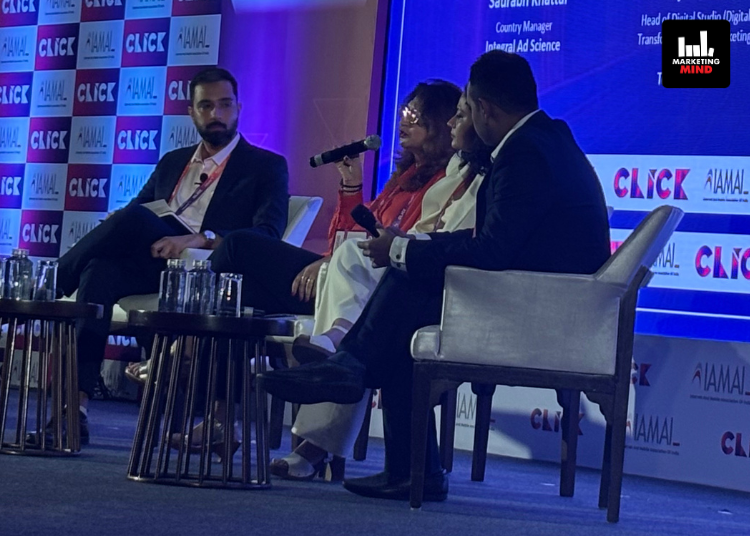
At IAMAI’s CLICK 2025, this tension surfaced in its most unfiltered form. A panel discussion on festive advertising, moderated by Saurabh Khattar, Country Manager at Integral Ad Science, featured Anjali Dutta, Head of Digital Studio (Digital Transformation and Marketing Lead) at Tech Mahindra, Purvaa Kapadia, Head of Marketing and CRM at Marks & Spencer, and Saurav Kumar, Paid Media Lead – Digital Marketing at Merck Group.
The topic “Driving Performance and Brand Equity in a Festive Season”- tackled a high-stakes moment for marketers: a period of soaring consumer intent coupled with intense competition. Amid the noise, the panel explored how brands can drive meaningful performance while reinforcing long-term brand value, combining creative excellence with contextual precision, attention metrics, and high-quality media environments.
Saurabh Khattar, who moderated the panel, brought clarity to a complex conversation at CLICK 2025. With years of experience in digital marketing, he guided the discussion toward actionable insights, focusing on how brands can navigate the high-pressure festive season while balancing creativity, performance, and ethical considerations. Khattar steered the panel to reflect not just on budgets and metrics but also on the nuanced role of AI in marketing—how automation and data-driven tools can increase efficiency without eroding human connection.
Under his moderation, the session explored the interplay between emotional storytelling and precision targeting, highlighting strategies that help brands drive conversions today while building lasting equity for tomorrow. By emphasizing both human centricity and technological leverage, Khattar positioned the debate around AI not as a replacement for creativity, but as a tool to amplify it responsibly.
In a crowded festive landscape, the conversation underscored that success is not just about showing up- it’s about showing up in the right place, at the right time, and in the right context.
The discussion revealed three distinct schools of thought: those who champion efficiency-first strategies, those who defend emotion-first storytelling, and a third camp that insists the middle path of balance is the only way forward.
In India, the festive quarter, October to December, has always been the sharpest test of marketing muscle. It is when advertising spends reach their annual peak, when families prepare for Diwali, Dussehra, Eid, and Christmas, and when consumer attention fragments across shopping, travel, entertainment, and gifting. For marketers, this three-month stretch is less a season than a battlefield: high budgets, high stakes, and high scrutiny from CFOs who demand proof that every rupee has converted into growth.
The conversation was not abstract. It touched the very heart of India’s marketing reality: the struggle to reconcile dashboards with stories, and algorithms with rituals.
For one section of the panel, the festive quarter is not about emotional fireworks but about mathematical precision. With media rates soaring in October and November and consumer attention scattered across dozens of screens, only sharp targeting, AI-driven optimisation, and attribution models can keep campaigns from collapsing under their own weight.
“Festive campaigns can no longer be run on instinct or intuition alone,” argued Saurav Kumar, Paid Media Lead – Digital Marketing at Merck Group, making the efficiency-first case. “When media costs peak and competition intensifies, precision becomes survival. AI and data don’t just help you target better; they tell you in real time whether your storytelling is working or not.”
He backed this with numbers from recent campaigns: “We analysed our data and figured out that just by spending 2 percent of our budget, we were able to save around 55 percent of our inventory cost-wise. The quality impressions went up by 55%.”
Kumar elaborated that the team first ran campaigns without filters and then compared them with optimised versions. “The results showed that simply by improving impression quality, we could save more than 50 percent of the budget while significantly enhancing outcomes. That’s what efficiency can deliver.”
For efficiency-first marketers, the festival rush is a stress test of ROI. The big-budget film — once the dominant Diwali weapon — no longer guarantees attention or conversion. “The days when you could release a big film and hope it carried you through the season are gone,” Kumar warned. “Today, every impression has to justify itself.
Kumar embodied the new data pragmatism. Anjali Dutta, Head of Digital Studio (Digital Transformation and Marketing Lead) at Tech Mahindra, offered an equally compelling defence of storytelling. For her, the festive quarter is not just a revenue window but a cultural one, when brands can etch themselves into family rituals, conversations, and collective memory.
“Festive season is when people are looking to connect emotionally, not just transact,” Dutta reminded the audience. “If you reduce your campaigns to efficiency alone, you might win the short-term sales, but you’ll lose the chance to build recall and trust that lasts far beyond the season.”
Dutta rejected the idea that emotion is a luxury. In India’s cluttered market, it is a necessity. “Every Diwali ad doesn’t have to be a blockbuster film,” she admitted, “but it does need to leave a feeling, a memory. Efficiency can get you the click; emotion gets you the connection.”
Her stance echoed a long-standing truth in Indian advertising: festive season is when brands are judged not just by what they sell, but by who they are. The brands that invest in symbolism, cultural cues, and storytelling may not always win the lowest cost-per-click, but they are more likely to be remembered the next year when the clutter returns.
Between the poles of efficiency and emotion came a third voice: Purvaa Kapadia, Head of Marketing and CRM at Marks & Spencer, who warned against false binaries. Kapadia urged marketers to see festive advertising as a calibration exercise, not a tug of war.
“Efficiency and emotion aren’t enemies,” Kapadia argued. “They are levers. A young D2C brand may need to prioritise performance to survive, while a legacy FMCG player must lean into cultural storytelling to protect equity. The art is in knowing when to dial up one without losing the other.”
This approach reframed the debate. Efficiency is not a rejection of creativity, and emotion is not a rejection of data. Instead, the two must fuel each other. “Think of it like music,” Kapadia explained. “Efficiency is the rhythm, emotion is the melody. You need both to make a song that people remember and repeat.”
The middle path recognises today’s reality: no brand can afford to ignore ROI, but equally, no brand can survive festivals without cultural presence.
A marketing crossroads
The panel at CLICK 2025 was more than a conversation; it was a reflection of where Indian marketing stands today. On one side lies the comfort of measurable outcomes, AI-driven targeting, and CFO-friendly dashboards. On the other side lies the enduring pull of stories, rituals, and shared meaning.
Both sides carry risk. Efficiency without soul reduces brands to algorithms. Emotion without precision risks irrelevance. Which is why the third school of balance, difficult though it may be to execute, increasingly looks like the path that can endure.
As Dutta put it: “Festivals are not just another sales window. They’re about who you are as a brand, not just what you sell.”
Kumar countered with pragmatism: “Without efficiency, even the best story won’t reach the right person at the right time.”
And Kapadia offered the synthesis: “This isn’t an either-or game. The brands that will win festive 2025 are the ones that can deliver both precision and presence, both emotion and efficiency.”
No single playbook anymore
The biggest takeaway? There is no single festive playbook left. The era when one-size-fits-all Diwali films dominated or when performance blitzes alone sufficed is gone. What remains is a live test of how each brand interprets its own mix of efficiency and emotion.
The CLICK 2025 panel left its audience with more questions than answers, a sign of how fluid today’s marketing moment is. Festive advertising has shifted from being a predictable calendar event to becoming the sharpest test of all – how brands reconcile data with culture, dashboards with stories, and precision with presence.