






Once upon a time, marketers thrived on cookies, digital ones, not the chocolate chip kind. But as India ushers in its Digital Personal Data Protection (DPDP) Act, the recipe for reaching consumers has changed. Data is no longer free for the taking; it now comes with conditions, consent, and consequences. The new mantra? Win trust, or lose business.
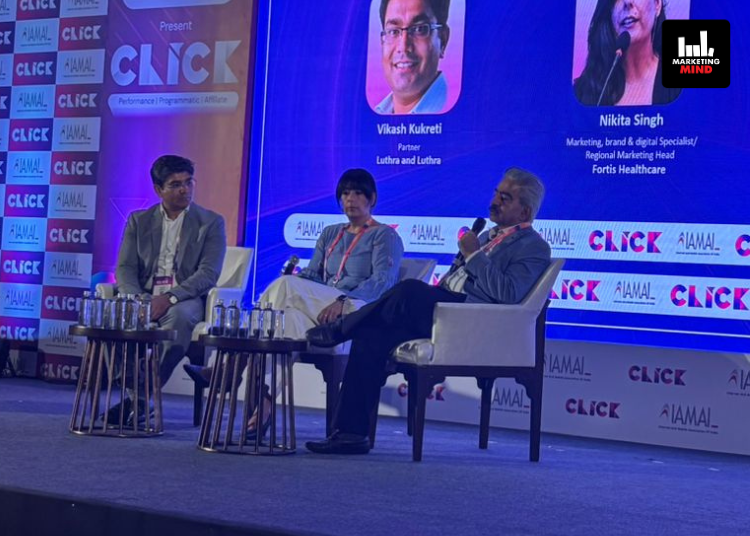
At IAMAI’s CLICK 2025, this shift took centre stage during a panel on privacy-first marketing. The session brought together Vikash Kukreti, Partner at Luthra & Luthra Law Offices, as moderator, alongside Nikita Singh, Marketing, Brand and Digital Specialist at Fortis Healthcare, and Sanjay Sindhwani, CEO of The Indian Express. Together, they unpacked how marketers must move from chasing data points to building relationships grounded in trust.
Singh broke down the concept into what she called three simple buckets: consent, minimalism, and transparency. “Earlier, we relied on third-party cookies and scattered data,” she explained. “Today, it’s about consent-driven engagement. If a patient comes to Fortis for a preventive health check-up, we only reach out if they’ve allowed us to. It’s about respecting that choice.”
For Sindhwani, privacy wasn’t a compliance checkbox, it was a matter of relationships. “The goal of privacy is trust between the consumer and the service provider,” he stressed. “When a bank calls me every week claiming I gave them consent, that’s not trust, that’s harassment. The law exists because too many people cut corners. Real trust is about respecting the consumer’s lived experience.”
To explain why regulation is necessary, he pointed to big tech. “Look at Google,” Sindhwani noted. “They’ve already delayed the phase-out of third-party cookies in Chrome multiple times. Why? Because unless everyone plays by the same rules, there’s no incentive to go first. That’s why a law like the DPDP is so important, it ensures a level playing field where all companies, big or small, must follow the same privacy standards.”
He illustrated this with the example of subscription businesses, notorious for making it easy to sign up but near impossible to cancel. “When I ran a subscription service earlier, I made sure customers could exit easily. That clarity built loyalty. If people feel trapped, you’ve already lost them.”
The panel also touched on the wider impact of regulation. Both speakers agreed that the DPDP Act could level the playing field. “I may want to play fair, but if my competitors aren’t bound by the same rules, I can’t sustain it,” Sindhwani said. “Legislation makes sure everyone follows the same standards, just like GST plugged tax leakages.”
Singh added that compliance had made marketing a far more collaborative function. “Earlier, I could just roll out a campaign. Today, I have to sit with data security teams, IT, even HR, to ensure our communication is not only impactful but also responsible. Consent is the new interface,” she said, emphasising that marketing strategy now spills across company departments.
The conversation kept circling back to the same theme: trust. Kukreti summed it up by pointing out that world economies themselves are built on trust and consistency. Singh agreed, highlighting that listening to customers was as important as asking for their consent. “If we are transparent and truly hear them, it builds credibility over time, and that translates into repeat customers and word-of-mouth growth.”
Sindhwani added a personal confession to drive home the point. “I have multiple email IDs, one for financial transactions, one for safe logins, and another for websites I don’t trust. That says it all. Consumers are already creating their own walls of trust. Marketers need to catch up.”
Healthcare, Singh reminded the audience, made the stakes even higher. “If sensitive health data leaks, it’s not just a breach, it creates a stigma. That’s why we’ve restricted who can even access such data internally at Fortis.”
As the panel drew to a close, there was consensus that the DPDP Act was not just another piece of legislation but a chance to rebuild consumer relationships. Trust, the panellists agreed, was no longer an abstract virtue, it had become a hard business metric.
Or as Singh put it in her parting line, “Trust is the new currency we’re all operating with. If you invest in it, the returns will follow.”