






There has always been that one summer afternoon we have all known too well, the kind where the sun does not just shine, it stares. It has lingered a little longer, burned a little sharper, and made every cricket match feel like a test of survival rather than sport. The ground has cracked under bare feet, the air has shimmered like a mirage, and somewhere between a missed catch and a desperate run, exhaustion has quietly crept in. But what if that exhaustion has not just been the heat? What if it has been something far more mischievous, almost villainous? What if, all along, the sun has not just been watching but drinking?
Back in 2009, McCann Erickson (Mumbai) took this very ordinary Indian summer and twisted it into something delightfully absurd and unforgettable. The agency has realized that dehydration, as a concept, has been far too dull for young minds. But the idea that the sun itself has been a sneaky antagonist, literally slurping away your energy, has been cinematic, chaotic, and instantly sticky. This has not just been advertising; this has been imagination weaponised. At the centre of it all has been a young Jay Thakkar, who has unknowingly become the face of every tired child who has ever dragged themselves off a playground.
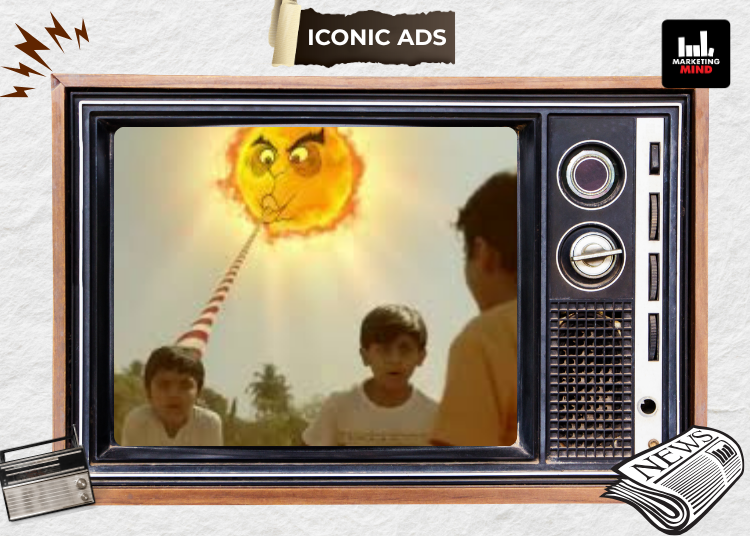
The film opened like a familiar memory, kids in a dusty field, a cricket match in full swing, the kind where rules have been flexible but passion has not. The sun has loomed above, not passive, but present, with a grin that has felt just a little too knowing. And then, without warning, it acted. A giant, bendy straw has descended from the sky, absurd yet oddly terrifying, and in one swift motion, it has plugged itself into a child’s head. What has followed has not just been visual, it has been visceral. That rhythmic slurp, that exaggerated gulping sound, has turned into the soundtrack of stolen energy.
And then the jingle has kicked in, almost playfully sinister: “Garmiyon mein bhaiya dhoop gurraye; body glucose choose, use maza aaye” (In the summers, the sun growls; it sucks body glucose and enjoys it.)
In that moment, colour has drained, literally. The child has faded into a lifeless grayscale, his body collapsing as if someone has pulled the plug on vitality itself. It has been dramatic, exaggerated, and yet strangely believable in the logic of childhood imagination. Because that is exactly how summer fatigue has felt, sudden, unfair, and slightly personal.
The story has not lingered in despair for too long. Like every good Indian narrative, the solution has arrived at home. The boy has turned to his mother, asking for water, simple, instinctive. But this is where the film has gently pivoted its message. Water, it has suggested, has not been enough. What the sun has taken has not just been hydration, it has been energy. And as the mother has stirred a glass of Glucon-D, the narrative has shifted from loss to restoration.
One sip, and everything has changed.
Inside the boy, an invisible meter has refilled, colour has rushed back into his veins, and the grayscale has dissolved into vibrancy. It has not just been a drink, it has been a comeback montage compressed into seconds. He has sprinted back onto the field, faster, sharper, almost untouchable. The sun has tried again, lowering its straw with the same sly confidence, but this time, it has failed. The boy has been too quick, too charged, too ready. And as he has struck that final shot, reclaiming not just the game but his energy, the sun has been left watching, defeated, outplayed.
What has made this ad iconic has not just been its creativity, but its audacity. It has taken something invisible, energy loss, and has given it a face, a sound, and a villain. The gulping noise has lingered in memory, the grayscale transformation has unsettled just enough, and the sheer absurdity of a sun with a straw has made it impossible to forget. It has been the kind of storytelling that has not explained a problem, it has performed it.
Over the years, this villainous sun has continued to hover in Glucon-D’s universe, evolving, softening, eventually retiring into more wholesome narratives. But this original moment, the straw, the slurp, the sudden collapse, has remained unmatched. It has captured something deeply cultural: the drama of Indian summers, the nostalgia of gully cricket, and the universal childhood belief that even the most ordinary things can come alive with intent.
Because in the end, this has never just been about a drink. It has been about a feeling, that invisible tug of exhaustion, that desperate need for a pause, that small, magical moment of revival. And somewhere in that vast, blazing sky, the sun has still lingered, not just as a force of nature, but as a character we have once feared, laughed at, and ultimately defeated, one sip at a time.