







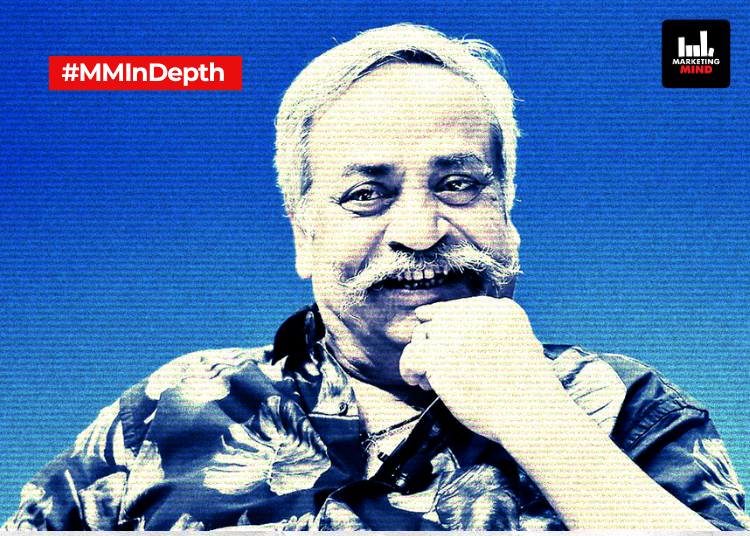
A life beyond headlines. It’s hard to write about someone who wrote India’s most memorable words. Today, as the advertising world mourns Piyush Pandey’s passing, it’s not just a legend we’re remembering, it’s a voice that became part of India’s emotional vocabulary.
Every jingle that made us smile, every line that felt “so us”, and every brand that found a home in our hearts, somewhere, Pandey’s pen had been there. He wasn’t just India’s greatest ad man. He was its storyteller, its conscience, and often, its mirror.
Industrialist Gautam Adani said it best. “Piyush Pandey was far more than just an advertising legend. He was the voice that made India believe in its own story. He gave Indian advertising its self-confidence, its soul, its “swadeshi” swagger. And he was a very good friend! Like a master batsman, he played every stroke with his heart. Today, India has lost a true son.”
And Prime Minister Narendra Modi remembered him as a “creative genius” who made “a monumental contribution to the world of advertising and communications”
The Jaipur Boy Who Dreamed in Colours and Words
Born in 1955 in Jaipur, Pandey grew up in a home buzzing with art and laughter. The youngest among nine siblings, his house was, in his words, a “creative factory” as per reports.
His father worked at a cooperative bank, but the real education came from his family, his sister Ila Arun, the celebrated singer and actress, and brother Prasoon Pandey, who would go on to become one of India’s finest ad filmmakers.
At St. Xavier’s School, Jaipur, and later St. Stephen’s College, Delhi, Pandey shone not just in classrooms but on the cricket field. He captained his college team and even represented Rajasthan in the Ranji Trophy.
After earning a Master’s in History, he dabbled in tea-tasting, construction, and even cricket coaching. His entry into advertising was, fittingly, accidental, encouraged by cricketer Arun Lal, who spotted Pandey’s knack for quick, witty wordplay.
That chance turned into destiny.
Finding His Home at Ogilvy
In 1982, Pandey joined Ogilvy & Mather (now Ogilvy India) as a client-servicing executive. He wrote his first ad for Sunlight detergent, and it was immediately clear that his words had a heartbeat.
By 1988, he had switched to the creative side, a move that changed Indian advertising forever.
From the Fevicol bus bursting at its seams to Cadbury’s girl dancing on the cricket field, Pandey’s work blended humour, simplicity, and emotion in a way few could match.
His campaigns didn’t sell, they spoke.
By 1994, he became Creative Director and soon joined the agency’s board. Under his leadership, Ogilvy India became the most awarded agency in the country and one of the most respected globally.
In 2019, he was named Global Chief Creative Officer of Ogilvy, a first for an Indian, while continuing to serve as Executive Chairman, Ogilvy India.
In 2023, he stepped into an advisory role, marking the culmination of over four decades with the agency.
Campaigns That Defined Generations
Pandey didn’t just make ads, he made memories.
The Fevicol ads taught us what ‘unbreakable’ meant, from villagers glued to a bench to fishermen on a packed boat.
Cadbury Dairy Milk’s ‘Kuch Khaas Hai’ campaign turned a chocolate ad into a celebration of unfiltered joy.
For Asian Paints, he gave us ‘Har Ghar Kuch Kehta Hai’, a campaign that treated walls not as surfaces but as storytellers.
For SBI Life, he drew from his mother’s line, ‘Heere ko kya pata tumhari umr kya hai’ turning it into a touching reflection on love and age.
He shaped Fevikwik’s ‘Todo Nahin, Jodo’, Vodafone’s iconic ZooZoos, Ponds’ ‘Googly Woogly Woosh’, and the unforgettable ‘Mile Sur Mera Tumhara’ India’s song of unity.
And when politics called, he answered with equal conviction, penning ‘Abki Baar Modi Sarkar’ in 2014, one of the most recognisable political slogans in Indian history.
His work was always rooted in the Indian heart, earthy, funny, wise, and deeply humane.
Beyond Advertising: A Creative Life in Full Colour
Pandey’s creativity refused to stay confined to boardrooms. He wrote two acclaimed books, Pandeymonium (2015) and Open House with Piyush Pandey (2022), both chronicling his life, his learnings, and his humour (HarperCollins India).
He co-wrote the screenplay for Bhopal Express and appeared in Madras Café (2013). He also lent his lyrical voice to patriotic anthems, none more iconic than Mile Sur Mera Tumhara (1988).
Outside work, he was known for his laughter, humility, and love for dogs. He and his wife, Nita Pandey, also a former Ogilvy colleague and now a canine hydrotherapist, shared their Goa and Mumbai homes with their beloved pets.
His humour was unfiltered and disarming. Once asked about writing an autobiography, he joked, “With five female dogs at home, there’s no need to bitch in a book”.
It was that mix of wit and warmth that made him so loved, in the office, at home, everywhere.
The Man Behind the Magic
Behind the creative genius was a man who believed in people. He mentored hundreds of young copywriters and art directors, always reminding them that ideas live in the streets, not spreadsheets.
He believed that advertising wasn’t about selling, it was about storytelling. “We don’t create consumers,” he once said. “We create believers.”
His leadership was rooted in empathy. He’d brainstorm over dinner, laugh at his own ideas, and always make the youngest team member feel like they mattered.
As Uday Kotak recalled, Piyush was “an amazing out-of-the-box thinker and a humble person who weaved creativity with an Indian context”.
Honours and Accolades
His walls may have been modest, but they glittered with the world’s biggest awards.
He received the Padma Shri in 2016, the Lion of St. Mark at Cannes Lions 2018 with his brother Prasoon, and the Legend Award at the London International Awards 2024.
He reportedly won over 600 international awards, and The Economic Times named him “India’s Most Influential Advertising Professional” for 14 consecutive years.
He also served as the first Asian jury president at Cannes Lions, a testament to how he took India’s creative voice to the world.
Tributes That Say It All
As the world mourns, words pour in like the campaigns he once created, full of heart. The news of his passing has left the advertising and business fraternity heartbroken, with tributes pouring in from industry leaders, global colleagues, political figures, and long-time collaborators.
Sumanto Chattopadhyay, former Executive Creative Director, Ogilvy South Asia, shared, “Piyush wasn’t just a boss or a creative guru, he was the compass that helped us find our true north. He believed that the simplest thought, honestly expressed, could move a nation. And time and again, he proved it. Today, we mourn the man. But we also celebrate the lamp he lit in so many hearts. Lamps that will light the way for the industry for a long, long time.
From the Highest Offices of the Country, Prime Minister Narendra Modi wrote on X, “Shri Piyush Pandey Ji was admired for his creativity. He made a monumental contribution to the world of advertising and communications. I will fondly cherish our interactions over the years. Saddened by his passing away. My thoughts are with his family and admirers. Om Shanti.”
Finance Minister Nirmala Sitharaman added, “A titan and legend of Indian advertising, he transformed communication by bringing everyday idioms, earthy humour, and genuine warmth into it. His legacy will continue to inspire generations.”
Union Minister Piyush Goyal paid his respects, “A phenomenon in the world of advertising, his creative genius redefined storytelling, giving us unforgettable and timeless narratives. To me, he was a friend whose brilliance shone through his authenticity, warmth and wit.”
From clients and collaborators, Amit Syngle, MD and CEO of Asian Paints, whose brand Pandey shaped through iconic campaigns, shared, “The news of Piyush Pandey’s passing leaves a void that is impossible to fill… Piyush was the architect who helped us find the enduring soul of our brand. It was his creative genius that birthed the iconic ‘Har Ghar Kuch Kehta Hai’ campaign, which fundamentally changed how India perceived the concept of ‘home’. His legacy is permanent, and his influence will continue to color the way we think about creativity for generations.”
Industrialist Anand Mahindra remembered his warmth, “What I will remember most is not the campaigns he crafted or the brands he built, but his hearty laugh and irrepressible zest for life… He always carried an ‘invincible summer’ within him.”
Sir Martin Sorrell, founder of S4 Capital and former WPP head, said, “He was a real Indian tiger who led Ogilvy from the front and was a creative titan. Clients appreciated his leadership — he carved out a reputation well beyond India’s borders.”
Uday Kotak added, “He launched Kotak Mahindra Bank with a campaign in 2003 describing banking as ‘common sense’. Amazing thinker, humble person. He weaved creativity with an Indian context. Will miss him.”
From the creative and cultural fraternity, Ad filmmaker Prakash Varma wrote, “I will forever be grateful for the love and blessings I received from Piyush. He has always been a guiding light and a true friend.”
Filmmaker Hansal Mehta expressed it with classic simplicity, “Fevicol ka jod toot gaya. The ad world lost its glue today. Go well, Piyush Pandey.”
Commentator Harsha Bhogle recalled his cultural impact, “Piyush Pandey entered a profession that spoke in beautifully nuanced English aur usko apni zubaan ka khubsoorat zaika pesh kiya.”
Creative veteran Prathap Suthan shared, “He changed Indian advertising forever, put our creativity on the world map… When I lost my wife Jo, his email reached me early the next morning. It felt like an arm around my shoulder. Thank you, Piyush, for everything.”
Former Ogilvy ECD Talha Bin Mohsin added, “He built people before he built brands. You made advertising human. You made all of us better.”
And Shubhranshu Singh, ex-CMO of Tata Motors, said, “In losing Piyush, we do not lose just a pioneer of advertising, but a beacon of kindness, humour and heartfelt friendship.”
A Legacy That Lives On
In the end, no number of stories can do justice to Piyush Pandey. He was laughter in the corridors, poetry in our ads, and emotion in our everyday life.
He taught Indian advertising to look inward, to find power in simplicity, beauty in imperfection, and stories in the ordinary. And in doing so, he gave this country a voice that sounded like itself.
Today, as the industry pauses to remember him, perhaps the truest tribute is to keep doing what he did so effortlessly, tell stories that make people feel something real.