






For the streaming industry, the metric of success has evolved from simply acquiring users to retaining them. With over 500 million monthly active users and 260 million paid subscriptions, JioHotstar sits atop a mountain of data that few platforms can match. The challenge for its product and engineering teams is no longer just about scale; it is about making that scale meaningful for each individual user.
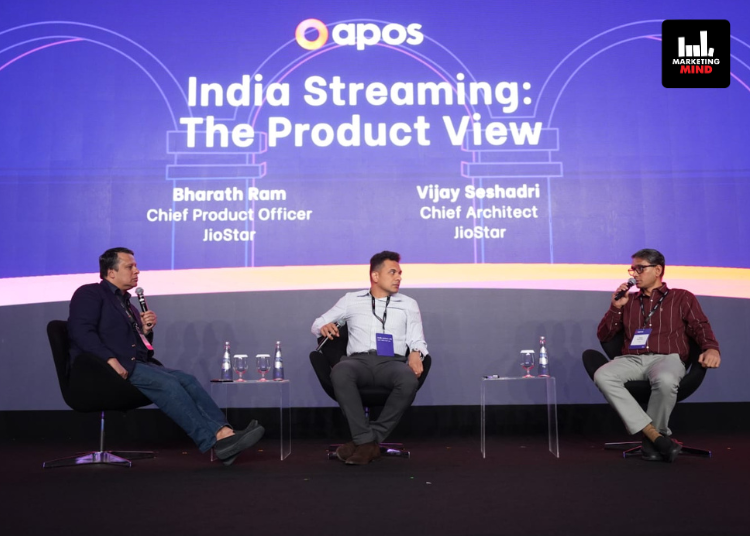
That challenge formed the heart of a conversation titled India Streaming: The Product View at APOS 2026. Bharath Ram, Chief Product Officer, and Vijay Seshadri, Chief Architect at JioStar, offered a rare glimpse into how the platform is designed for economic diversity, why conversational interfaces are the next frontier for discovery, and how commerce is being woven into the fabric of the viewing experience.
The Product Vision Starts Backwards from the Consumer
Before a single line of code is written, the product vision at JioHotstar begins with a question: what does the consumer actually need? In a market as diverse as India, that question has no single answer, but it provides a consistent North Star.
Ram laid out the philosophy plainly, explaining that the process is rigorously metric-focused. “A lot of product vision starts, as you can expect, backwards from the consumer experience. And in consumer internet platforms, you specifically optimize for managing a consumer lifecycle. How do you acquire, retain people for a considerable period? And then the product vision evolves from trying to improve, like, your hour-by-hour metric, and what fits into that paradigm.”
Seshadri added a crucial dimension, noting that scale itself informs the product design. “One of the things about operating a platform at our scale is that it’s a very iterative process, in the sense that if you look at non-functional requirements, like availability, scale, cost efficiency, all this feedback goes into product design.” He positioned product as the “what” grounded in customer problems, while engineering focuses on the “how.”
Standing Between the Viewer and the Content
The economic diversity of India’s streaming audience is staggering, ranging from a user on a 149-rupee mobile plan to a family watching 4K content on a Connected TV. Designing a single product that works for both is a foundational act of product-market fit.
Ram explained that the strategy is built on identifying common threads while enabling unique experiences. “There are a diverse set of consumers, and if you look at, let’s say, three, four categories of consumers, then there is a common thread that binds them all, and then there are unique experiences for the product that they opt into.” He noted that a user on both CTV and mobile has a different pattern than a mobile-only user.
The goal, he emphasized, is to become invisible. “It’s also very important that you are just standing in between them and content. So, the sooner you can remove yourself out and give them the content that they want to watch, and the experiences that they want to go through, then automatically the retention cycle kicks in.”
This philosophy extends to upgrading users. He revealed that during IPL, “we specifically increased a lot of mobile people to consider Connected TV,” a strategy that is “working really well.”
The Great Unlock: Moving from Typing to Talking
For years, content discovery has been dominated by recommendation algorithms. But with the explosion of content supply, JioStar’s product team believes the next paradigm shift will be conversational, moving users from typing keywords to having a dialogue with the platform.
Seshadri highlighted the urgency of this shift. “With the explosion of supply, the content discovery problem has become significantly more acute for customers. If you look at how customers are discovering content on platforms like ours, nothing much has changed in the last 15 to 20 years.” He pointed to their partnership with OpenAI as a step change, where voice adoption is already taking off.
“We are seeing that over 60% of the users, when they have a choice between voice and text, are adopting voice,” he said. He described a vision where the interface is visual and conversational, allowing users to start with a high-level query like, “It’s a Friday evening, give me some recommendations to watch with my family,” and then curating that into high-quality watch time. “We think that content discovery is fundamentally transforming with this new AI capability,” he added.
JAMS and the Blending of Content & Commerce
One of the most intriguing products on display at the JioStar pavilion was JAMS, a video intelligence layer that makes the entire library machine-readable. This technology is not just for improving search; it unlocks a new revenue stream by blurring the lines between content and advertising.
Ram described how traditional advertising relies on specific, logical pauses in content, like the six balls of an over in cricket. But with JAMS, the platform can scan the action itself. “If you truly start peeling the layers of the onion and understanding what the list of items within a content are, what shirt is this person wearing, what shoe is this person wearing, then the separation of these two logical blocks starts thinning.”
This allows for a more realistic form of product showcase. “Here you’re actually seeing a live usage, where the product is being actively used in a non-advertising context and that it provides more realism and the person is able to understand how it’s being used,” he said.
Seshadri positioned this as the “derivative layer” of AI, distinct from generative AI. “How do we process that to gain more intelligence? That has multiple applications. One is we talked about discovery, being able to power semantic search… The other, of course, is what Bharat was talking about, which is commerce.” He confirmed that this is a “core capability that can help power multiple applications for us.”
Starting with Habits, Ending with Transactions
The ultimate ambition for JioHotstar is to move beyond passive viewing. The product team’s vision is to make the platform a place where users actively lean forward to engage, play, and eventually transact.
Ram outlined the logic clearly. “The habit-building goes first and then what you do with the habits that have been built is usually what falls. What we ideally like, consumers in JioHotstar, to do is lean forward and start interacting with the market.”
He cited examples like playing a game around Bigg Boss or cricket. “The most important side effect is you have millions and millions of people who can lean forward and interact with the app and that’s like a natural habit for them.”
That habit is then the bridge to commerce. “The commerce part is essentially the same organic behaviour but you are not playing a game that’s a companion to cricket, you are essentially creating a set of sequences that allows you to buy a product.”
He pointed to their existing game, Jeeto Dhandana Dhan, as a proof of concept. “If that hadn’t worked, Swiggy wouldn’t work because there’s no reason for people to click on buttons and pages and just lean back and watch.”
Looking ahead, Seshadri sees commerce as the next sector to be disrupted by conversational AI. “The next sector to be disrupted here is product commerce. And a platform like ours that can crack seamless purchasing experience while watching content could be a transformative change for us over the next 12 months,” he concluded.