






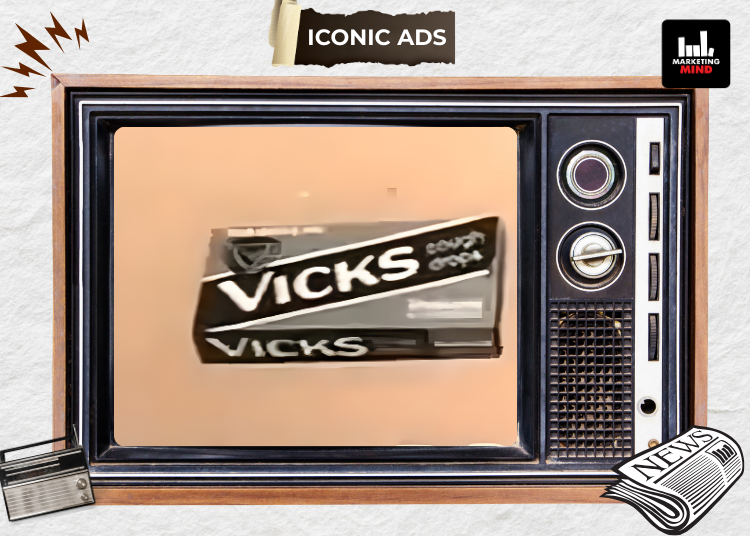
Some ads try very hard to be memorable. This one didn’t. It simply appeared on Doordarshan, listened to a little girl clearing her throat, and became unforgettable without making a fuss.
First aired in 1982, when India had just one television channel and families actually watched it together, the Vicks toffee commercial was set inside a very familiar Indian home. Created by Ogilvy, Benson & Mather, the film relied on observation rather than spectacle, and on common sense rather than flashy visuals.
The scene is delightfully simple. A young daughter sits there, visibly irritated by something she cannot quite describe. It is not exactly a cough. It is not quite a sore throat. It is that maddening, scratchy feeling everyone recognises instantly.
“Gale mein khich khich.”
Beside her sits her father, calm and untroubled, with the air of a man who has handled far worse domestic emergencies. He does not interrogate her symptoms. He does not suggest turmeric milk or steam inhalation. He simply reaches out, hands her a Vicks toffee, and settles the matter like this has always been the obvious solution.
Then comes the line that did all the heavy lifting.
Then comes the line that did all the work.
“Vicks ki goli lo, khich khich door karo.”
No exaggeration. No dramatic claims. Just a cheerful little jingle that wraps up both the problem and the solution in one breath. The genius of the ad lies in its language. Instead of correcting how people spoke, it embraced it. By using khich khich, a phrase already embedded in everyday conversation, Vicks became instantly relatable.
The result was predictable, in the best possible way. The line slipped out of the television and into daily life. Parents repeated it. Children remembered it. Anyone clearing their throat risked hearing it from across the room. Before long, khich khich stopped being just a complaint and became a category that Vicks quietly owned.
More than forty years later, the ad still endures because it understood a simple truth. People do not always describe discomfort accurately, but they describe it honestly. And in 1982, Vicks listened carefully, responded simply, and created a jingle that still turns up uninvited in conversation. Proof that sometimes, the most effective advertising is just a sensible father, a patient daughter, and the confidence to say exactly what everyone is already thinking.