



In a digital world overflowing with notifications, endless scrolling and shrinking attention spans, brands have spent years obsessing over one thing, visibility. More clicks, more impressions, more reach and more traffic have long defined marketing success. But somewhere along the way, consumers have started becoming more selective about what truly deserves their attention.
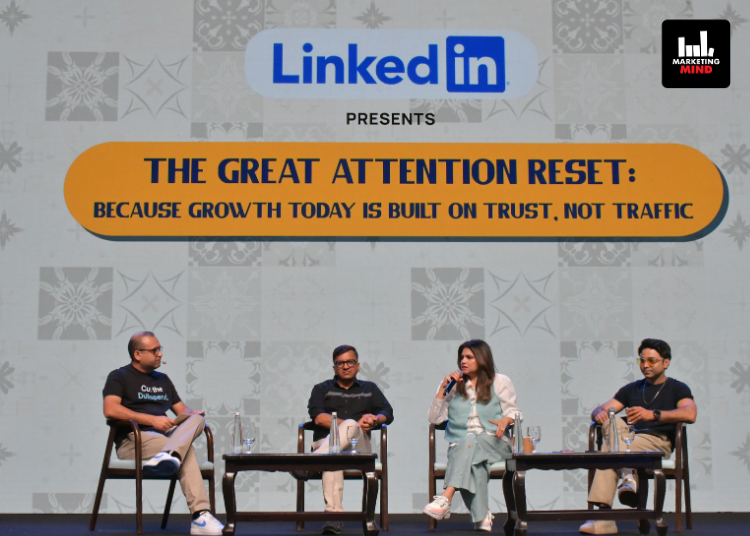
That shift formed the core of the conversation during Day 3 of Goafest 2026 at the session The Great Attention Reset: Because Growth Today Is Built on Trust, Not Traffic. Moderated by Devajit Roy, Head of India, Mid Market and Growth – Marketing Solutions, LinkedIn, the discussion featured Punit Dharamsi, Executive Vice President, Association of Mutual Funds in India (AMFI), Tuhina Pandey, Director, APAC Communications and Chief Marketing Officer, India and South Asia, IBM, and Jahid Ahmed, Senior Vice President and Head of Digital, HDFC Bank. Together, the panel explored how modern marketing is increasingly moving away from vanity metrics towards credibility, trust and meaningful engagement.
What made the conversation particularly relevant was how universally familiar the problem has become. Consumers today are constantly exposed to content, but far less willing to trust it blindly. Whether in finance, banking or technology, the challenge for brands is no longer simply about being seen, it is about being believed.
Dharamsi reflected on how trust becomes especially important in financial communication, where consumer behaviour is often tied to emotions, uncertainty and life decisions. According to him, the most effective communication happens not during random campaigns but during moments that genuinely matter in people’s lives. “Financial communication works best during key life moments like first jobs, marriage, childbirth, retirement, increments, and tax planning,” he said.
He explained how AMFI has increasingly focused on contextual messaging that aligns with financial milestones, particularly encouraging younger audiences to begin SIP investments from their very first salary. Rather than reacting with panic-led communication during volatile markets, Dharamsi stressed the importance of long-term investor education. “Through continuous, always-on communication, educational content formats, and character-led storytelling, the emphasis remains on investor education and trust-building over panic during market volatility,” he added.
The conversation also highlighted how the meaning of relevance itself has evolved in today’s attention economy. Pandey pointed out that in increasingly complex B2B environments, brands are no longer communicating with a single decision-maker. Instead, they are engaging entire buying committees made up of CMOs, CFOs, CEOs and CIOs, each consuming information differently.
“Relevance matters more than reach in today’s attention economy,” Pandey said, emphasising that attention alone no longer guarantees influence or business outcomes. She also noted that artificial intelligence is beginning to reshape communication in entirely new ways, becoming both an audience and an intermediary in how information is consumed and evaluated.
For Pandey, storytelling remains central even in highly data-driven environments. “Strong storytelling, aligned sequencing, and smart repurposing across short- and long-form content help drive engagement across the funnel,” she explained, adding that marketing effectiveness today must ultimately connect back to larger business journeys and pipeline impact rather than isolated campaign metrics.
Ahmed, meanwhile, brought the discussion firmly into the evolving realities of digital marketing and consumer trust. According to him, the industry is witnessing a fundamental shift away from interruption-led advertising towards ecosystems built around intent, safety and credibility. “Attention today is built on trust, safety, relevance, and frictionless experiences,” he said.
Ahmed also highlighted how modern consumers increasingly rely on peer validation, creator-led influence and educational content before making decisions. In that environment, credibility often performs better than aggressive visibility. “Marketing is shifting from interruption-led communication to intent-led ecosystems, where credibility matters more than reach,” he added.
As digital ecosystems become more personalised, Ahmed stressed that first-party data and large-scale personalisation are becoming essential for building sustainable customer relationships and improving long-term value rather than driving one-time conversions.
While each speaker approached the topic through a different industry lens, the larger takeaway from the session remained remarkably consistent: the attention economy has matured. Visibility alone no longer guarantees relevance, and reach without trust is becoming increasingly ineffective.
At a time when consumers are overwhelmed with content but cautious about what they engage with, the brands most likely to grow are not necessarily the loudest ones. They are the ones capable of building credibility slowly, consistently and meaningfully over time.