




Marketing has always loved a good reinvention story, but few have felt as quietly radical as what has been unfolding inside the television set. At first glance, nothing has changed, the same soaps, the same cricket matches, the same family rituals around the big screen. And yet, beneath that familiar glow, television has been learning a new language. One where the ad you see is not the same as the one your parents see in another city. One where the blunt force of mass reach has been steadily giving way to precision, intent, and data.
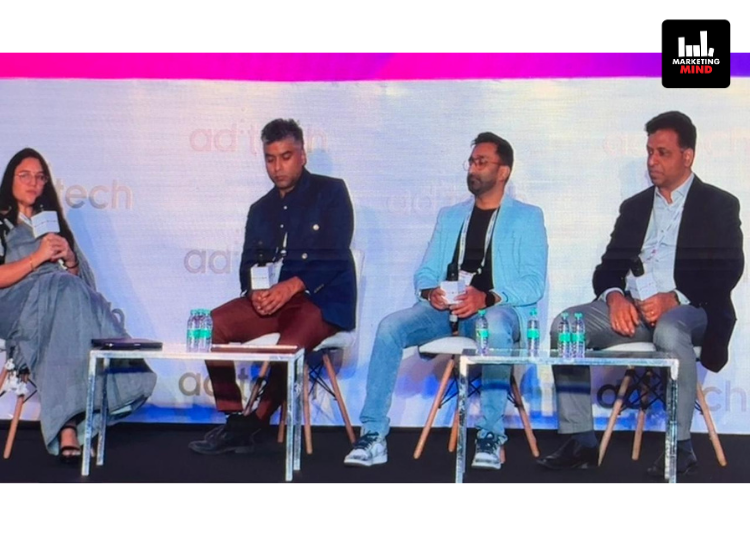
At ad:tech, a panel featuring Deepti Khutal, VP Partner Solutions at INVIDI Technologies, along with Prasad Sanagavarapu, COO at INVIDI, Shrey Jule, India Business Lead – Exchange Platforms at Google, and Rajiv Rajagopal, Head of Advanced TV at WPP Media has captured this inflection point, not as a distant future, but as something that has already begun to reshape how India watches, buys, and monetizes TV.
Setting the tone, Sanagavarapu has grounded the conversation in scale, dismantling the often casual assumption that television is fading into irrelevance. “We are actually talking about 210 million households who watch TV in India, the reach of the TV itself is about 700 million users. And that’s not an insignificant amount of money,” he said, reminding the room that linear TV continues to be the “bread and butter” of broadcasters. The real challenge, as he has framed it, has not been about relevance, but about evolution, “you still have TV stuck in legacy systems, while digital has grown tremendously.”
What INVIDI’s addressable technology has done, Sanagavarapu explained, is deceptively simple yet fundamentally disruptive: “TV buying is largely spot-based, digital runs on impression-based. These are two different currencies. As part of addressable advertising, what we do is change the currency from spot-based buying to impression-based buying.” That shift, Sanagavarapu emphasised, has unlocked something much bigger, “when you transform that, you can actually bring the digital workflows onto the TV buy, and start buying TV the same way.”
And in that transition, the impossible has quietly become operational. “We have been working with Google, and mapped a programmatic workflow where you have programmatic guaranteed buys onto TV, from the demand side, you can create a campaign that flows all the way down to buying TV,” Sanagavarapu added, calling it “a new frontier where you can actually buy TV through programmatic.”
For Google, the move into linear has not been about expansion for its own sake, but about completing the ecosystem. Jule framed it through a distinctly market-first lens: “At least in India, Indian TV is not growing anywhere, but we’ve been hearing from publishers and broadcasters across the globe, they want incremental demand.” The promise of programmatic, Jule suggested, lies not just in access but in accountability. “The biggest benefit is measurement, they’ll be able to showcase the efficacy of their inventory beyond just GRPs.”
More importantly, Jule positioned this shift as one that benefits every stakeholder simultaneously. “We become enablers to both advertisers and publishers, and on top of that, it’s also the best experience for the user. If you have linear TV getting programmatic ads, you’re serving the right ad to the right user in the right context.” In a medium historically defined by compromise, that idea, relevance without trade-offs, has begun to feel like a quiet revolution.
From the agency lens, Rajagopal perhaps captured the emotional weight of this shift most vividly. “Five, six years before, this would have been a fictional story for a planner,” he said, reflecting on how media planning has traditionally been constrained by channels, GRPs, and dayparts. “Now it’s coming to a point where I can buy audiences on TV, this is the first instance where an audience brief and a media plan are both the same.”
That convergence, Rajagopal suggested, is not just operational but philosophical. “What my audience targeting is, now eventually it will be possible on television as well.” And as television itself continues to fragment across distribution modes, Rajagopal argued for a more unified way of thinking: “It will make a lot more sense for us to plan TV as one holistic view, distributions are multiple, but audience segments are central.”
Rajagopal also pointed to signals that have already begun shaping this future, “TV will soon be programmatic, household IDs will emerge, and we have already moved into a multi-measurement ecosystem.” For planners, this has not just meant new tools, but a fundamentally new way of thinking about outcomes. “It’s going to be even more learning, when you create these audience segments and start marketing them across media.”
Beyond planning, the economics of television itself have begun to shift. As Sanagavarapu explained, the move from spots to impressions has unlocked significant value. “The sum of the impression sales is going to be much, much more than the cost of one spot, we have seen about 4x to 5x growth.” At the same time, inefficiencies that were once accepted as inevitable have started to erode. “TV always has what I call a ‘leakage tax’, a large proportion of the audience is not even relevant. When you turn that into impression-based buying, you reduce a lot of wastage.”
Perhaps more interestingly, this transformation has begun to democratize access to television itself. “The barrier of entry to TV is extremely high, but with impression-based buying, SMEs can actually buy TV at a much lesser cost,” Sanagavarapu noted, hinting at a future where television is no longer just a big-brand playground.
What has emerged across the discussion is not a replacement narrative, but a hybrid one. As Jule put it, “we have to look at this as a hybrid ecosystem on the big screen.” Connected TV, he has said, will continue to act as the “precision performance engine,” while linear, now made addressable, adds scale and reach. “A combination of both is already proving to do really well… driving better conversions than running campaigns in silos.”
Rajagopal has taken that thought further, grounding it in real-world use cases. “We are suddenly linking it with business outcomes, a traditional CPG brand wanted to target differently in a specific market, and we were able to address that using linear layered with CTV.” In another case, Rajagopal illustrated how the medium itself has evolved: “A hoarding gives you three seconds, now I can use the same locality and serve a 30-second ad in a living room environment.” The implication has been clear, this is no longer just about media efficiency, but about storytelling depth and contextual relevance.
Even in environments without a return path, the sophistication has been steadily increasing. As Sanagavarapu clarified, “it is not necessary that you can target users one-on-one, but you can create cohorts of users and target those cohorts.” And as Rajagopal added, these cohorts have only been getting richer, “it could be affinity, shopping behavior, household income, and layers of data like e-commerce or transaction data keep adding to this.”
In many ways, what this panel has captured is not just a technological shift, but a philosophical one. Television has not been replaced, it has been reframed. It has moved from being a medium you buy, to a medium you understand. From something you plan around, to something that plans with you. And as Sanagavarapu succinctly concluded, “CTV will have the strongest growth, but this provides the adjacency in reach.”
In other words, the future of television has not been about choosing between linear and digital. It has been about finally making them speak the same language, and, in doing so, turning the most familiar screen in the house into the smartest one.