






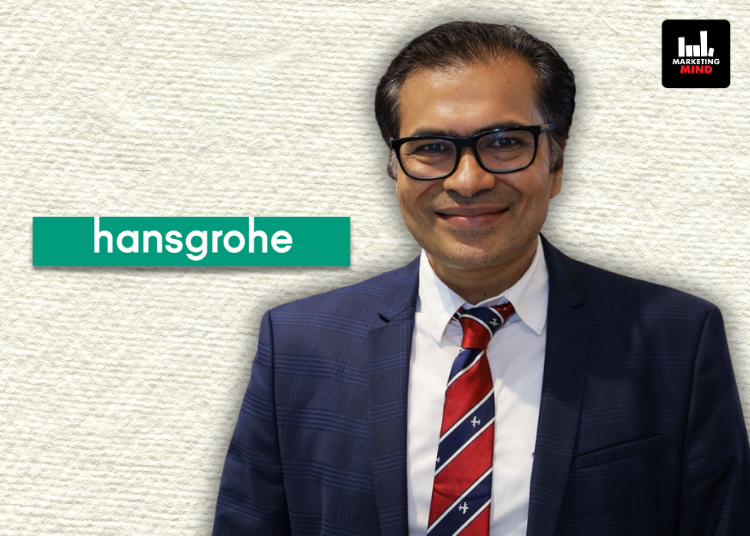
“Success in 2026 will be defined by brand consideration uplift among key decision influencers, measured through quality engagement with architects and designers, and recall at the early stages of the consumer journey,” Vishal Gupta, Commercial Director – Sales and Marketing, Hansgrohe India, said. “It will indicate that Hansgrohe is present in core conversations well before the point of purchase.”
It was a telling place to begin, by speaking not of reach or frequency, but of recall; not of campaigns, but of conversations. In that single metric lay Hansgrohe’s marketing philosophy for the year ahead: influence before intent, education before exposure, and trust before transaction.
Gupta’s reflections traced a decisive shift in how premium brands must advertise in a market that no longer confuses noise with value.
When the Market Stopped Browsing and Started Deciding
“In 2025, India’s premium home and lifestyle market moved from aspiration to intention,” Gupta said. “Consumers began valuing longevity, wellness, purposeful design and trusted performance alongside aesthetics.”
That shift, he explained, fundamentally altered Hansgrohe’s marketing priorities. “Digitally driven discovery and informed research pushed us away from transactional visibility toward education-led storytelling,” he said. “We strengthened early-stage influence through architects, designers and digital platforms, ensuring brand consideration is built long before purchase decisions.”
For marketing, this meant abandoning short-term persuasion in favour of long-term presence.
Advertising Sustainability Without Dilution
“We embedded sustainability not as a moral add-on but as intelligent luxury,” Gupta said. “Resource efficiency, durability and engineering precision had to enhance everyday comfort.”
Water-saving innovations became communication anchors rather than footnotes. “Technologies such as EcoSmart and EcoSmart+, as seen in Raindance Alive, reduce water usage without compromising experience or design,” he said. “This allowed sustainability to reinforce performance and wellness rather than dilute our premium positioning.”
The result was advertising that persuaded without preaching.
Turning a Low-Engagement Category Into a High-Involvement Brand
“2025 reinforced that involvement comes from meaningful participation, not volume,” Gupta said. “Bathrooms, once considered low-engagement spaces, have become emotional and design-centric.”
Hansgrohe’s marketing response focused on people over products. “By engaging homeowners, designers and installers through curated touchpoints and co-creation, we built involvement through relevance, consistency and trust,” he said, “rather than through broadcast-led messaging.”
Fewer Campaigns, Deeper Conversations
“A focused set of experience-led platforms delivered disproportionate impact,” Gupta said. “Curated design forums, partner dialogues and immersive brand ecosystems prioritised depth over reach.”
He pointed to specific IPs that shaped influence. “Collaborations such as D List, along with in-house platforms like Design of Spirits, Teal Club and Developers’ Dialogue, allowed us to build close-knit, niche conversations with architects, designers and developers,” he said. “These initiatives genuinely moved the needle.”
This shift, Gupta noted, redefined media efficiency itself. “Depth over volume, supported by digital amplification, significantly enhanced brand consideration in influential circles,” he said.
Digital as the Core Marketing Engine
“Digital evolved from a channel into an operating system for our marketing,” Gupta said. “It guided discovery, education and inspiration.”
Content followed suit. “We moved from product specifications to design inspiration, sustainability storytelling and expert collaborations,” he said. “Our India Instagram community grew to 38,000 followers, becoming a critical early touchpoint for architects, designers and premium consumers.”
For Hansgrohe, engagement quality replaced vanity metrics.
“Global design principles, innovation, excellence and sustainability, remained non-negotiable,” Gupta said. “Local insights shaped how we told those stories in India.”
This balance, he explained, “allowed us to maintain international prestige while creating relevance for Indian creators, partners and homeowners.”
Advertising, Partnerships and the Road to 2026
“2025 was a defining year for luxury housing and hospitality in India,” Gupta said. “Both segments increasingly prioritised wellness-led, sustainable bathroom experiences.”
Looking ahead, he outlined a clear marketing trajectory. “In 2026, premium housing demand, infrastructure growth and hospitality revival will accelerate interest in experience-driven, technology-enabled solutions,” he said.
Hansgrohe’s advertising and marketing focus, therefore, is set. “Our priority in 2026 will be to deepen partner engagement, expand into high-growth markets, and introduce solutions that set new benchmarks in design, efficiency and everyday comfort,” Gupta said. “Marketing success will come from being present early, credibly and consistently.”
In an age obsessed with immediacy, Hansgrohe’s 2026 playbook, as Gupta articulated, chooses foresight instead.