








VDO.AI’s latest YouTube Advertising Trends Report highlights the growing impact of contextual targeting, with click-through rates (CTR) rising by as much as 55% and view rates increasing from 31.9% to 47%.
While most advertisers on YouTube have traditionally prioritised audience targeting, followed by demographics and intent signals, the report points to an often-overlooked factor: the content environment in which ads appear.
Based on campaign data across seven verticals, the study finds that content alignment is a key differentiator between average and high-performing campaigns. In addition to stronger CTRs and view rates, brand suitability improves significantly from around 70% to over 95%, indicating that contextual relevance enhances both performance and brand safety.
Category-wise, real estate brands advertising alongside home tours and interior content see the highest gains, with CTR uplifts of 40–55%. Automotive campaigns aligned with car reviews and test drives follow with 35–50%, while consumer electronics brands placed next to tech reviews and unboxing videos report increases of 30–45%. Similar trends are seen across FMCG, health and wellness, finance, and edtech, where improvements range between 20–45% depending on the category and content fit.
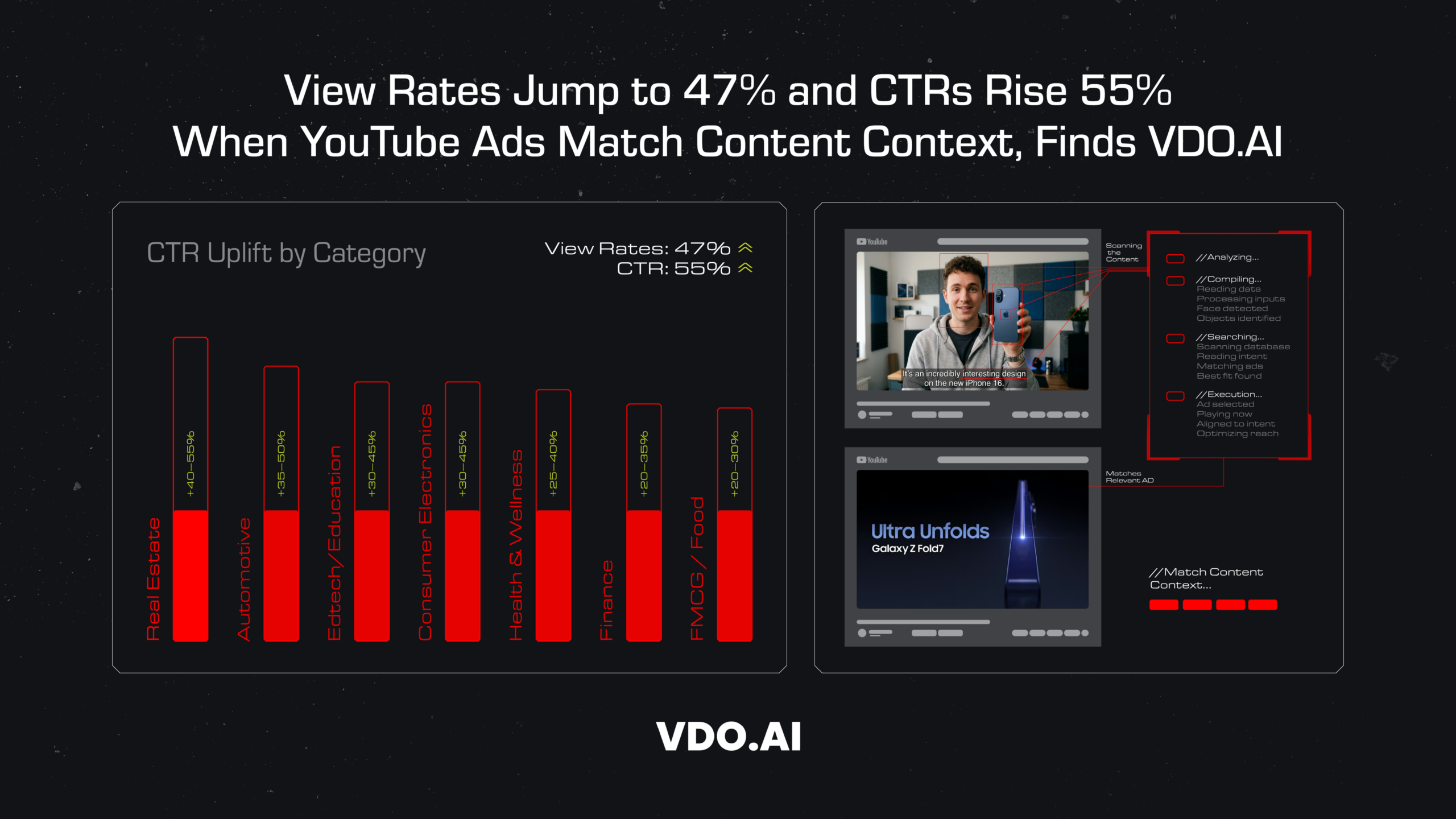
At a transactional level, retail campaigns see CTRs climb from 0.84% to between 1.2% to 1.8%, while travel campaigns improve from 0.78% to between 1.1% and 1.6%.
The findings suggest that beyond identifying the audience, the context of what users are watching at the time of ad exposure plays a critical role. As YouTube continues to expand across formats and screens, the content environment is emerging as a core driver of campaign effectiveness rather than just a secondary optimisation lever.
Arjit Sachdeva, Co-founder, VDO.AI, said, “There is a growing body of evidence and our report adds to it, that audience targeting alone does not fully explain YouTube campaign performance. Across the seven verticals we analysed, campaigns aligned to relevant content environments consistently outperformed unaligned ones on every measured metric. For the industry, the lesson is that context is not a refinement of audience targeting. It is a parallel input that deserves equal rigour at the planning stage.”