






Great advertising often skips the explaining. No voiceover full of adjectives, no chart of bond strength, just the thing itself, shown plainly, with disbelief doing the persuading. Fevikwik’s 1998 “Fishing” commercial, made by Ogilvy, is the purest version of that idea in Indian advertising, and decades later it’s still the reference point for selling an invisible property, instant adhesion, through one absurd, unforgettable image.
The Premise Is the Punchline
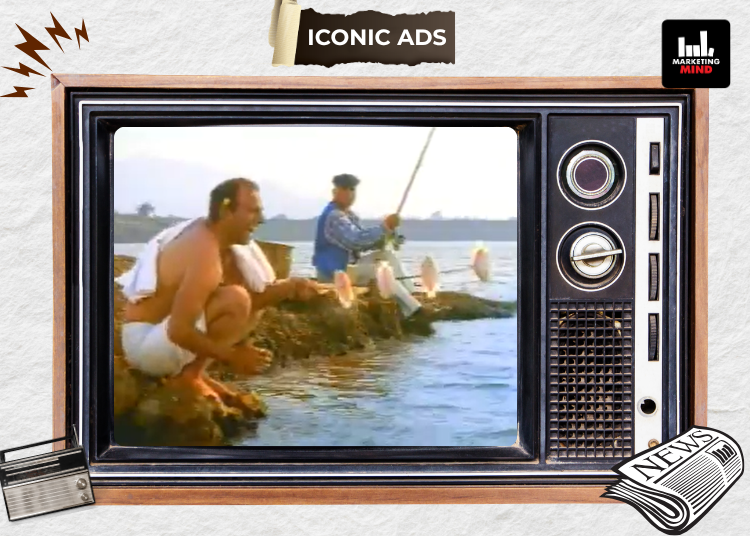
The story lasts seconds: a fisherman dabs a drop of Fevikwik on a bare stick, dips it in the lake, and pulls out a fish stuck to the wood, no hook, no line, no bait. No subplot, no dialogue needed. The joke and the product demo are the same beat, which is rare: everything in frame exists purely to set up that one impossible payoff.
Comedy as Proof, Not Decoration
Where most adhesive ads of the era leaned on technical claims, Fevikwik replaced credibility-by-data with credibility-by-disbelief. A glue funny enough to catch a fish does the math for you: it must be absurdly strong. The viewer isn’t told the glue is instant; they watch a man bend the physics of fishing in real time, and the laugh is what lodges the message in memory.
The Mind Behind It: Piyush Pandey
The ad was conceived by Piyush Pandey, widely regarded as the father of modern Indian advertising and, for decades, the chief creative force behind Ogilvy India. Pandey built his reputation on rejecting the imported, aspirational style of earlier Indian ads in favor of stories rooted in rural, vernacular, everyday life: village idiom, local humor, plainspoken Hindi.
Campaigns like Fevicol’s “unbreakable bond” ads and Cadbury’s “Kuch Khaas Hai” carry the same DNA: ordinary settings turned into stages for a single sharp, visual idea. “Fishing” fits squarely into that signature. It’s a tall tale a villager might tell, not a studio-polished pitch. His brother, Prasoon Pandey, directed the spot, bringing the comic timing and visual restraint needed to make a single gag carry an entire commercial.
A Tagline That Outlived the Ad
“Chutki mein chipkaye” (sticks in a snap) escaped the commercial and entered everyday Hindi vocabulary, the real test of an iconic campaign: people start using the brand’s own language, not just remembering it.
Why It Endures
The ad solved a hard problem with maximum simplicity: how to visualize “instant” and dramatize an invisible property without abstraction. The answer was a tiny, impossible, self-contained world where the punchline doubles as the pitch. In a landscape that often mistakes more (more cast, more cuts, more claims) for better, “Fishing” remains a quiet rebuke: one drop, one stick, one fish, nothing else was needed