






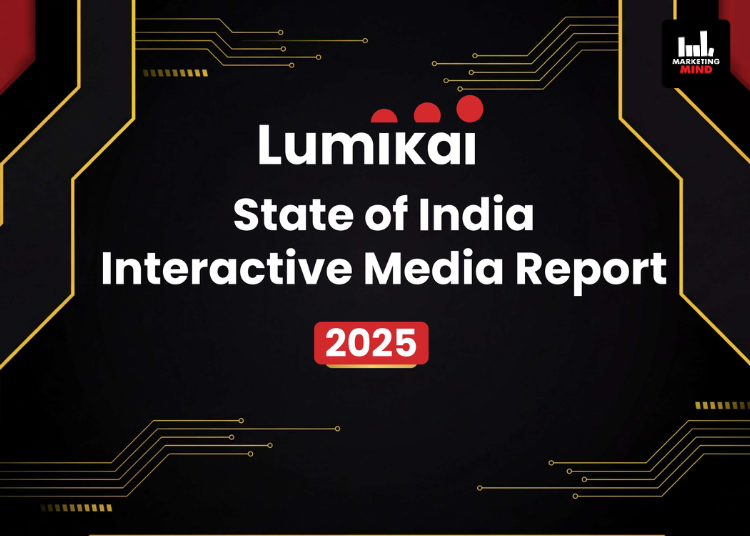
The fifth edition of the ‘Lumikai State of India Interactive Media 2025’ report highlights the rapid evolution of India’s digital content landscape. The report emphasises on the growth of emerging formats like microdramas, which scaled from near insignificance a year ago to a $300 million market today.
The report estimates the sector at $13.8 billion, growing at 17% YoY, driven by a base of 877 million smartphone users. It underscores a broader behavioural shift, as mobile-first audiences increasingly move away from traditional media towards interactive, personalised formats across video, social media, gaming, animation and VFX, and audio.
The report decoded five key components of the surge of the interactive media landscape:
- Micro-Dramas Are The New OTT
Micro-drama platforms are projected to reach $4.5 billion by 2030, with 91% growth expected in 2026. The key driver of this boom lies in the density of 450 million downloads and 100 million MAUs, as people have developed a preference for one-minute serialised dramas built for vertical mobile screens and optimised for the attention patterns of India’s 877 million smartphone users.
These numbers have outperformed the metrics recorded by most OTT platforms.
- India’s Free-To-Play Gaming Market Grew 17%, Crossing $1.5 Billion
India’s free-to-play gaming market grew 17% year-on-year to $1.5 billion in CY25, with ARPPU (Average Revenue Per Paying User) at $18, and is projected to reach $3.2 billion by 2030. ~555 million Indians played mobile games in 2025, with one in four of them being paid users. This pattern has generated $1.5 billion in revenue so far, while being on track to cross $3.2 billion by 2030.
Despite a challenging regulatory year, India’s revenue-to-download mix shows gamers generate 4.5x more revenue than non-gamers, comparable to global benchmarks. In-app purchases are the fastest-growing revenue stream at 19% CAGR, with in-app advertising following at 13%. As real-money gaming is removed from the revenue mix, IAP revenue becomes a primary lever of monetisation.
- RMG Users Migration
One in three real-money gaming (RMG) users has shifted to offshore platforms, spending up to
Rs 10,000 per month in an unregulated, zero-tax environment. India’s Promotion and Regulation of Online Gaming Act, passed in August 2025, banned real-money gaming.
The primary research, in conjunction with VTION, estimates that approximately one in three erstwhile RMG players migrated to offshore betting platforms, spending up to Rs 10,000 per month with no regulatory oversight, no consumer grievance mechanisms, and no tax contribution to the Indian exchequer.
A measurable rise in VPN-enabled browser usage among RMG users further corroborates the shift. Banning did not eliminate demand, but it merely redirected it. The remaining majority redistributed time toward microdramas, audio platforms, and social entertainment, directly accelerating growth in those categories.
- India’s Animation Building Its Own Blockbusters
India’s $1.6 billion AVFX industry, which derives 80% of its revenue from international studios, is increasingly investing in original IP as AI reduces production timelines by 30–50%.
Indian animation titles like Mahavatar Narsimha ($40M global box office collections) and The Legend of Hanuman (~9.4M OTT views), along with the much awaited Baahubali: Eternal War, signal a growing audience appetite for made-in-India animated IP.
Four in five rupees earned by India’s $1.6 billion animation and VFX industry serve foreign productions. Increasingly, for the first time, domestic films like RRR, Brahmastra, Pathaan, and Tiger 3 show a surging domestic market as Indian filmmakers allocate 15% – 30% of production budgets to VFX. AI is now compressing production timelines by 30% to 50%, shifting India from a cost-arbitrage workforce to a speed-led, IP-capable competitor.
- Astro And Micro Learning Apps Outmonetise Social Media
Astro-devotional and micro learning platforms lead with $8.4 and $5.5 annual ARPU respectively, despite smaller user bases, showing that intent-led categories monetise better than scale-driven platforms.
Astrology and devotional platforms like AstroTalk, SriMandir, and AstroYogi generate nearly 40% higher annual ARPU than social media, highlighting significantly stronger monetisation per user. High-trust, intent-driven verticals convert and retain paying users at rates that horizontal platforms cannot match.
Interactive and micro learning platforms like Duolingo, Seekho AI, Master AI by Eloelo, and Supernova AI show the same pattern. They are emerging as a fast growing acquisition channel with 290M cumulative downloads in 2025 alone. The next generation of category winners in India will be built vertically, not horizontally. Interest and intent in a specific domain beats broad reach with shallow monetisation built for habit and boredom.
Commenting on the report, Salone Sehgal, Founder and Managing Partner, Lumikai, said, “Micro-dramas crossed $300 million in their first year. That tells you something fundamental about where Indian media is heading – toward formats that are mobile- native, interactive, and geared for a new generation of media consumers. The paradigm shift from search to social to video is well understood. The next shift with interactive media and AI is now underway in India.”
Aditya Deshpande, Principal, Lumikai, said, “The RMG ban didn’t eliminate demand. Our research with VTION shows one in three former players migrated to offshore betting platforms – spending up to Rs 10,000 a month with zero oversight, zero tax contribution, and zero consumer protection. Meanwhile, the rest of the market is healthy: video gaming grew 17% and is on track to cross $3 billion by 2030. The demand is real. The question is whether regulation channels it productively.”