







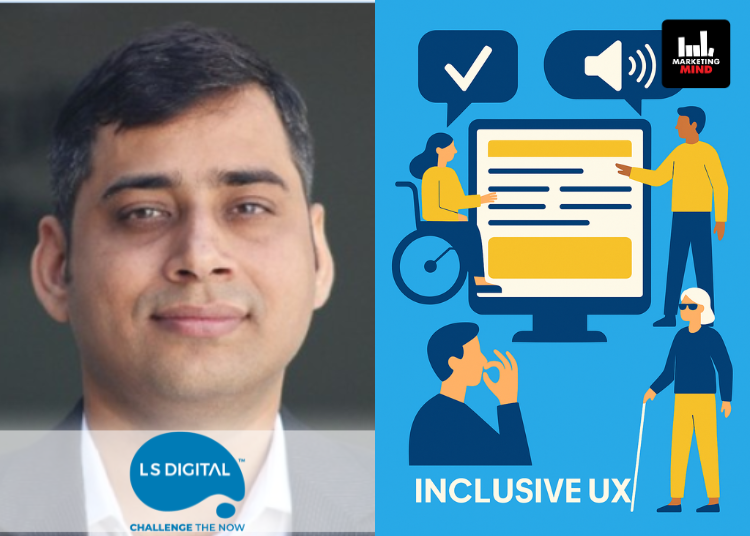
Our lives are increasingly mediated by screens. From booking a doctor’s appointment to applying for a government ID, from paying utility bills to accessing education, everyday activities have shifted online. But while digital platforms promise convenience, they don’t work equally well for everyone.
For millions, navigating these platforms is difficult- sometimes even impossible. Barriers related to disability, age, geography, language, or digital literacy still exclude vast segments of India’s population. And as the country moves toward becoming a $1 trillion digital economy, this exclusion is no longer acceptable.
This is where User Experience (UX) design acts like a catalyst for equity. Good UX is rooted in empathy. It’s about designing digital experiences that are not only efficient and elegant but also equitable. It’s a discipline that, when applied with care and intention, can help dismantle the invisible barriers between people and technology.
In India, over 2.2% of the population lives with a disability. That’s over 26 million people. Globally, the number crosses one billion. Add to that the elderly – projected to make up 20% of India’s population by 2050 – and the millions who speak regional languages, use shared phones, or are new to the internet. The idea of a single “average user” no longer holds.
Digital platforms must now accommodate a spectrum of experiences.
Yet, inclusion often remains an afterthought. Accessibility tends to be viewed through the narrow lens of compliance – something that’s patched in late, rather than built into the design from the start. But inclusion is not a checklist. It’s a mindset. True accessibility involves everything from thoughtful colour choices and consistent layouts to offering voice support, local language content, and interfaces that don’t assume high-speed internet or the latest smartphones.
A recent global study by WebAIM found more than 50 million distinct accessibility errors across just one million websites. In India, while efforts like the Accessible India Campaign are creating awareness, the execution gap remains wide. Without an ecosystem-wide commitment – from businesses, designers, developers, and regulators – digital access will remain uneven.
Language and localisation are among the most overlooked barriers in digital design. Despite the linguistic diversity of India – with 22 official languages and hundreds of dialects – most apps and platforms default to English or, at best, Hindi. For users in Tier II and Tier III cities, this creates a language barrier for a significant portion of the population. Translating interfaces isn’t enough. Localisation requires cultural nuance: the right icons, metaphors, and tones that resonate with a specific community.
This also ties into how we design different devices and tech realities. Many Indians access the internet on shared, low-end smartphones. They deal with irregular connectivity, limited storage, and slower processors. A beautifully designed app that works smoothly on a flagship phone may fail entirely in these real-world conditions. Optimizing for lower bandwidth, building adaptive layouts, and offering offline support are not just technical decisions but acts of inclusion.
Importantly, inclusive UX isn’t just about doing good. It makes business sense. Studies show that companies prioritizing accessibility perform better financially. Inclusive platforms attract more users, build deeper engagement and long-term loyalty. Tech giants like Microsoft and Apple have embedded accessibility at the heart of their product strategies. Closer home, Indian fintech, healthcare, and edtech startups are beginning to realise that inclusive design is not a niche investment but a growth strategy.
Creating inclusive digital experiences calls for more than periodic audits or accessibility widgets. It demands a shift in perspective. It means involving diverse users in the design process – not just testing for usability at the end but co-creating from the start. It means questioning assumptions, embracing simplicity, and designing not just for users like us, but for users unlike us.
Inclusive UX will be the differentiator between services that scale and those that serve. Designing for everyone isn’t a technical challenge. It’s a reflection of what we value as a society. With empathy and intention, UX can turn the promise of digital India into a reality for all.