


For years now, the death of television has been a recurring headline in media conversations, often driven by the rise of OTT platforms, creator-led content, and mobile-first audiences. But if Day 2 discussions at Goafest 2026 were any indication, industry leaders believe television’s obituary may have been written far too soon.
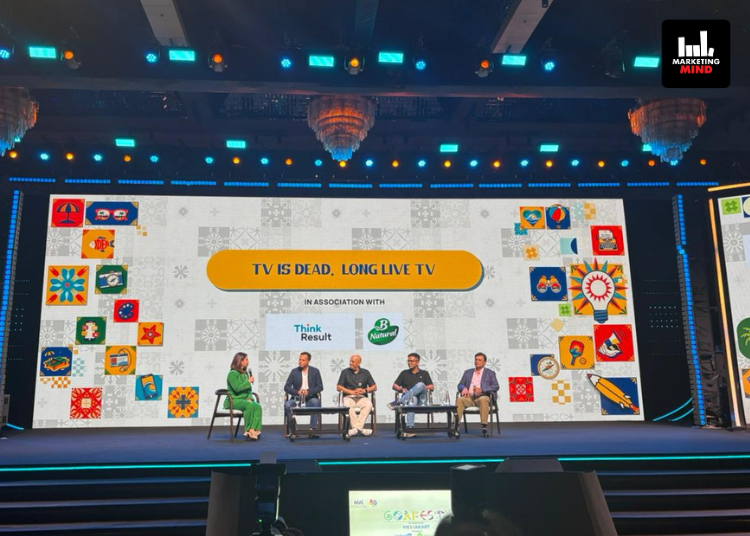
At a panel titled ‘TV Is Dead. Long Live TV – Resetting the Role of Television in the Age of Fragmentation’, speakers unpacked television’s changing role in an increasingly fragmented media ecosystem, arguing that while consumption habits have evolved, TV continues to remain one of India’s most powerful storytelling and brand-building mediums.
The panel featured Akshay Agarwal, Head, Linear Ad Sales, Sony Pictures Network India; Rajiv Dubey, Vice President, Media and Marketing Activations, Dabur India; Arpan Biswas, CMO, Ajio; and Avinash Pandey, Secretary General, IBDF, with Tamanna Inamdar, Managing Editor, NDTV Profit, moderating the session.
One of the strongest arguments made during the discussion was rooted in sheer scale. Television in India, speakers noted, still reaches nearly 900 million viewers across 190 million TV homes, with penetration continuing to grow at nearly 6% annually and expected to add over 100 million more TV homes by 2028. The consensus across the panel was clear: “Television is not dead, only the mode of signal delivery has changed.”
Speakers argued that rather than a battle between legacy and new media, the future lies in coexistence, with TV + OTT together driving deeper content consumption. Television, they said, continues to remain one of the strongest mediums for mass reach, community viewing, trust and credibility, and unskippable storytelling, while also offering what many digital-first ecosystems struggle to replicate – emotional brand building at scale.
Agarwal said television continues to deliver massive scale with high watch-time and credibility, but acknowledged that broadcasters now need to evolve from passive reach to participative engagement. He pointed to shows like Indian Idol and KBC, arguing that their success lies not just in viewership but in how audiences vote, engage socially, follow contestant journeys, and use second screens and apps.
According to Agarwal, the future TV playbook will increasingly revolve around interactive content, social amplification, co-created viewer experiences, and brand moments integrated within content. He also called for industry conversations to move beyond GRPs and reach toward ROI, attribution, and business outcomes, adding, “It is not TV versus digital, it is TV and digital.”
Dubey brought a marketer’s lens to the conversation, pointing out that in southern markets and several Indian states, TV penetration still remains over 80-90%, while both Free-To-Air TV and Connected TV are growing rapidly.
For brands, he argued, media planning can no longer be an either-or debate. Instead, marketers today need a mix of television, celebrities, regional influencers, and micro-content formats to build reach and relevance. While younger audiences like Gen Z may often use mobile as their first screen, Dubey said influencer marketing comes with its own set of challenges, including brand safety risks, reputation volatility, and cancel culture concerns, making credible platforms like television a safer environment for many brands.
Biswas added that communication today is only one part of brand building, especially for e-commerce businesses where the actual consumer experience often defines the brand as much as advertising does.
He noted that for digital-first brands, elements like search experience, delivery, user interface, and customer journey play a direct role in shaping brand perception. Biswas argued that television is fundamentally a distribution channel, similar to digital platforms, and that the same content today can travel across TV, Meta, YouTube, and OTTs depending on strategy. According to him, the real conversation should not be about platform superiority, but about content effectiveness and business outcomes.
A larger theme that emerged through the discussion was that emotional brand building cannot happen purely through algorithms, and that every medium continues to have its own utility. While influencer ecosystems and digital platforms may offer agility and audience precision, television still retains unmatched strengths in mass storytelling, shared viewing, trust, and cultural credibility.
As fragmentation continues to reshape media consumption, the panel made one thing clear – television may no longer be the only screen, but it remains far from irrelevant. In fact, in an age of choice overload, its role may simply be evolving rather than disappearing.