


Brands in India are navigating an increasingly complex advertising landscape. Consumers are scattered across multiple channels, attention spans are shorter, and marketers are challenged to balance immediate performance with long-term brand growth.
These themes were at the heart of a fireside chat at the 10th edition of the dentsu Digital Advertising Report 2026, held in Mumbai recently. The fireside chat featured Priyanka Khaneja Gandhi, Head, Ads Marketing and Creative Solutions at Amazon Ads India, in discussion with Narayan Devanathan, President and Chief Strategy Officer, South Asia at dentsu.
Gandhi traced the evolution of retail media from physical stores to online marketplaces. “When we started traditional retail, it was all physical…all about being in stores. Then, in the online marketplaces, giving us access to consumers online and shopping signals, probably it was called Retail Media 1.0, and that was the start of retail media,” she said.
She explained that Retail Media 1.0 focused on capturing shopping intent through sponsored products and search. “Brands were using sponsored products and search, when people were shopping online, trying to capture the intent of buying at that point in time,” she added.
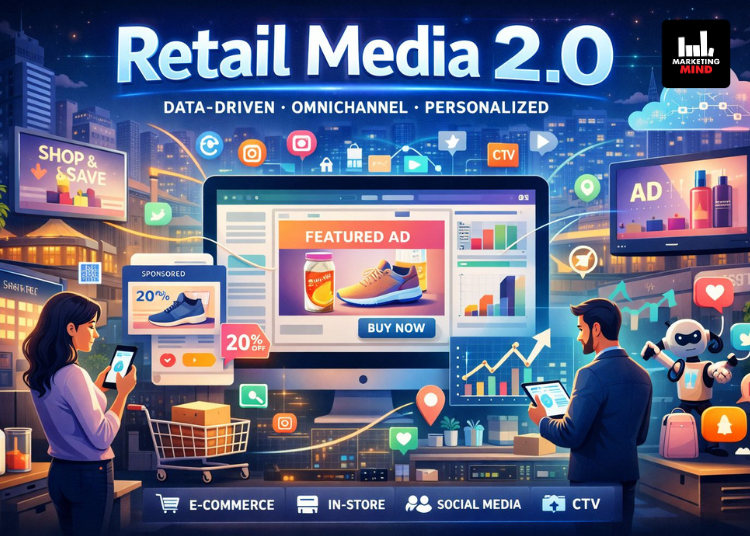
Turning to Retail Media 2.0, Gandhi highlighted its full-funnel approach. “Retail media 2.0 is all about moving up the market. Online marketplaces like Amazon now are diversifying and we have a whole host of ad solutions, right from video to display ads, social amplification, influencers, and all the way down to shopping touch points. All being provided in a unified way through one service. What this enables brands to do is actually engage with consumers across the consumer chain.”
She described three key drivers behind this transformation. “One is real-time, real signals. We have trillions of signals across browsing, streaming, and shopping, capturing people in the entertainment zone and shopping. Second, advertising solutions span awareness, consideration, and purchase. And third, holistic measurement, the ability to measure outcomes from brand building to delivering business results,” she said.
Gandhi also shared growth statistics for retail media. “If you look at retail media in more developed markets, take the United States for example, retail media spend is already around 15% to 20% of overall ad spend, with over 17% year-on-year growth. Some market forecasts even predict it will surpass television ad revenue by 2028. In India, over 10% of ad spend is now retail media, with projected growth at 25% year-on-year,” she said.
Devanathan asked how full-funnel advertising can help brands navigate fragmented attention. Gandhi explained that consumers interact across multiple touchpoints, making a single channel insufficient. “People are spending time across so many touch points. Attention spans are falling. Unlike the earlier world, a single touch, it is very hard for any single touch point to make people aware of the brand, build preference, and nudge them to purchase,” she said.
She detailed how full-funnel advertising works in practice. “When I help you drive awareness, there are avenues like video streaming where you can do brand storytelling, which makes people aware the brand exists. Then for consideration, you can re-market those audiences when consumers are evaluating brands. Finally, at the shopping touchpoint, you can nudge them with specific ads to convert. It enables you to reach the right audience at the right time, helping to grow reach, build preference, and drive conversions. It also drives loyalty,” she said.
Measurement is also handled differently for large and digital-first brands. “For established brands, they focus on building memory structures and balancing upper, mid, and lower funnel investment. Digital-first brands focus on optimisation and reaching more consumers. Full-funnel advertising enables long-term growth while taking care of short-term sales,” she said.
Furthermore, Gandhi illustrated the impact of full-funnel strategies with brand examples. “L’Oréal Dermatological Beauty, launching CeraVe, mapped audiences across the funnel: awareness, consideration, and conversions. As a result, CeraVe became the number three brand within six months of launch,” she said.
“Colgate’s premium whitening toothpaste, using a similar strategy, became a best-seller within three months. Digital-first brand Euroloop, using a full-funnel strategy, saw a 47% increase in brand searches and a 40% increase in conversions,” she added.
She also highlighted Amazon’s scale and integration. “Amazon MX Player gives us a broad reach of 250 million active users monthly, and then there are premium households you can reach through Prime Video. It is access to premium relevant audiences through innovative video formats, integrated with culture and content. Someone who watches an ad on Prime Video can be shopping on Amazon.in, and we can measure that,” she said.
Looking ahead, Gandhi emphasised the strategic importance of retail media. “Retail media is no longer going to be an option. It is becoming a necessary competitive advantage and an active brand partner for growth,” she said.