




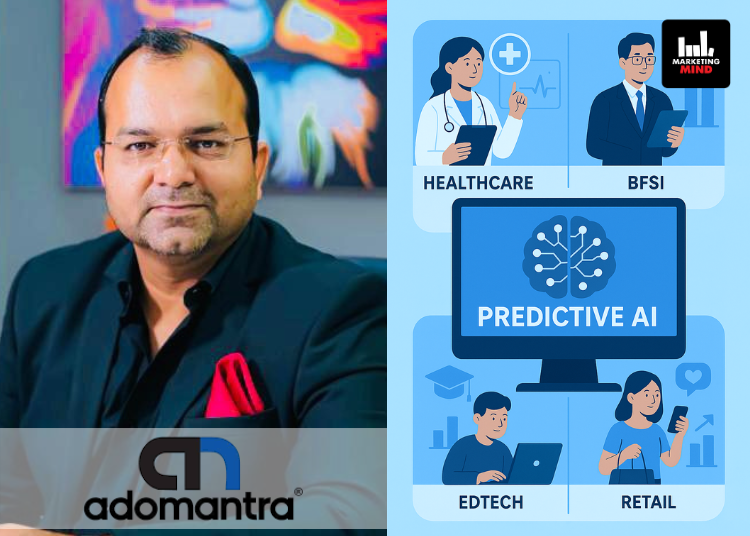
Artificial Intelligence is a game changer across the globe and within that Predictive AI will become transformational in the coming years. The artificial intelligence industry will reach $3,935.5 million by 2028. Every sector and industry are expected to use Artificial Intelligence, which will lead to a massive industry revolution.
Businesses and governments will use it to make data-driven choices, streamline operations, and improve strategic planning. It will find its way in healthcare, banking, trade, logistics, BFSI sectors and will also be increasingly used in the marketing tools and campaigns. Let’s explore four key sectors where AI, especially predictive AI is set to transform marketing strategies, and understand how each is harnessing its power to drive smarter, data-led growth.
Healthcare: India’s healthcare market is experiencing explosive growth, estimated to be $1.6 billion in 2025, expanding at an annual growth rate of around 40.6%. Think of a patient receiving a perfectly timed reminder about his annual health check-up, along with wellness tips based on his medical history. It is like e-commerce platforms showing the exact product recommendation that we are looking for. But in the case of healthcare, it is providing personalised health information and service suggestions. Electronic health records and patient interactions are remembered and analysed for every patient interaction, understanding patterns in health behaviours to provide personalized care. Predictive AI in healthcare marketing is expected to increase the patient experience by close to 35% in the coming two years.
BFSI- The global artificial intelligence (AI) in BFSI market size is estimated to reach USD 37.99 billion in 2025 . This is one sector, which will exponentially use AI and predictive AI to help and support consumers, assess risks, use algorithms for fraud detection, and customise recommendations based on incomes.
AI in BFSI can host millions of parameters and process complex, multifaceted data, making them ideal for predictive analysis. It is also now being used to target consumers based on their age, family history, income bracket, geography suggesting best financial services, as per their life and living. Using Predictive AI in marketing, can enhance consumer outreach by 55%; it usually integrates with existing marketing automation tools, offering data-driven insights to supercharge automated marketing campaigns.
EdTech: AI analyses student activity, completion rates, engagement levels, and quiz performance to predict which courses they are likely to buy next. Marketing messages are then tailored basis the areas of interest and learning pace. Predictive AI analyses on what kind of marketing messages should reach which kind of students. Geo-targeting is then used for regional campaigns. Predictive AI helps consumer acquisition based on time spent on the platform, content consumed and frequency of return visits. It also uses cross device retargeting, to re-engage with users who visited the site but did not sign up; it keeps showing ads on YouTube, Instagram or any other app.
Retail: Another sector which will increasingly use predictive AI, is the retail, specifically e-commerce industry. Data-driven personalization, optimisation of inventory management, enhanced customer experiences, will be driven by Predictive AI to a large extent, going forward. The AI in retail market in India generated USD 584.7 million in 2024 and is projected to grow to USD 3.47 billion by 2030, at a CAGR of 33.7%. The demand forecast usually informs retailers how much inventory is needed, when it is needed, and accordingly marketing campaigns are set to reach out to the consumers. Programmatic targeting is used to align ad delivery with real time consumer behaviour across platforms.
Predictive AI will lead to a paradigm shift as it can analyse which consumers will buy, think of buying later or even unsubscribe. Accordingly, it will help marketers reach out to consumers, suggesting the best ads, best time to showcase the ads. It can also suggest on which creatives, formats, ad campaigns can drive the highest engagements.
Predictive AI can increase sales by 30-35% and with more advancements in its technology, the sales conversion rates can be even higher. There can be real time bid adjustments in programmatic advertising. Hence, for marketers Predictive AI will not remain as an option but will become integral for optimum results in developing and driving marketing campaigns.