





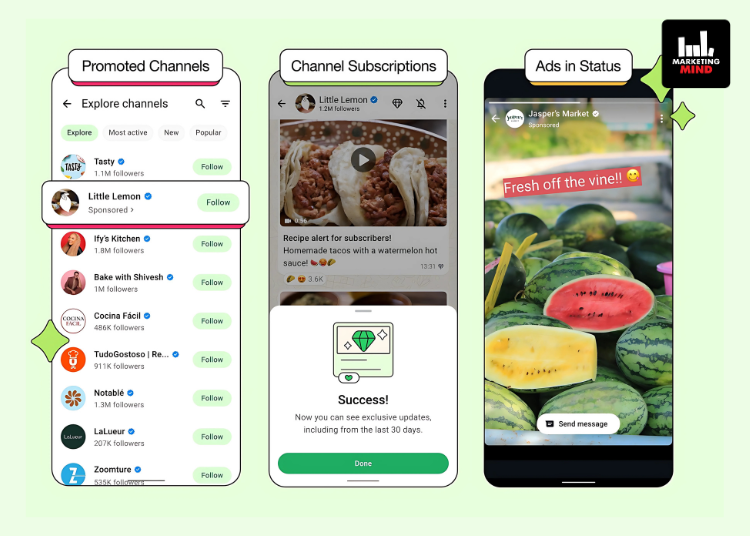
For years, WhatsApp has remained Meta’s most private and least commercialised product- intended for conversations, not conversions. But now, the platform is taking its most decisive step yet into advertising. With the announcement of Status Ads, Promoted Channels, and Paid Channel Subscriptions, Meta is gently prying open the gates for brands to connect with users inside what has long been considered a sacrosanct, utility-first space.
These ad formats will appear exclusively in the Updates tab- a space that includes WhatsApp Status, India’s version of Instagram Stories, and Channels, one-way broadcasts from people, brands, or organisations users choose to follow. Importantly, these tools are kept separate from WhatsApp’s core chat interface, preserving its end-to-end encrypted sanctity.
For marketers, this is both a tantalising opportunity and a tightrope walk.
India, with over 500 million WhatsApp users as last publicly disclosed by Meta, has long been one of the platform’s most active markets. It’s also one of the most sensitive when it comes to privacy and brand communication. Meta’s approach seems aware of this, building ad experiences that are native to high-engagement surfaces like Status and Channels, without breaching the intimacy of personal chats.
The big question: Can brands strike the right balance between discoverability and discretion in a space that thrives on trust?
While the industry leaders we spoke to had varying perspectives on execution and user sensitivity, they shared a common belief: WhatsApp’s shift into advertising will only succeed if marketers tread carefully and respect the platform’s intent-based usage.
Some see Status and Channel ads as a potential goldmine for time-sensitive and transactional messaging. Others warn that misuse could backfire spectacularly, turning India’s most beloved app into yet another ad-saturated space.

Dhanya Mohan, Lead – Strategy at TheSmallBigIdea, believes this separation is crucial to preserve the app’s user experience. “Ads in Status, paid Channel subscriptions, and Promoted Channels now offer businesses sharper targeting without disrupting the user experience, as these appear in the Updates tab only.”
Adityan Kayalakal, VP – Marketing at Jupiter, sees potential but with caution. “WhatsApp has been a non-spam place for years. But now, with out-and-out advertising visible, there will be some early pains. If we can find the relevant mix of messaging, it still makes sense to advertise here.”
He believes India’s price-sensitive market will shape how users respond.

“There’s going to be some amount of initial outrage because customers are finding ads in every place. The outrage when Amazon Prime started telling customers that you’re paying us, but we’re still going to show you ads. You pay us a little more to take ads out. We are a cost-conscious country, so having ads might be a better outcome than starting to pay for the platform.”
Still, Kayalakal stresses the need for careful testing. “It’s too early to talk about results; it’s still experimental. We’ll need three months to see the real impact.”
Marketers often treat all Meta platforms alike. But Kayalakal warns against this mindset.
“We open WhatsApp not for distraction. We open it for a reason to message a family member or colleague. On Instagram, you seek entertainment. So if you put advertising in WhatsApp, it can feel more like an obstacle.”
This intent-based usage is both the opportunity and the challenge. WhatsApp is seen as a need-based tool, not an entertainment feed. That’s why brands must tread lightly, tailoring content to be useful, not flashy.

Garima Vishnoi, SVP – Media Alliances and Partnerships at White Rivers Media, agrees that success will depend on a brand’s sensitivity to user context.“Success here isn’t guaranteed. The line between value and intrusion is razor-thin. Over-message, and the audience will mute you. Fail to deliver, and you’ll be blocked.”
Transactional messages, quick updates, and time-sensitive deals might be the best fit.
“Brand communication should align with this action-driven mindset, tactical messages like offers, limited-edition launches, order updates, and discount codes perform best currently,” Mohan said.
Larger brand-building or storytelling efforts might struggle unless delivered via opt-in Channels, Mohan added.
Kayalakal shared that his team is already exploring how to approach WhatsApp as a media platform, “We had a workshop this week to figure out how we want to use the platform. We’re also at the Meta Marketing Summit this Friday. We’ll start talking to their teams about what kind of shortcuts we can take in some cases.”
Still, he’s clear: there’s no rushing in. “I think we’re going to be careful about how we walk into this because consumer backlash is something we don’t want to create.”
For now, Kayalakal sees WhatsApp as part of customer engagement or service budgets — not core awareness or performance buckets.“I think WhatsApp is a separate allocation. It would fall within events, customer maintenance, and customer service.”
That said, he’s keeping room in his experimental budget. “Every good marketer has a little bit of budget that they keep for experiments on new platforms. If it tests well, then you would see it taking a serious place in next year’s budgets.”
In its previous avatar, WhatsApp was a no-go zone for marketing. Now, with monetisation entering carefully ringfenced areas, marketers are being invited in but with a warning.
“This isn’t just marketing,” said Vishnoi. “It’s an invitation to respect the user, their boundaries, and their intent.”
The ad formats may be new, but the expectation remains old: make it worth the user’s time, or don’t show up at all.
Kayalakal puts it best, “Start small, literally baby steps. See what the response is, and see how we can improve it to actually help the customer.”
For brands and marketers, this marks the first time WhatsApp offers scalable, structured tools for discovery and engagement within its ecosystem. As these features continue to roll out globally, India is expected to remain a key market for adoption, experimentation, and impact measurement- given its high user base and WhatsApp-first digital habits.
The next phase of this rollout will likely hinge on platform performance, user receptiveness, and advertiser feedback, as Meta expands WhatsApp’s role from a communication tool to a measurable media channel.