






In a digital ecosystem increasingly shaped by dashboards, platform metrics, impressions and performance scores, a bigger question is beginning to challenge marketers and advertisers alike: who measures the measurers?
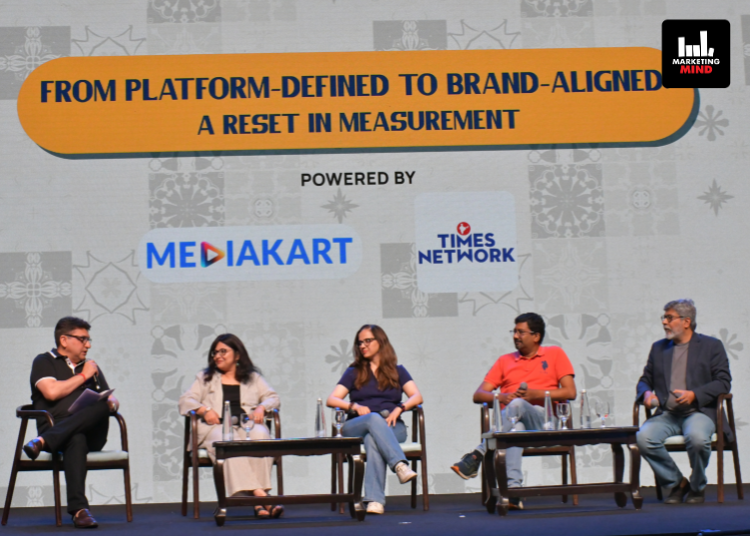
That question took centre stage during a Day 3 panel discussion at Goafest 2026 titled ‘From Platform-Defined to Brand-Aligned: A Reset in Measurement’, where industry leaders debated how brands should rethink measurement in an era where platform-defined metrics often dominate marketing conversations.
The panel featured Aditi Mishra, CEO, Lodestar; Dhiraj Gupta, Co-Founder & CTO, mFilterIt; Neha Markanda, Chief Business Officer, ShareChat; and Shahad Anand, Business Head, Mediakart, with Ashish Sehgal, CEO, Times TV Network and CGO, Times Media & Entertainment, moderating the session.
A strong consensus across the panel was that while data has become central to marketing decision-making, measurement cannot remain confined to platform dashboards or performance-led vanity metrics alone.
Gupta framed the issue around trust, arguing that measurement is ultimately about validating platform claims and building advertiser confidence. He stressed that independent third-party measurement is essential instead of relying only on platform-defined metrics, especially in digital advertising where advertisers often never physically see their own targeted ads.
According to Gupta, “Brands need proof of audience quality, delivery and campaign execution, cautioning that agencies have seen instances where campaigns showed high impressions but low actual delivery.” He summed up the conflict bluntly, saying, “The maker cannot be the checker and the checker cannot be the maker,” highlighting how platforms marking their own performance can create clear conflicts of interest.
At the same time, Gupta argued that not everything can or should be measured purely through numbers, noting that creativity, instinct and consumer understanding still remain important, even in increasingly data-driven ecosystems.
Meanwhile, Mishra expanded on that idea, saying platform metrics should be treated as tools and not the final measure of brand success. While performance metrics can offer useful signals, she argued that they cannot define long-term business growth on their own, especially since platforms are ultimately designed to grow themselves, not necessarily build brands. Mishra stressed that there is no single universal source of truth in measurement today, and while models like MMM may be useful, they are often backward-looking and less agile for today’s fast-changing ecosystem.
For Mishra, the real challenge lies in balancing data, instinct and consumer understanding, because ultimately, “consumers buy products, not algorithms.” She also argued that creative storytelling remains critical alongside measurement frameworks, since structured metrics alone cannot create emotional brand impact.
Anand brought the conversation back to business fundamentals, saying brands are ultimately driven by efficiency, money and growth, but measurement itself should never become the end goal. Metrics such as CAC, ROAS and conversions, he argued, only matter if they are actually driving business outcomes. According to Anand, brand building, customer acquisition and direct sales all require different measurement approaches, and campaigns must ultimately be judged on whether they are creating behavioural or perception change, not just reporting numbers on a dashboard.
He also stressed that as every piece of digital content becomes monetisable, the need for trusted third-party verification systems becomes even more critical to ensure advertiser money is being utilised transparently.
Markanda offered a platform-side perspective, arguing that platforms need to position themselves as partners aligned with brand objectives, rather than one-size-fits-all solutions. She noted that different platforms solve different business use cases and cannot fulfil every objective equally, pointing out that ShareChat’s own strength lies in driving engagement and user-generated participation.
Markanda said user participation and content creation are often stronger indicators than surface-level metrics, describing “user truth” as moments when audiences actively engage and participate in campaigns, while “brand truth” ultimately lies in improvements in sales, traffic and business metrics.
She argued that brands need to triangulate platform data, user behaviour and business outcomes together, rather than expecting perfect metric alignment. According to Markanda, platform context matters as much as impressions and reach, especially in a market like India where consumer behaviour differs widely across regions, languages and cultures.
The discussion also challenged traditional targeting frameworks, with speakers noting that demographic-based targeting alone is no longer sufficient, and that brands need to move toward cultural relevance and contextual storytelling.
A larger takeaway from the session was that measurement frameworks themselves may need to evolve to better account for creator ecosystems, language diversity, platform culture and contextual engagement, rather than reducing everything into cost, reach or engagement metrics.
As digital media becomes more fragmented and monetisation becomes increasingly complex, the panel made one thing clear: measurement should help brands achieve business objectives, not become the objective itself. In an era where trust is becoming non-negotiable, brand-aligned measurement may matter more than platform-defined success.