



Marketing Mind
Newsletter
  • Home
  • Advertising
  • Marketing
  • Media
  • Business
  • What’s Buzzing
  • AdAura Awards
  • More
    • All
    • Case Studies
    • Celebrating Women Leaders
    • Guest Posts
    • Podcast and Video
    AI Didn't Change What Agencies Make, It Changed What They're For

    AI Didn’t Change What Agencies Make, It Changed What They’re For

    The Hunger To Keep Improving Is What Drives Me: Jitika Gupta

    The Hunger To Keep Improving Is What Drives Me: Jitika Gupta

    Campaigns Don't Build Brands, Customers Do

    Campaigns Don’t Build Brands, Customers Do

    How AI Agents Are Helping Brands Run Hyper-Local Campaigns At Scale

    How AI Agents Are Helping Brands Run Hyper-Local Campaigns At Scale

    Confidence Is Something You Build By Doing Things That Scare You: Priyanka Arora On Embracing Uncertainty

    Confidence Is Something You Build By Doing Things That Scare You: Priyanka Arora On Embracing Uncertainty

    Why Global Pop Culture Is The New Local Marketing

    Why Global Pop Culture Is The New Local Marketing

No Result
View All Result
  • Home
  • Advertising
  • Marketing
  • Media
  • Business
  • What’s Buzzing
  • AdAura Awards
  • More
    • All
    • Case Studies
    • Celebrating Women Leaders
    • Guest Posts
    • Podcast and Video
    AI Didn't Change What Agencies Make, It Changed What They're For

    AI Didn’t Change What Agencies Make, It Changed What They’re For

    The Hunger To Keep Improving Is What Drives Me: Jitika Gupta

    The Hunger To Keep Improving Is What Drives Me: Jitika Gupta

    Campaigns Don't Build Brands, Customers Do

    Campaigns Don’t Build Brands, Customers Do

    How AI Agents Are Helping Brands Run Hyper-Local Campaigns At Scale

    How AI Agents Are Helping Brands Run Hyper-Local Campaigns At Scale

    Confidence Is Something You Build By Doing Things That Scare You: Priyanka Arora On Embracing Uncertainty

    Confidence Is Something You Build By Doing Things That Scare You: Priyanka Arora On Embracing Uncertainty

    Why Global Pop Culture Is The New Local Marketing

    Why Global Pop Culture Is The New Local Marketing

No Result
View All Result
Marketing Mind
No Result
View All Result
Home Advertising

Multiple Fears Have Made Creativity A Lost Child In Advertising: Swati Bhattacharya

In an exclusive interaction with Marketing Mind, Swati Bhattacharya, the outgoing Creative Chairperson of FCB India, opened up on her more than three decades long journey in the adworld, its transformation over the years and why she wants to be a soldier of creativity without a joblist.

Shreya Negi by Shreya Negi
February 26, 2024
in Advertising
A A
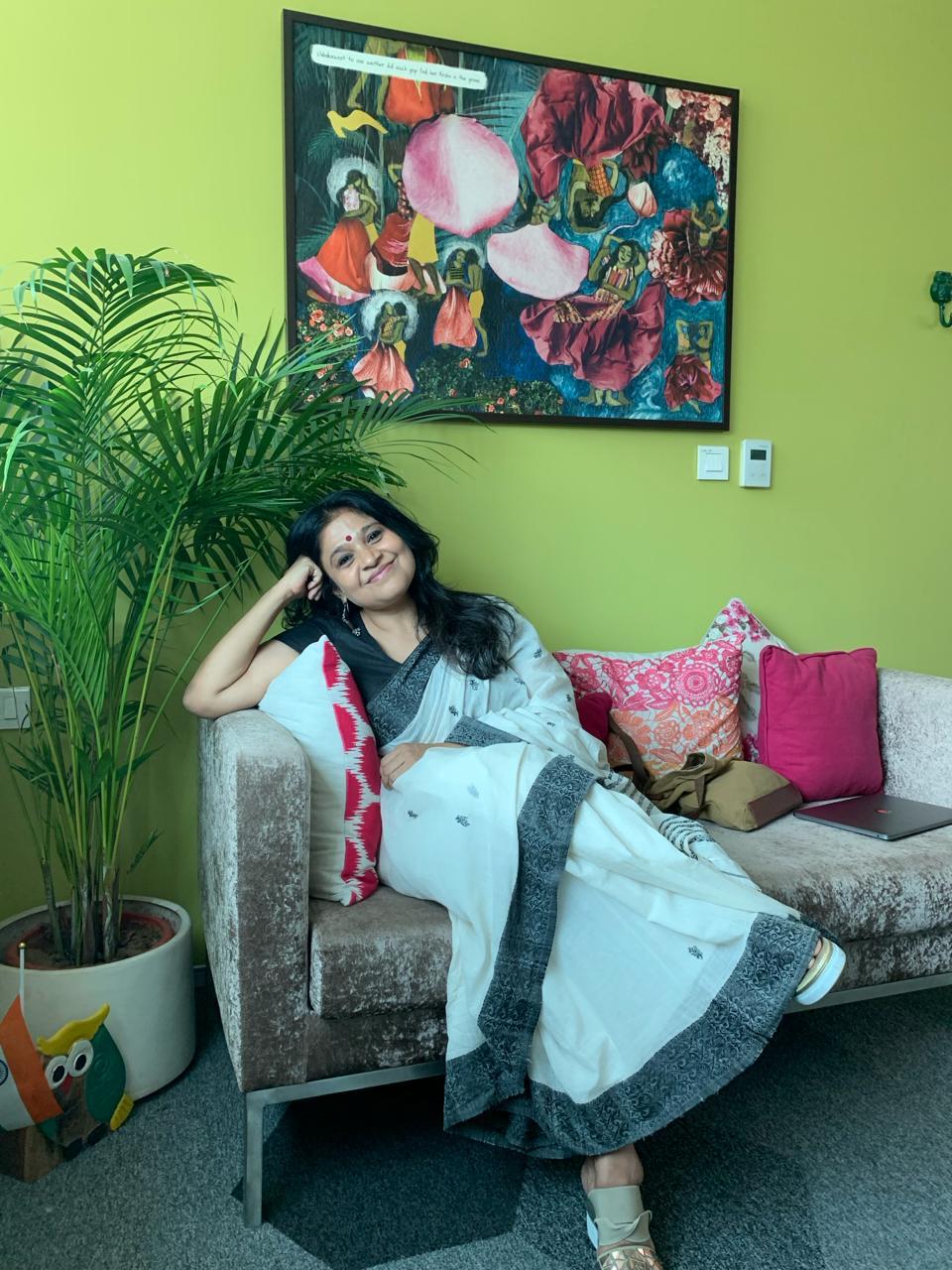
Swati Bhattacharya, the outgoing Creative Chairperson of FCB India

The first encounter with advertising happened at a very young age for Swati Bhattacharya, the outgoing Creative Chairperson of FCB India.

An only child, she grew up in a family where her mother was working in Public Relations and father in Indian Newspapers Society (INS), therefore, the home felt more like an ad school.

Starting her career with JWT and spending 22 years in the agency, followed by a short stint at Dentsu Mamalabs, what it took for her to join FCB India eight years back was a meeting with Susan Credle. It was Credle– the then Global Chief Creative Officer of FCB Global, who has been recently appointed IPG’s first-ever Creative Advisor– who gave her the opportunity to be India’s first woman CCO in 2016.

Under Bhattacharya, FCB India has won more than 160 awards- including One Show Pencils, Glass Lion, Gold Lions, Silver Lions, Bronze Lions, Clio golds, D&AD Yellow Pencils/ Graphite Pencil/ Wood Pencils and 4 Spikes Grand Prix- in the past eight years.

Opening up on the reason behind her impending departure from FCB India by the end of March this year, Bhattacharya revealed that it is mainly because of her sudden craving to explore and find new creative playgrounds outside advertising.

“It is just the human being in me wanting to take some time off and wanting to stand alone- without the designation and without the support of a big network agency. Just be a soldier of creativity without a joblist!,” she said.

In a candid chat with Marketing Mind, she mentioned that even though she and the team at JWT were making ‘really popular’ work, they were invisible on the global stage.

“In JWT, I was working on very successful campaigns like ‘Epang Opang Jhopang’, Pepsi, 7UP, Maggi Hot N Sweet Chilli Sauce and Polio for UNICEF with Mr. Bachchan,” she said.

This is in stark contrast to her time at FCB Group India, where she is a celebrated figure as she has been the one coming up with work that won awards, both in India and internationally.

“So, I have seen success, both with and without awards, and that’s the beauty of it. The beauty of my time at JWT was we were working with the most popular brands that were so culturally spicy that it didn’t matter if the work would never travel outside India,” she recalled.

With this, she also busted the much talked about myth of FCB bringing her in solely to work on campaigns for awards purposes. Replying to a question on the same, she laughingly replied, “I had never won or entered any award before joining FCB. If somebody told me then that I will have to win 160 international awards that include Cannes Golds, Yellow Pencils and Clio Grand, I would have never had the guts to take on the challenge.”

She added, “I have never done anything only for awards and so, the sole pressure of writing something that brings home an award, would kill me!”

“Even to win globally, your work has to resonate. It has to foster connections in various parts of the world. So, yes, I’ve won a lot but it’s all coming from the same source. It wasn’t that I was fixing potholes one year, fixing ozone layer in the second year and fixing organic crops in the third year. My award work is who I am, what I believe in, my sensibility and the brands who asked me to work for them expect me to bring my sensibility to them,” she said.

Additionally, she also pointed out that she gets invited to a client’s boardroom on the basis of who she is and what she can do for the brands. “And, that makes me think why there is so much intersectionality between my work and me,” Bhattacharya said.

Talking about her stint at FCB India, she mentioned that it was campaigns like ‘Sindoor Khela’ for Times Of India, ‘The Open Door Project’ for Millennium School, ‘Project Streedhan’ for DSM India, Horlicks’ ‘Bottle Of Love’, Times of India’s ‘Out and Proud’, STIR’s ‘Untangling The Politics Of Hair’, ‘Chatpat’ for SOS Children’s Villages of India, ‘Can’t Wait, Won’t Wait’ with Alia Bhatt for Dark Fantasy, ‘#DilDostiDominos’ for Domino’s Pizza India, and many more that made her eight years with the agency truly incredible.

That being said, she also highlighted that during the end of her time in JWT, she had begun doing short films and documentaries because she was getting bored with advertising.

“I would always say that for me advertising is like a relationship, and even Tarantino puts it- ‘Whenever you’re tired of a relationship, you should try a romance!’ But during my FCB India stint, I felt that out here, it became such a deeply romantic career phase that I never wanted to escape what I was doing in my day job. Not only did my work find purpose, my brands did too,” she stated.

Upon being questioned on the timing of her departure, which comes quite soon after the agency roped in a new CEO and rejigged leadership, Bhattacharya stated that it’s a passing phase, and it is just coincidence that the timeline reflects such a thing.

She wished the agency all the best and added, “I feel all the new young leaders in FCB are ready now, be it Udayan, Anusheela, Rakesh, Kartikeyan and Romit are ready for the next chapter and something new and exciting will get born now.”

In Bhattacharya’s POV, today advertising is undergoing a transformation and becoming more science than art, which is why it’s good that people like her, who could become critical of that, are moving out to do other things.

“Since the power of measurability has taken center stage, the quest of immediate reaction is coming at the cost of making a connection!,” she opined.

“Even when I’m judging Cannes and I look at some of the work that’s coming in digital or gaming, it looks really beautiful when I view it but just as I put my laptop down, I don’t remember one single piece of work. This is a malaise of the age that we are living in, and I think that it’s going to pass. This business needs creativity at the center and not on the sides,” she emphasized.

That being said, she also underscored that for somebody like her, who believes that intimacy is the algorithm of creativity, when the algorithm of science takes over creativity these days, she feels as if she’s having a lover’s tiff with the industry.

“There is a lot of fear in the boardroom today- We fear the client and the client fears the consumer- and when these fears talk to each other, creativity is a lost child in the power corridors looking for mom,” she sighed.

For her, what’s been the driving force in all her work is establishing a human connection. While she has encountered many skeptics and naysayers along the way, who raised questions like whether the approach is too soft or will the product differentiation come through, she has not only battled it out, but actually enjoyed winning them over.

“All my accolades are a result of this journey. And the fact that I did this while leaving office at 5.30 pm, makes it even more wicked,” she said.

On a parting note, Bhattacharya also propounded that women tend to have a better relationship with success overall, for they know where to keep it and how to deal with it.

“Women don’t do that- I have more than you or Mine is bigger- thing,” she said.

Success to her, seems similar to a roommate that stays with one for a bit, but for the rest of one’s life, it is love which is an individual’s only legacy.

“The awards made my CCO stint shiny, otherwise men would think I was just a diversity token. But for any man or woman to succeed, there is a need for an ecosystem for survival. Susan gave us that and that’s what made it so easy,” she said.


Related Posts

Dentsu Creative Isobar Wins Bandhan Bank's Creative Mandate
Advertising

Dentsu Creative Isobar Wins Bandhan Bank’s Creative Mandate

by MM Desk
July 22, 2026

Bandhan Bank has appointed Dentsu Creative Isobar as its creative agency partner following a multi-agency pitch. The agency has been...

EssenceMediacom Retains Uber’s APAC Media Mandate
Advertising

EssenceMediacom Retains Uber’s APAC Media Mandate

by MM Desk
July 21, 2026

EssenceMediacom has retained Uber's Asia-Pacific media account following a competitive regional pitch. The agency has continued its partnership with Uber...

Latest

Every marketer talks about building awareness, few have to build it without talking about the product. India's alcobev industry has spent decades navigating that paradox. Direct product advertising isn't permitted, making surrogate advertising only one part of the marketing equation. The bigger challenge has always been earning something no media budget can buy: consumers who become advocates for the brand. For Debasree Dasgupta, Chief Marketing Officer, Pernod Ricard India, that's the category's biggest truth. “Consumers will always be your biggest advertisers,” she said. It's a philosophy born out of necessity. But it has also shaped how alcobev brands think about marketing itself. “The principles of marketing are the same whether it's personal care, beauty or alcobev. What changes is the complexity.” That complexity, according to Dasgupta, isn't just about navigating regulations. It's about understanding consumers, managing a diverse portfolio, and ensuring brands continue to grow despite having fewer traditional marketing levers than almost any other consumer category. India remains one of the world's most tightly regulated alcohol markets, where brands have to navigate different state regulations, on-trade and off-trade ecosystems, and restrictions on advertising products directly. For marketers, that has meant learning an entirely different language of brand building. Marketing hasn't changed, The rulebook has Dasgupta's own career has prepared her for exactly that. Rather than following a straight path, she has moved across FMCG, health and hygiene, beverages and now alcobev, picking up different lessons along the way. “I think the beauty is that I didn't have a linear career path, and I think it was very deliberate and intentional.” Each company, she said, has added a different layer to her understanding of marketing. “Unilever taught me to be extremely consumer-centric and always keep the consumer at the heart. Reckitt taught me commercial discipline, that marketing needs to lead to commercial and business growth. PepsiCo was about how brands stay relevant in culture.” Bringing those experiences together at Pernod Ricard has reinforced one belief. “The principles of marketing remain the same.” The environment, however, certainly doesn't. While referring to India as one of the markets where alcohol advertising is prohibited, she said, “The regulatory landscape is quite complex. That's the piece that one needs to wrap their minds around as you navigate and ensure that you're able to drive business growth.” That complexity extends well beyond regulation. “At a portfolio level, it's important for us to understand what is delivering the present and what will deliver tomorrow,” she said. “Where is growth coming from today, and where will growth come from in the future?” When consumers become the media channel Perhaps the biggest difference between alcobev and traditional consumer goods lies in how brands create awareness. Unlike an FMCG company, Pernod Ricard cannot advertise its alcohol products directly. “So the disadvantage that we have versus CPG is we cannot advertise products,” Dasgupta said. “We are in compliance with the guidelines that exist today.” Instead, the company builds visibility through compliant brand extensions such as packaged drinking water, while investing in passion points like cricket, music and digital platforms. “For us, the brand extension is a compliant business in itself and we can advertise that. We continue to double down on social, digital and influencer marketing for those businesses.” Furthermore, Dasgupta went on to say, “What we rely on is on-premise advocacy. We rely on sampling. We ensure that our liquids are extremely high quality so that when the moment of truth happens, consumers really love the product.” That has also meant new launches take longer to build. “Awareness build-up is much slower because consumers discover the product at the point of sale. That's very different from an FMCG brand.” Which naturally raises another question: if brands can't advertise products, who does the selling? “The consumers will always be your biggest advertisers,” Dasgupta said. “If you walk into an outlet and see someone drinking, it gives you confidence in the brand.” Word of mouth, she believes, becomes one of the category's most powerful marketing channels. “In a category where you can't advertise the product, consumers become your champions.” That consumer-first philosophy also shapes how global brands are adapted for India. For marketers outside the alcobev industry, the constraints may seem daunting. For Dasgupta, they've simply reinforced a timeless lesson. When the product can't do the talking, the brand, and ultimately the consumer, has to.

Consumers Are Our Biggest Advertisers: Pernod Ricard India’s Debasree Dasgupta On Surrogate Advertising

July 22, 2026
ANHAD Group Appoints Adil Altaf As CEO To Lead Real Estate Vertical

ANHAD Group Appoints Adil Altaf As CEO To Lead Real Estate Vertical

July 22, 2026
I&B Ministry Launches 'Gems Of India' Challenge To Spotlight Grassroots Digital Creators

I&B Ministry Launches ‘Gems Of India’ Challenge To Spotlight Grassroots Digital Creators

July 22, 2026
RVCJ Media Ranks Among India’s Top Social Brands In Comscore Weekly Scorecard

RVCJ Media Ranks Among India’s Top Social Brands In Comscore Weekly Scorecard

July 22, 2026
iCubesWire Launches iQ Conversational AI Platform For Creator Marketing Intelligence

iCubesWire Launches iQ Conversational AI Platform For Creator Marketing Intelligence

July 22, 2026
Aisle Elevates Chandni Gaglani As Executive Vice President & Head To Drive AI-Led Growth

Aisle Elevates Chandni Gaglani As Executive Vice President & Head To Drive AI-Led Growth

July 22, 2026
Facebook X-twitter Instagram Youtube Linkedin
Discover the latest trends in Marketing, Advertising, Startups & Media.​
  • About Us
  • Millennial Achievers
  • Contact Us
  • Privacy Policy
  • Become a Guest Contributor
  • About Us
  • Millennial Achievers
  • Contact Us
  • Privacy Policy
  • Become a Guest Contributor

To Advertise & Collaborate With Marketing Mind, Contact Us Here.

Subscribe to our newsletter for exclusive content.

By continuing you agree to our Privacy Policy & Terms & Conditions


©2026 All rights reserved. Digi Giant LLP

To Advertise & Collaborate With Marketing Mind, Contact Us Here.

Subscribe to our newsletter for exclusive content.

  • About Us
  • Contact Us
  • Become a Guest Contributor
  • Terms & Conditions
  • Privacy Policy
Facebook X-twitter Instagram Youtube Linkedin

©2024 Copyright. RVCJ Digital Media Pvt Ltd

Welcome Back!

Login to your account below

Forgotten Password? Sign Up

Create New Account!

Fill the forms bellow to register

All fields are required. Log In

Retrieve your password

Please enter your username or email address to reset your password.

Log In
No Result
View All Result
  • Home
  • Advertising
  • Marketing
  • Media
  • Business
  • What’s Buzzing
  • AdAura Awards
  • More

© 2026 All rights reserved. Digi Giant LLP

This website uses cookies. By continuing to use this website you are giving consent to cookies being used. Visit our Privacy and Cookie Policy.